
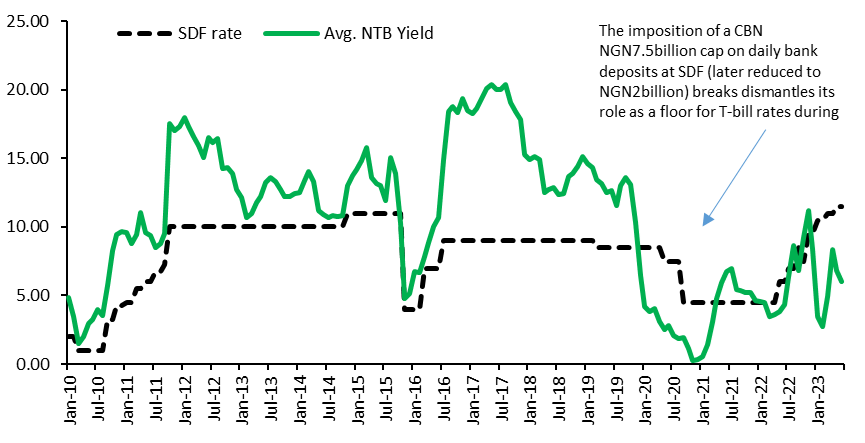
A dovish rate hike at the July 2023 MPC meeting, but SDF move holds promise: At the conclusion of its two-day monetary policy meeting in July, the Central Bank of Nigeria (CBN) decided to raise its benchmark monetary policy rate (MPR) by 25bps to 18.75%. Alongside this change, the asymmetric corridor around the MPR was adjusted from +100/-700bps to +100/-300bps, while leaving other policy settings unchanged. This adjustment means that the CBN will now lend money to banks at 19.75% through its standing lending facility (SLF) and remunerate banks at a higher rate of 15.75% for parking excess reserves at its standing deposit facility (SDF). The move to increase the SDF rate would appear to suggest that the CBN now recognizes that the wider corridor for deposit rates coupled with the daily cap of NGN2 billion, had weakened the transmission mechanism of policy adjustments on market rates. However, the CBN needs to complete the loop by issuing a circular to remove the daily limit. On its own and within Nigeria’s context, the 25bps MPR hike is insignificant (less than 1%) due to the country’s high double-digit interest rates. Hence, the policy announcement should be viewed as largely dovish.
Figure 1: SDF and T-bill yields
Source: CBN
NTB yields spike at the weekly T-bill auction on thin liquidity: At the fortnightly T-bill auction where the Central Bank of Nigeria (CBN) offered NGN 264 billion, a decline in system liquidity in the prior week meant that investor demand was soft, resulting in bid-cover ratios at 1.5x. Most banks had expected a stop rate in the 6-8% range for the 1-year paper, but secondary market trading just before the auction close surged to 11-12%. This suggested either a steep deterioration in interbank liquidity conditions before the auction or indicative signaling from the CBN into the auction. As a result, the one closed at a stop rate of 12.15% with an implied yield for the of 13.8%, which caused a sell-off in the NTB secondary market with a significant yield increase of 270-280bps.
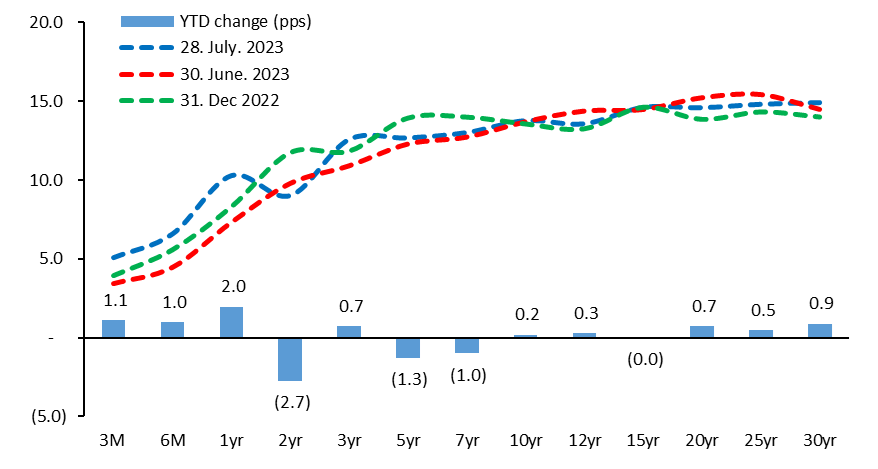
However, towards the end of the week, market liquidity improved with the long-awaited FAAC inflows of NGN 561 billion, along with coupon inflows. This led to a retracement in interbank rates, which declined from 20-21% to 1-2% by the close of the week. Nevertheless, the jump in the 1-year NTB had second-order impacts, causing bearish sentiments in the FGN bond market where yields expanded across the curve: front-end (+80-85bps), belly (+10-20bps), and long (+35-40bps).
Figure 2: Naira Yield Curve
Source: FMDQ
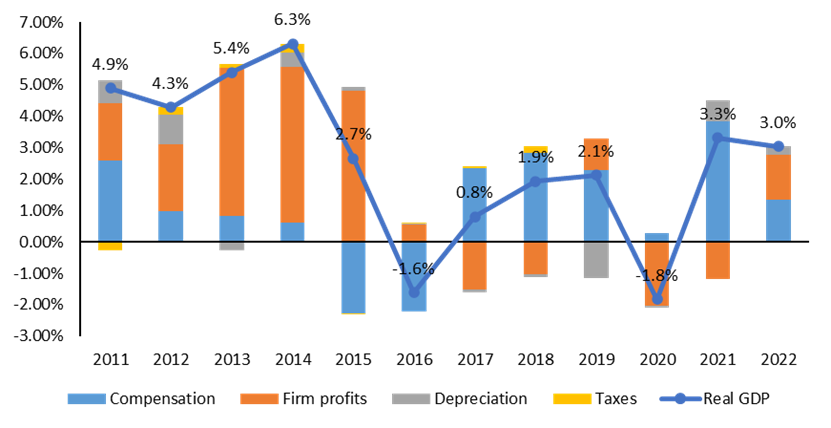
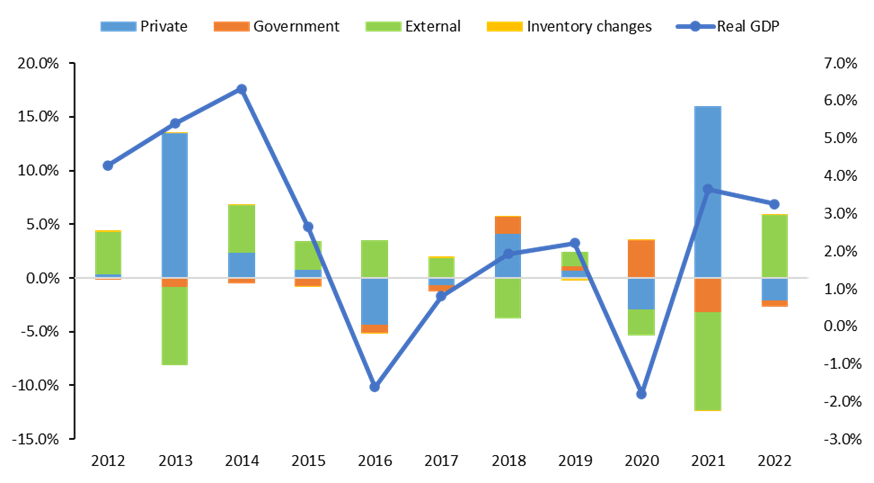
GDP by income and expenditure: The NBS provided breakdowns of economic growth based on alternative definitions of income and expenditure, which offer insights into the structural dynamics of the economy. On the income side, the slowdown in headline growth can largely be attributed to a significant decline in real wages, dropping from 14% to 4%. However, there was a positive note as corporate profitability rebounded, ending a two-year contraction and posting a growth of 2.3%. On the expenditure side, a combination of weaker private consumption (-2.4%), which aligned with the slowdown in wages, and declines in government spending in real terms (down 10%), counteracted the positive developments in the external sector, particularly in exports. Overall, the analysis indicates that pressured household incomes and spending played a more substantial role in constraining economic growth. This highlights the urgency for policymakers to address runaway inflation and implement structural reforms that can create a lower-cost environment, ultimately leading to stronger economic growth. By taking these measures, they can alleviate the strain on household finances and foster an environment conducive to renewed economic expansion.
Figure 3: Nigeria GDP growth: Attribution by Income
Source: NBS
Figure 4: Nigeria GDP growth: Attribution by Expenditure
Source: NBS
IMF remains bearish on Nigeria’s growth outlook: For the July iteration of its world economic outlook, the IMF retained its April 2023 projection that Nigeria’s economic growth would slow in 2023 (3.2%) and 2024 (3%) from 3.3% in 2022 reflecting security issues in the oil sector. The justification for this slowdown appears to be odd given that if anything Nigeria’s oil output appears to be recovering and the oil sector is likely to exit recession in the Q2-Q3 period following new security ‘arrangements’ 😉 If anything, the concern is over the health of the non-oil sector given the price shocks.
I close with the last quote from Adam Smith for this July – It is not from the benevolence of the butcher, the brewer, or the baker that we expect our dinner, but from their regard to their own self-interest. We address ourselves not to their humanity but to their self-love, and never talk to them of our own necessities, but of their advantages.
If you would like to receive this every week as well as other posts or you know someone who will find the information on this site useful, you can add your email using the subscribe button below
Discover more from Eco215
Subscribe to get the latest posts sent to your email.