
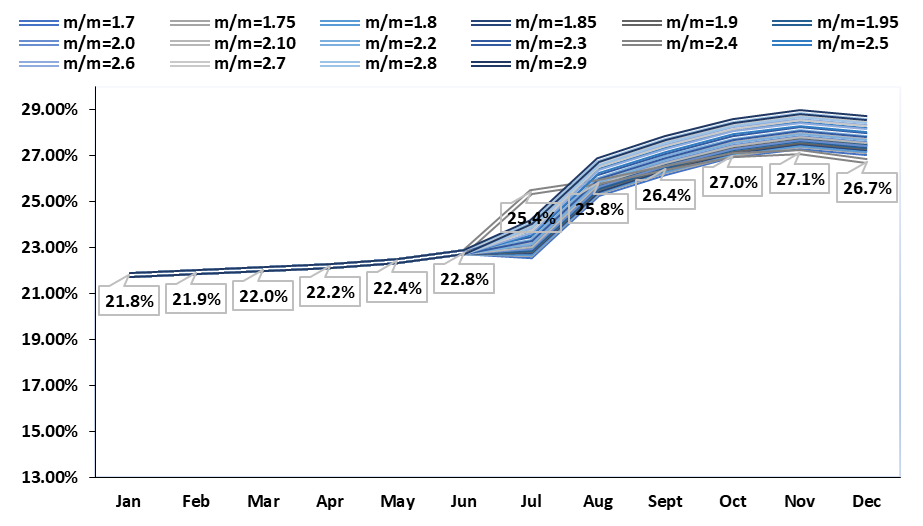
Inflation rises lower than expected, NBS likely excluded new fuel prices in June 2023 CPI report: The much-anticipated June 2023 inflation came out on Monday and at 22.79%, the reading came in well behind the broad expectations for a print between 23%-26%. Though the m/m reading was at 2.13% (May: 1.9%) which is the highest level since 2017, the sense was that relative to the scale of the fuel price increases, the impact should have been higher. The NBS would later come out to hint at some technical issues with the timing of its collection conducted in early June as the driver for this tame print and that the impact would be reflected in the coming months. Looking at the CPI breakdowns, the NBS argument has some merit as the housing, water, electricity, gas and fuels (HWEGF), which contains fuels, barely moved with the monthly print up 22bps to 1.62%. For context, this level is only 10bps above the January 2023 print of 1.56% and well below the 2-3% monthly print recorded during the 2016 fuel price increment. Furthermore, the Nigerian definition of core inflation (which includes fuel prices) declined over the month to 1.75% (May: 1.81%). It would appear to me that the NBS did not incorporate the fuel price adjustments in June. In all, over H1 2023, headline inflation averaged 22.2% (2022: 18.8%) underpinned by shocks to food prices from a combination of insecurity issues and higher transports costs supported by a weaker exchange rate. The base case remains for a step-wise jump in July once the NBS properly captures the higher petrol prices.
Figure 1: 2023 Inflation: Actual and Forecast
Source: NBS, Authors Computation
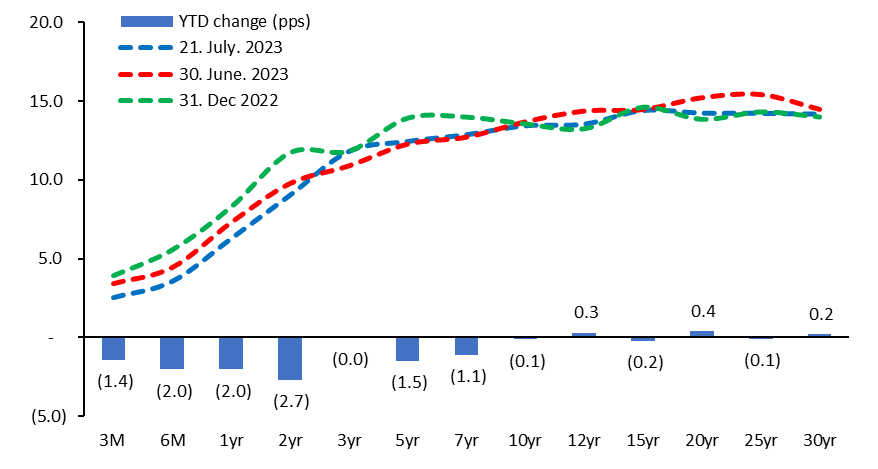
DMO takes advantage of robust liquidity to sell large amounts of debt at lower yields: At the monthly bond auction where the DMO had NGN360billion worth of bonds to sell, robust system liquidity ensured that demand was robust at 2.6x the offer. This enabled the DMO to sell NGN657billion worth of bonds at lower average rates (13.63% vs 14.94% in June). The sale brings gross bond sales over the first seven months 2023 to NGN4.2trillion, well more than the NGN3.3trillion worth of bonds issued all through 2022. In terms of secondary market activity, the down-leg in primary market bond yields filtered through to the secondary market with some bull steepening led by T-bill yields (down nearly 200bps on average) relative to 5-10bps compression in bond yields.
Figure 2: Naira Yield Curve
Source: FMDQ
AMCON and bond auction debits decimate system liquidity: System liquidity declined over the week following the annual AMCON debits estimated at NGN350-400billion and outflows for the NGN657billion bond auction sale which pushed interbank rates from the 1-2% level seen over recent weeks to 20-21% over the week. That said, system liquidity is likely to recover with the news of NGN950billion FAAC distribution for June 2023.
FAAC distributions surge following FX devaluation and Subsidy Removal, Signs of Fiscal Restoration? Nigeria’s distributable FAAC revenues exploded to NGN1.9trillion in July (Previous: NGN786billion) reflecting gains from 40% Naira devaluation, increased NNPC profitability following the removal of petrol subsidies, NLNG dividends and pick-up in oil output in recent months. Interestingly, in a new development, it was announced that the FGN and States decided to hold back NGN1trillion to be deployed into a newly created Infrastructure Support Fund with the remainder NGN905billion then distributed across the three tiers of government. This was framed as necessary to manage the inflationary fallout from injecting the entire NGN1.9trillion. That the Nigerian government is now interested in curbing inflation by stemming monetary impetus from its fiscal operations, a departure from prior thinking when the objective was to boost fiscal distributions suggests a potential inflection in fiscal dynamics. In essence, the FX depreciation and subsidy removals can be viewed as massive fiscal consolidation moves which have restored a sense of fiscal balance at both federal and state levels. (This raises prospects for a ratings upgrade in coming months by Moodys which ran ahead of the curve in downgrading Nigeria to Caa1). The foregoing also implies that domestic policy settings will now likely return to pre-2015 mode when Nigeria’s monetary fiscal nexus ensured that the financial system experienced a structural excess liquidity situation which necessitated that the CBN constantly engage in auto-immune liquidity mop-ups in a bid to sterilize the impact of petro-dollar receipts on domestic money supply. An explainer here, Nigeria’s present fiscal-monetary nexus arises as every month money supply increases as the CBN prints new Naira to swap for FGN petro-dollars earned during the month from oil exports. In an ideal scenario, the FGN should simply sell its oil export dollars at market rates to displace Naira liquidity and the CBN joins other participants to purchase dollars. The present scenario imposes a requirement for the CBN to embark on aggressive liquidity management operations to sterilize these flows as the CBN pursues a defacto reserve money targeting alongside nominal exchange rate stability vs inflation targeting of conventional central banks. Usually, this approach resulted in an inverted yield curve with higher short-end rates during periods of excess structural liquidity occasioned by the petro-dollar to naira flows. In a similar vein, during periods of weak fiscal revenues when Nigeria runs a structural liquidity deficit, the CBN becomes tolerant of high front-end liquidity in a bid to temper the costs of financing leading to a normal yield curve.
Devaluation boosts money supply to a fresh record: The CBN released money supply data for June 2023 which showed a jump in annualized growth in key monetary aggregates: M1 (+36% vs. 20% in May) and M2/M3 (+49% vs 18% in May) which compares to its 10% targets for these variables. Looking at the components, there was big a surge in growth in net foreign assets (+323% vs 8% in May) reflecting the impact of revaluing the net FX reserve position from NGN461/$ to NGN770/$. In addition, net domestic assets (NDA) also jumped (+23% vs 15% in May) reflecting the impact of NGN weakness on USD loans in the financial sector. This is evident when looking at the trends in the sub-components of NDA: growth in credit the private sector quickened from 18% in May to 53% at the end of June while the growth in government lending decelerated from 59% to 53%. Cumulative CRR debits moderated to NGN15.1trillion vs NGN15.4trillion which would be consistent with CBN pulling back from liquidity management over the month.
Divergent trends in the FX market as Naira comes under renewed pressure in parallel market but appreciates at the IE window: The naira appreciated by 3.4% to NGN777/$ at the I&E window helped by some CBN interventions (USD30million & CNY50million) anchored around NGN740-750/$ levels. Trading activity was softer (down 13% w/w) with trades around the NGN700-NGN855/$ region. However, at the parallel segment, the trend was quite different, as the Naira fell by 5% w/w, settling at NGN860-870/$ levels. The divergence likely reflects heightened outflows unable to clear at the official window. One can observe that the upper end of trading within the IE window (NGN850/$) is close to the lower end of the parallel rate which would suggest that while USD supply is available, it will only equilibrate at weaker levels. It also implies that these sellers are likely fresh speculative positions.
This throws the issue back at the absence of USD supply or some backstop required to stabilize the present market situation. CBN interventions appear soft relative to historical trends for weekly sales (USD150-250million) which reflects underlying soft firepower. Gross external reserves declined to a two-year low of USD33.9billion. Unlike other countries which provide net reserve positions, the CBN historically does not provide this data and given the pretend FX rate over the last three years, one could hardly decipher the figure out using data on net foreign assets contained in money supply aggregates. Thus, the devaluation offers a rare chance using the monetary aggregate data to guess this number: it would appear that Nigeria’s net reserves likely closed June 2023 at USD14.4billion by my estimates. This low level would seem to explain CBN’s reluctance to sell dollars into the FX market, in recent months in 2023 as well as speed in adjusting to reality, following the suspension of Godwin Emefiele as CBN governor, by the same set of bureaucrats who ploughed along with his doomed ostrich FX defense strategy.
To stabilize the situation in the near term, I reiterate that Nigeria needs to raise a large stash of dollars (USD5-10billion) via selling Eurobonds or seeking multilateral borrowing (from the IMF/WB) or adjusting interest rates higher to attract capital flows. Of the three alternatives, the first appears unlikely given the level of Eurobond yields (10-11%), while the second, which I strongly advocate given the front-loaded reforms that are often conditionalities for accessing these loans, for lacks broad consensus due to political cowardice. The last option is thus a third-best transitory option that can provide a reprieve to create room for deeper structural reforms to occur.
However, there is a dodgy narrative peddled around which seeks to reduce this debate to that of the classic evil hot money narrative: that raising interest rates to cultivate hot-money flows never solves anything. This utopian perspective ignores the reality that to stem the current situation we need to raise the returns to holding Naira to dampen speculative activity and hopefully attract badly needed capital inflows. Often the solutions that follow from the do-nothing pseudo low-rate supporters is that Nigeria should look to attract foreign direct investment (FDI) inflows. While this sounds nice on paper, this view misses the point that the first step in any surgery is to calm the pain with anesthesia and painkillers before more decisive operations. In complex economic situations, (which most people care less to understand) achieving a perfect idealistic solution is often impractical or impossible due to the interdependence of choices made by various agents and the time-inconsistency issues. Consequently, the practical solution is usually a second or third best, realistic alternative rather than some utopian ideal.
July 2023 MPC – A time to return to credible liquidity tightening: The CBN holds the 4th two-day monetary policy retreat of 2023 and the members of the MPC stand at an inflection point. For a start, the recent change in political leadership and in fiscal policy are consequential and non-trivial and as such this MPC cannot afford to be neutral. Having long complained about fiscal dominance, recent announcements subsidy removal, FX unification and more recently the FAAC distributions have varied implications for price stability. Furthermore, the suspension of the erstwhile CBN governor provides an opportunity for introspection and deep thinking about the evolution of monetary policy. Over the last eight years the committee had played an ‘emperor is naked script’ of denying reality about the FX rate while dabbling into hare-brained experiments with unorthodox policies which failed. One also recalls how several members of the MPC also went along with the disastrous Naira re-design policy which had nothing to do with economics and amounted to a direct political intervention by the CBN in the 2023 general elections. Thus, the imperative for the CBN is to return to orthodoxy and rebuild its policy credibility.
To accomplish this task the MPC must ensure that decisions at the July 2023 meeting should flow from an objective analysis of the likely trajectory of variables (inflation, money supply and exchange rates) at the heart of its central bank mandate. With inflation and money supply running well ahead of its targets and likely to remain so in the near term, central bank policy must seek to level with reality by shifting to a contractionary stance to steady the ship. To be credible the decisions reached at the July 2023 MPC must seek to attain significant (not symbolic) changes in the path of interest rates and money supply by restraining excess liquidity within the financial system.
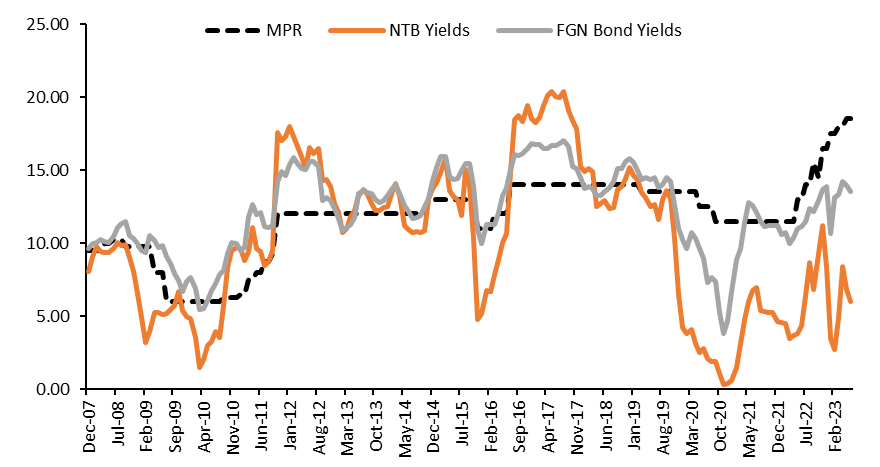
This can be accomplished via three classic means: 1. Return to open market operations 2. Reactivating the standing discount windows 3. Direct liquidity withdrawals via an increase in cash reserve requirements to 35-40%. The first two options have cost implications for CBN’s profitability (something the apex bank has become sensitive about given the near-death experience from the elevated OMO bill sales over the 2017-19 era). Discount windows can be effective in setting a floor for market interest rates and will work in Nigeria once the CBN removes the daily limit of NGN7.5billion imposed by the suspended CBN governor. OMO bill issuance helps signal the level of rates the CBN desires. That said either of the two can achieve the objective of moving market rates to desired levels while the third option is zero cost and does an untidy job in terms of directing rates to desired levels.
A fourth hybrid approach could see the CBN combine direct and indirect approaches wherein the CBN either retains CRR at 32.5% (it could hike it to 35% to suck out present liquidity) and combines this with the sale of non-discountable securities (a sort of Stabilization Securities) at low rates (somewhere between 3-5%) to banks with excess liquidity positions until market rates attain a pre-set level. This allows CBN to unlock the liquidity from its newly created Ways and Means bonds at a profitable level. They can STRIP out these bonds to fit what they want on the securities side. Once market rates are at target levels (in my mind 15-18%), the CBN can remain on the sidelines. These securities must be non-discountable for this to work for the signal to be effective and the low rate is to disincentivize banks from sitting in cash. The rule will target banks holding cash positions well in excess of the minimum liquidity ratio and can be iterated until market rates reach a target level. It leaves the CBN with the flexibility to conduct liquidity management at individual bank level during the period of tightening without sacrificing its balance sheet at the expense of bank profits.
It is important to note that these are merely short-term fixes to patch over the looming structural liquidity surplus from a healthier fiscal profile. Fundamentally, Nigeria needs to remove the forced surrender rights on petro-dollars granted to the CBN and allow the apex bank set money supply at a level consistent with desired growth and inflation outcomes and participate in FX markets like every other agent. The long history of the surrender rights suggests the CBN takes a dim view of the cost of reserve acquisition (which is effectively the price it prints new Naira notes) and can ignore market signals during periods of low USD export inflows. Moving to this situation is not without risks and more finer iterations are required but it will allow for the development of a deeper and more liquid FX market. That said, the CBN could yet decide to play neutral tomorrow as the current leadership await the appointment of a substantive governor which would imply symbolic rate hikes (50-100bps) with no impact on liquidity or market interest rates.
Figure 3: Monetary policy and market rates.
Source: FMDQ
I close with this quote by Adam Smith, “Every individual… neither intends to promote the public interest, nor knows how much he is promoting it… he intends only his own security; and by directing that industry in such a manner as its produce may be of the greatest value, he intends only his own gain, and he is in this, as in many other cases, led by an invisible hand to promote an end which was no part of his intention”.
If you would like to receive this every week as well as other posts or you know someone who will find the information on this site useful, you can add your email using the subscribe button below
Discover more from Eco215
Subscribe to get the latest posts sent to your email.