
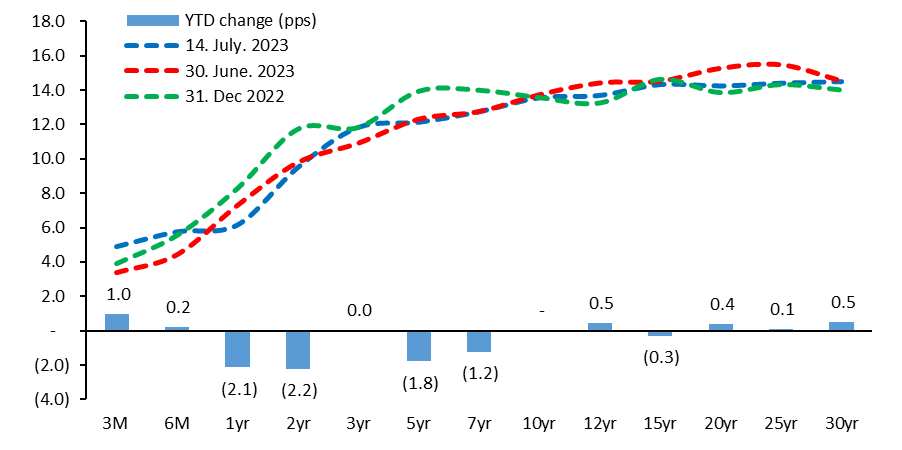
CBN’s ‘lukewarm’ stance towards excess liquidity continues to apply downward pressure on interest rates: Interest rates have maintained the downtrend observed since the middle of June 2023, after the CBN’s switch to an ‘equitable’ CRR regime injected nearly NGN1trillion of liquidity into the banking system. This change in monetary policy has given rise to an intriguing paradox. Despite the CBN’s implementation of rate hikes, its neutral stance towards surplus liquidity in the banking sector has driven short-term interest rates to unprecedented lows, with Nigerian Treasury Bills (NTB) yields hovering between 4-6%. At the recent bi-weekly NTB auction, conducted on behalf of the Debt Management Office (DMO), the CBN rolled over NGN 142 billion at stop rates of 2.86% (compared to the previous 2.87%), 3.50% (down from the earlier 4.37%), and 5.94% (reduced from the preceding 6.23%). Moreover, this surplus liquidity in the banking sector has exerted a gravitational pull on bond yields (down 21bps w/w) with bond prices now up 9.3% over 2023 with the most substantial gains observed during the final two weeks of June (+7%) relative to a modest 2% increase in July.
Figure 1: Naira Yield Curve
Source: FMDQ
Naira weakens: The USDNGN exchange rate experienced renewed downward pressure in the past week, with the Naira crossing the NGN800/$ threshold within the official segment, ultimately closing at NGN803.9/$. Simultaneously, the parallel rate depreciated, reaching NGN815-817/$. The fresh pressures likely stem from a mix of seasonal demand ahead of the summer travel but are testament to the weak USD supply picture in the FX market. Turnover activity remains soft down 22% over the week to USD68million per day. Notably, data from June indicated a notable increase in flows through the Investors’ & Exporters’ (IE) window, amounting to USD 1.77 billion, mainly driven by robust exporter inflows amounting to USD 630 million. This upswing in flows highlights how the FX market unification has facilitated the resurgence of export flows that had diminished during the previous Emefiele era.
Post unification, there is a pressing need for clarity on the future operation of the FX market. The Central Bank of Nigeria (CBN) must improve its communication about the new workings of the system and demonstrate a firm commitment to a flexible exchange rate regime moving forward. Furthermore, it is crucial for the CBN to establish a credible interest rate and monetary policy framework, complete with clear inflation targets and transparent measures to address core inflation. The current lack of communication from the CBN is detrimental to market confidence, as there remains a significant need for clarity to prevent excessive volatility. External reserves continued the downtrend in the week (down to USD34billion) even as Nigeria announced the redemption of the USD500million 6.375% July 2023 Eurobond issued in 2013 without much fanfare.
CBN lowers CRR for merchant banks: Interestingly, the CBN released a new circular which slashed the cash reserve ratio on merchant banks to 10 percent effective August 2023. Merchant banks numbering six (6) are wholesale banks with no access to ‘retail’ customers as their minimum depositors must be more than NGN50million. In justifying the position, the CBN cited the nuanced business model of merchant banks (restating the definition of their business model having no access to retail deposits) and that it expects this reduction will bolster increased lending towards infrastructure, real sector and long-term financing of the economy. My interpretation is that this is another ‘unwinding’ circular as the CBN looks to normalize policy from the heterodox approach pushed by the now suspended Godwin Emefiele who included merchant banks under the harsh CRR regime as part of demand management approach to FX management. Merchant banks balance sheets are dominated by short-cycle cash-backed trade finance type loans due to the contorted nature of their balance sheet funding. While this approach ensured risk free lending with often nil NPL reports, it made these entities often look no different from glorified finance houses with thin margin investment banking and securities brokerage units though with some significant wealth management options.
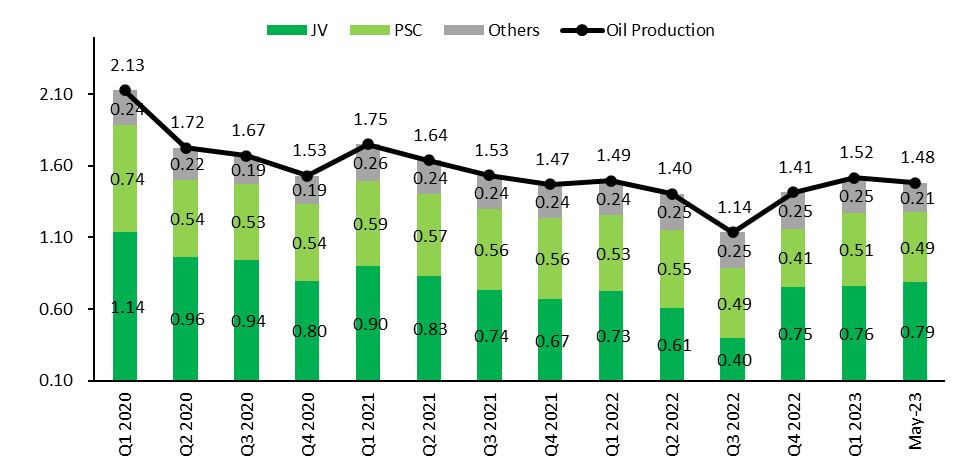
Nigeria’s oil production increased over June: Data from the NUPRC shows that Nigeria’s oil production rose 4% over the month to 1.48mbpd. The pick-up reflects higher exports via the Forcados terminal increased (+16% to 163kbpd) which offset weakness along the Bonny (-11% to 107kbpd) and Qua Iboe (-5% to 126kbpd) export terminal. Over H1, recovery in output along onshore terminals (mainly Forcados and Brass) alongside increased output on offshore fields (Agbami, Erha and Bonga) were central to the improved oil output. Over the week the NNPC guided to production at 1.7mbpd in November likely reflecting a full recovery in Brass and Bonny with the latter still well below 2020 peak levels. Nigeria’s oil GDP likely exited recession in Q2 2023.
Figure 2: Nigeria Oil Production by Regime
Source: NUPRC
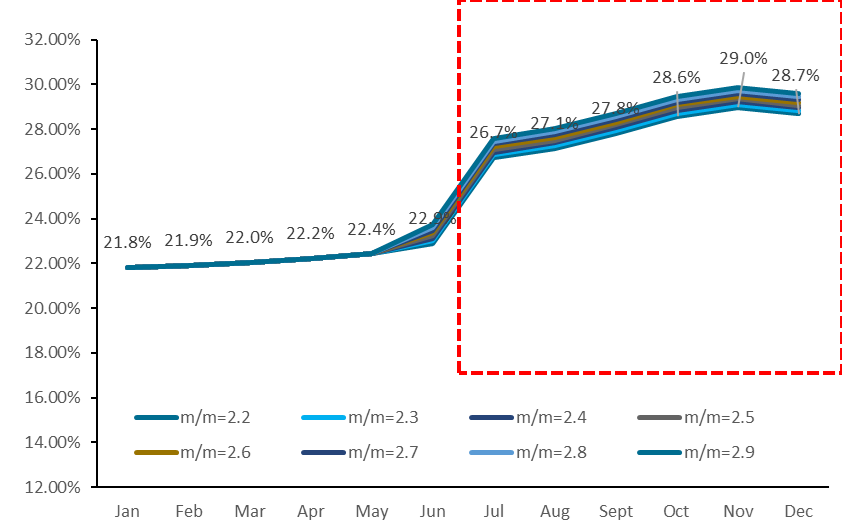
June 2023 inflation will show impact of petrol subsidy removal: The NBS will look to publish the June 2023 inflation report which will show impact of the removal of petrol subsidies which pushed fuel prices from NGN238/litre to anywhere between NGN490-550/litre across the country. Looking at past episodes of fuel price hikes: the 2016 cumulative hike of 49% resulted in a 250-270bps increase in m/m inflation and the 2012 49% hike cascaded into a 300bps increase in m/m inflation. The present increase is thus unprecedented, and monthly inflation likely jumped 400-600bps over June which should spit out an annualized CPI change of 25-27% over the month. Holding prices steady could see inflation accelerating towards 30% by year-end.
Figure 3: 2023 Inflation Forecast
Source: NBS, Authors Calculation.
In the week ahead, the DMO will look to sell NGN360billion worth of bonds evenly across the FGN 2029, FGN 2033, FGN 2038 and FGN 2053. Given the robust system liquidity held by banks and the recent slide in yields under 15%, my sense is that the auction will be well bid which should allow the DMO to take more than the amount on offer. Presently yields across these papers are down 100-120bps from the June auction levels reflecting the loose financial conditions occasioned by the CBN’s passive stance. My sense is that auction reprices to current levels.
Summer Reading
- The Time Travelling Economist – Charles Robertson: This book is simply unputdownable as it provides a useful prism to understand the divergence across economies. The author introduces a compelling prism, incorporating three crucial variables: fertility rates, literacy, and electricity generation, to shed light on the disparities in capital and economic development across nations. The book presents a convincing argument that low fertility rates play a pivotal role in explaining variations in savings and capital accumulation among countries. Those with lower fertility rates tend to have higher savings rates and structurally lower interest rates, while the opposite holds true for countries with higher fertility rates.
- Furthermore, the significance of literacy and electricity generation becomes apparent in understanding why some nations rapidly industrialized and escaped the middle-income trap, while others failed to industrialize and are now transitioning into low-quality service-based economies. Countries boasting high literacy rates are better equipped to provide a skilled labor force for industrialization, reducing the likelihood of reliance on subsistence farming, which is often observed in Sub-Saharan Africa (SSA).
- Electricity generation, in particular, grid power on a scale that generated a surplus for the industrial sector (ie cheap) was crucial to industrialization. Many SSA countries electing to build railway lines (which generate poor returns) vs electricity should take note. When these three variables align, countries can unlock the necessary capital for industrialization and sustainable economic take-off. The book highlights the historical context of developed countries, revealing multiple cycles of debt defaults, leading to the questioning of the stigmatization associated with debt defaults. Advanced economies, boasting capital surpluses and low interest rates, are encouraged to take calculated risks in supporting the development of developing nations. While some countries may default, the overall benefits of fostering even development outweigh the potential risks, especially when compared to the consequences of failing countries plagued by conflicts. On the contrary, the book presents a grim outlook for countries with high fertility, low literacy rates, and inadequate electricity generation. The example of the Sahel today, compared to the situation two decades ago, serves as a chilling reminder of the potential consequences of lacking progress in these crucial areas.
- The Price of Time – Edward Chancellor: This book offers a compelling historical perspective on the concept of interest rates, tracing their evolution over time. It provides valuable insights into current trends and effectively challenges the rationale behind zero-interest rate policies put forth by central banks. By delving into the intricacies of interest rates, the book highlights their immense significance as a powerful variable influencing every economy. The analogy of interest rates being akin to tree rings that help date the age of a tree aptly emphasizes their importance in understanding economic cycles. By comprehending interest rates, readers can gain valuable insights into their current position within an interest rate cycle and navigate through potentially questionable explanations put forth by central bank governors to justify unconventional and potentially ineffective interest rate policies, as is the case in Nigeria presently.Overall, this book is a valuable resource for anyone seeking to gain a deeper understanding of interest rates, their historical context, and their pivotal role in shaping economic trajectories. It offers a critical perspective on zero-interest rate policies and encourages readers to question and analyze the underlying justifications provided by central banks.
Tomorrow is the 233rd anniversary of the death of Adam Smith and I close with this one:
The prudent man always studies seriously and earnestly to understand whatever he professes to understand, and not merely to persuade other people that he understands it; and though his talents may not always be very brilliant, they are always perfectly genuine – Adam Smith (The Theory of Moral Sentiments, 1759)
If you would like to receive this every week as well as other posts or you know someone who will find the information on this site useful, you can add your email using the subscribe button below
Discover more from Eco215
Subscribe to get the latest posts sent to your email.