
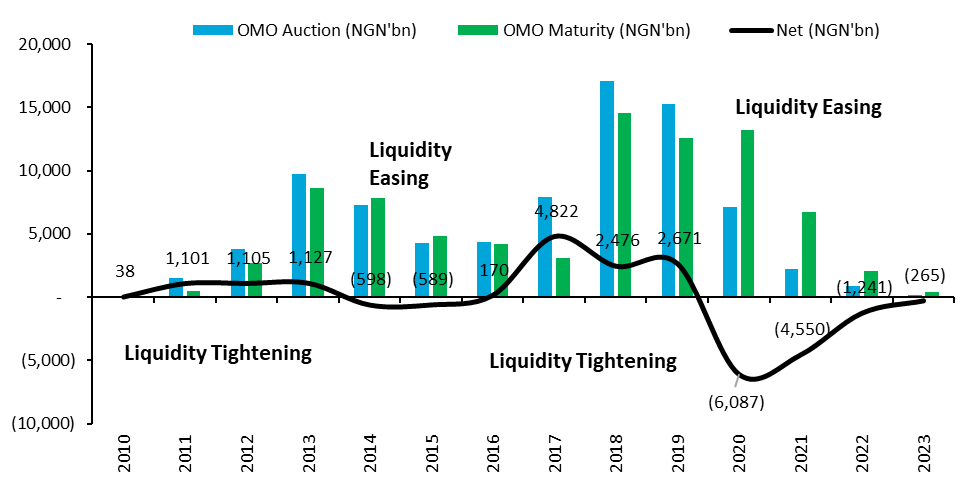
CBN stirs the waters with a return to OMO bill issuance: After a 7-month hiatus, the CBN surprised debt markets with the announcement of an OMO auction on Thursday where it sold NGN150billion worth of OMO T-bills with the 6m and 1yr tenors priced at effective yields of 15.7% and 16.9% respectively. The return to OMO issuance, a day after presiding over an NTB auction where yields closed lower, hints at a desire by the CBN to signal higher market interest rates given renewed FX pressures. Is this the start of a return to credible liquidity tightening or just another feint? All will be revealed in the coming weeks, but my sense is the CBN will have to tighten liquidity to bolster market interest rates and cultivate some offshore portfolio inflows to deal with ongoing FX problems.
Figure 1: Annual OMO Sales Activity
Source: CBN
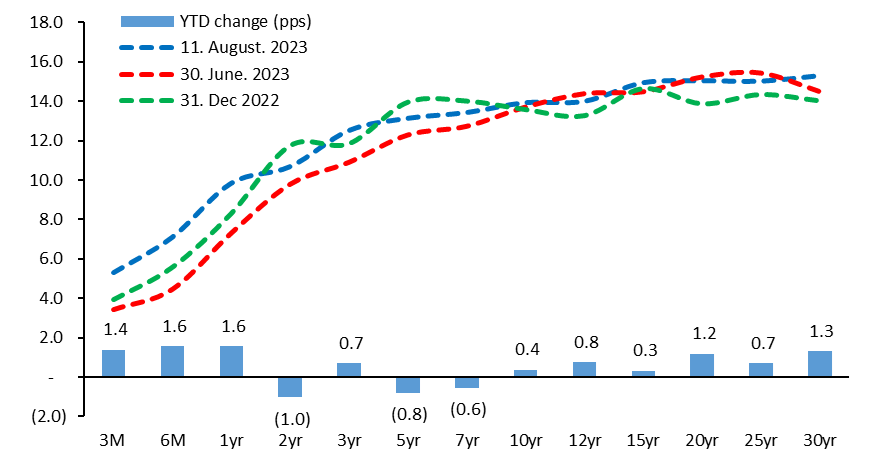
Liquidity drives NTB stop rates lower, but OMO announcement induces bearish sentiments: At the fortnightly NT-bill auction, the CBN, on behalf of the DMO, refinanced NGN154billion worth of short debt at lower effective yields across the 3M (down 100bps to 5.1%), 6M (down 230bps to 6.1%) and 1yr (down 300bps to 10.9%). This was on account of strong demand at the auction with bid-cover ratio at 5.4x (last: 1.5x), a function of robust banking system liquidity at the start of the week. Nonetheless, secondary market T-bills closed the week bearish with the CBN’s announcement of an OMO auction on Thursday with higher stop rates than market levels. In a similar vein, the OMO announcement catalyzed further negative sentiments in FGN bonds ahead of the monthly bond auction with yields up 20-35bps over the week.
Figure 2: Naira Yield Curve
Source: FMDQ
Naira comes under fresh pressures at the parallel market, CBN back to familiar games? Naira woes at the parallel market deteriorated over the week with the exchange rate testing fresh lows NGN950/$ with market feelers linking the development to demand from Nigerians looking to travel for summer holidays and pay school fees for kids abroad. Strong growth in the demand from non-tradable services in the last decade as been the main driver of FX weakness. Elsewhere, the IE window rate continues to demystify wider trends holding steady around NGN740.60/$. At some point you have to ask whether the CBN is not up to the old tricks again of dictating the level for banks to trade Naira.
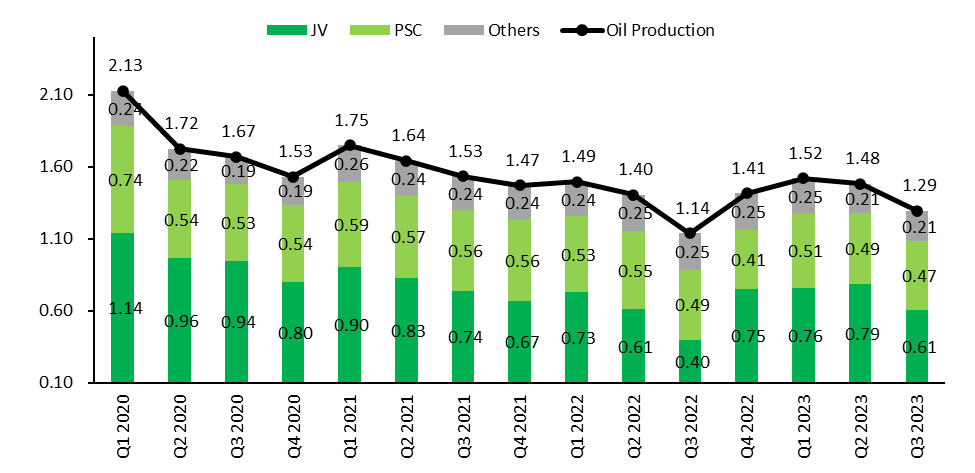
Nigeria’s oil production slid in July due to repair work on Forcados: Data from the NUPRC shows that Nigeria’s average crude oil production fell 13% in July to 1.3mbpd largely reflecting outages along the Forcados export terminal (down 60% to 106kbpd). In early July, terminal operator, Shell suspended loadings after workers cited an oil sheen along one of the loading vessels. Repair work is yet to be completed as at early August. Declines were also seen in output via the Brass export terminal (down 16% to 31kbpd) where exports were likely curtailed to deal with a spill along Nembe creek observed during the period. There were also declines along Bonny (down 22% to 84kbpd) and the offshore Erha (down 21% to 60kbpd) with the latter likely reflecting some maintenance work.
Figure 4: Nigeria Oil Production by Regime
Source: NUPRC
CBN releases its long delayed audited annual accounts: On Thursday, the CBN quietly published its long delayed audited annual reports from 2016-2022. The audits for the missing years were undertaken by a joint team of Ernst and Young (EY) and KPMG vs the tag team of PwC and EY in the 2013-2015 period. Curiously the CBN website release put the date of publication as the year-end of the missing years as against the actual date of August 10, 2023 in what must seem like an attempt at re-writing history. I will look to do a proper analysis of the results in the coming days as there is a lot of deliberate or naïve misinformation being pushed in the mainstream media even from some of the more business minded operators.
On the surface, the results showed that CBN’s profitability declined strongly over the 2018-2020 period before recovering in 2021-22. Of note, the 2018-19 profits appear to have been ‘helped’ by some one-off items and strong derivative activity even as the CBN admitted that it egregiously violated the CBN Act with its Ways & Means facilities. The CBN Act will need to be amended to include the possibility of criminal prosecution for misconduct in the future for such signed off violations. Even more revealing was the scale of loan write-offs which suggest huge losses to the Nigerian taxpayer for loan facilities provided by the CBN. The large Stage III impairments show the CBN to be an even worse lender than commercial banks it routinely examines and regulates. Looking ahead, we would need to proscribe the CBN from providing direct interventions anywhere on the scale observed in the last eight years without parliamentary oversight. Focus should be on adequately capitalizing the various development finance banks presently in operation and having them undertake the market interventions for tackling underserved segments of the credit market outside of CBN control. CBN involvement in these entities should be purely regulatory as with the commercial banks.
Yields likely to track higher at the bond auction on thinner liquidity: In the week ahead, the DMO will look to sell NGN360billion at the monthly bond auction via the re-opening of four papers: FGN 2029, FGN 2033, FGN 2038 and FGN 2053. In the secondary market, these bonds are trading at 13.14%, 13.93%, 14.94% and 15.3% respectively. Yields are higher than at the last auction and market liquidity is tighter following OMO sales which might mean yields move higher. YTD, the DMO has sold NGN4.2trillion worth of bonds which adjusted for maturities is at NGN3.5trillion or 50% of the domestic borrowing target by my estimates. On my numbers, the DMO needs to maintain a run-rate of 500-550billion per month over the rest of the year to clear its domestic borrowing target. However, a stronger outlook for fiscal revenues following the FX devaluation and subsidy removal alongside a softer expense profile with likely limited progress on capital expenditure means the DMO is not hard-pressed to hit the NGN7trillion borrowing target. All-in, yields should reprice from the last auction levels towards FGN 2029 (13.2-3%), FGN 2033 (14.2-14.4%), FGN 2038 (15.1-15.2%) and FGN 2053 (15.5-15.6%).
The man of system, on the contrary, is apt to be very wise in his own conceit; and is often so enamoured with the supposed beauty of his own ideal plan of government, that he cannot suffer the smallest deviation from any part of it. He goes on to establish it completely and in all its parts, without any regard either to the great interests, or to the strong prejudices which may oppose it. He seems to imagine that he can arrange the different members of a great society with as much ease as the hand arranges the different pieces upon a chess–board. He does not consider that while [sic] the pieces upon the chess–board have no other principle of motion besides that which the hand impresses upon them; but that, in the great chess–board of human society, every single piece has a principle of motion of its own, altogether different from that which the legislature might choose[sic] to impress upon it –Adam Smith (Theory of Moral Sentiments, 1759)
If you would like to receive this every week as well as other posts or you know someone who will find the information on this site useful, you can add your email using the subscribe button below
Discover more from Eco215
Subscribe to get the latest posts sent to your email.
My first read here and I love it love it!!! Well done 👏🏽
It has been a while since you posted.
Hope we don\’t have to send a search and rescue team out for more of this great content.