
I would like to apologize for the break in transmission, i took some time off to deal with a loaded personal schedule. Back to regular programming. In between, I have had some thinking on this newsletter and as content has widened beyond the original idea of a fixed income write-ups, I have thought to change the name from ‘The Nigeria Fixed Income Weekly’ to ‘The State of Nigerian Macro’. The initial episode will be a bit long to catch-up on developments over the last two months. Happy reading!
Fixed income markets turn bearish over Q3: Bond yields have moved higher since the end of July with the curve up roughly 150-160bps. This in part reflects tightening financial system liquidity starting from the middle of August and into September as well as curve repricing in response to the surge in the 1yr T-bill from single digit levels to 12-13% stop rates at recent auctions and the return to OMO bill issuance by the CBN. Both developments appear to have spurred a rotation away from duration by short money (read banks) towards T-bills. Looking at the net discount window positions, from an average daily net placement position of NGN46billion in June, Nigerian banks became average daily net borrowers in the CBN discount window in July (NGN1.5billion), a situation which worsened to NGN43billion in August and NGN175billion thus far in September. The August and September data include episodes of net borrowing positions in the NGN300-500billion regions. So fundamentally, despite improvements in FAAC inflows, financial system liquidity deteriorated over August, a seasonally dry month for liquidity. Against this backdrop, placement rates have tracked higher from 9-10% in July to 13-15% in August-September.
Figure 1: Naira Yield Curve

Source: FMDQ
Oil production recovered in August following completion of Forcados repairs: Data from the NUPRC shows that Nigeria’s average crude oil production recovered in August, up 9% to 1.4mbpd largely reflecting recovery along the Forcados export terminal (down 35% to 144kbpd) following the completion of repair work. Output also picked up along Bonny (+52% to 127kbpd) and Qua Iboe (+12% to 149kbpd) but remained challenged on the Brass River terminal (down 12% to 28kbpd). Of Nigeria’s four key export terminal, output via Brass which is the end-point for the constantly disrupted Nembe Creek Trunkline system is still operating well below peak capacity of 100-110kbpd. Curiously, Eni-Agip, the operator of Brass, recently announced its decision to sell the asset to domestic operator Oando. In terms of outlook the NNPC appeared sanguine about getting to 1.6-1.7mbpd, though the current level should see the oil sector exit recession over Q3 2023. Over the medium term, Nigeria needs to end the neutral posture towards IOC exits with a new round of direct high-level talks with the IOCs to get them to take FIDs in the light of rising oil prices. Pragmatism suggests that Nigeria should be willing to deliver concessions to IOCs to develop and exploit oil resources to raise output. Access to USD capital which will remain a problem for domestic independents and has been a prohibitive factor for expanding output in the assets sold during the last cycle.
Figure 2: Nigeria Oil Production by regime

Source: NUPRC *Q3 2023 is August 2023 data.
Inflation accelerated over August, food prices surge: The NBS reported that Nigeria’s inflation climbed strongly over August with the headline reaching 25.8% in August (24.08%) which tracked significantly ahead of my expectations for 25%. The development reflects an acceleration in the monthly run rate to 3.18%, the highest print (since the 2012 fuel price hikes). The pressures came from urban farm produce prices (+4%) which suggests a combination of higher transport costs and supply chain issues likely weighed. Food inflation is now knocking at the 30% handle which possibly explains the decision to pause on the fuel price adjustments in early September. Inflation is unlikely to slow down anytime soon and my forecast is that we are now likely to accelerate close to 30% in the headline reading.
Figure 3: Nigeria 2023 Inflation: Actual and Forecast
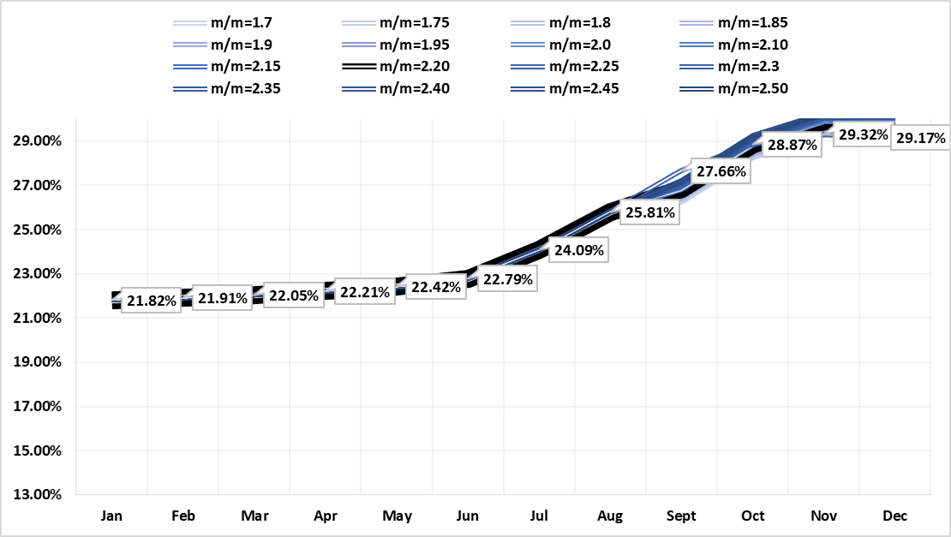
Source: Authors Calculation, NBS.
Nigeria’s growth remained weak over Q2 2023 driven by contraction in the oil sector: The NBS published economic growth data which showed that the economy expanded only 2.5% in the second quarter of the year. Looking at the data, the main drag stemmed from the oil sector (down 13%) where output shrank over Q2 on account of the Forcados disruptions in April when workers downed tools at ExxonMobil. The Non-oil sector expanded 3.6% over Q2, up from the 2.8% over Q1 as the segments (trade, manufacturing and agriculture) that were adversely affected by the controversial Naira design policy recovered.
This quarter marked the end of the Muhammadu Buhari administration’s eight-year rule and the reading implies that economic growth decelerated from 5.1% per quarter in the Goodluck Jonathan era to 1.3% under Buhari. This reflects average non-oil growth of 1.9% a quarter (vs 6.6% under Jonathan) and oil sector contraction of 5.6% per quarter (vs. -4.2% under Jonathan). Thus, not much change in terms of oil sector trends but the degradation in non-oil growth appears linked to the poor FX market policy choices of the Buhari administration and their adverse impact on USD illiquidity hurt trade and manufacturing sectors hardest. Growth within the agriculture sector also softened markedly, though I cannot say whether this reflects a structural trend. But one working hypothesis on agriculture GDP growth post 1999 is that much of the big gains reflected increases in area under crop cultivation which would suggest insecurity issues (The Boko Haram insurgency in the North-East and various farmer-pastoral conflicts along the middle-belt) adversely impacted agricultural output over the Buhari tenure alongside longstanding low productivity issues within the sector.
Figure 4: Nigeria Real GDP Growth Disaggregation

Source: NBS
JP Morgan’s net reserve data reveals the scale of Nigeria’s encumbered FX reserves: In August 2023, JP Morgan (who ironically bank Nigeria’s external reserves) put out a report which estimated that Nigeria’s net reserve position stood at around USD3.7billion, after adjusting the gross reserve number at the end of 2022 (USD37billion) for a range of items: outstanding off-balance sheet swaps (USD21billion), on-balance sheet FX forwards (USD7billion) and securities lending obligations (USD5.5billion). The swap data is consistent with the estimated non-public OMO outstanding figure (NGN9.8trillion or USD21.2billion) issued by the CBN to Nigerian banks and other financial institutions (likely BOI and AFC) in exchange for USD liquidity over 2022. The scale of these off-balance sheet transactions, a development engineered by the Godwin Emefiele regime is troubling. Curiously, in a departure from prior practice, the CBN in 2017 elected to start masking the size of swap activity which now went off-balance sheet and would be lumped with other items including forwards and naira settled futures.
Figure 5: Nigeria FX forwards, swaps and futures

Source: CBN
Rather than allowing the nominal exchange rate to adjust, the CBN under Godwin Emefiele opted to maintain the illusion of a stable exchange rate by borrowing against future reserve inflows through swap transactions with Nigerian financial institutions. These actions could not have occurred without the agreement of other members of the CBN’s top brass and the explicit or implicit endorsement of the Buhari administration. If these actions were carried out by a commercial bank, the CBN would have dismissed its management and recommended them for prosecution for financial mismanagement. Yet the CBN hierarchy led by Godwin Emefiele embarked on a reckless financial gamble to encumber a portion of Nigeria’s future external reserves to pretend about reality. The Buhari administration must come in for some stick as Emefiele likely acted in line with their expressed desires not to devalue the exchange rate. Bizarrely the finance minister, under whose watch these irresponsible actions were administered is today comfortably sitting as an Executive Director at the World Bank, a position secured under circumstances that a neutral party would describe as ‘self-nomination‘. In my view, the Tinubu government needs to exercise its power and recall this appointment if anything to signal that individuals who superintend disastrous economic policies should not go unpunished.
Naira races to NGN1000/$ and CBN’s FX forward debacle: The Naira pressures accelerated over September with the currency now knocking at NGN1000/$ at the parallel market though the official window remains held down at NGN770/$. The drivers remain: thin USD liquidity within the official window, weak external reserves and negative real yields on Naira fixed income amid persistent demand pressures. In early September, the Acting CBN governor, Ade Shonubi, noted that the CBN would clear its outstanding FX forward obligations (2022: USD6.8billion). These forwards were originally issued to Nigerian corporates, as a way for the CBN to curb the practice of frontloading of USD demand at the spot market but would appear to have been subsequently discounted to Nigerian banks. On the face of this announcement, one would have thought the CBN was starting to experience a recovery in USD inflows hence the desire to clear the backlogs. However, this was not the case, as it would appear that the CBN was looking at other options including a provocative nuclear proposal of settling under different terms from the original ones. Though it’s unclear what happened next, the CBN would later issue a circular which dictated that banks were not permitted to utilize the FX translation gains for dividend payment or covering their operating expenses. On the face of it, the circular would appear to suggest that the CBN was no longer going down the nuclear route but also, that the CBN was unhappy with the large FX translation gains posted by Nigerian banks following the 40% Naira depreciation in June. This leads to the worrying realization that the CBN did not appear to have thoroughly evaluated the implications of the June 2023 FX unification announcement on its outstanding forward, futures and swap obligations with Nigerian counterparties. If the apex bank undertook these assessments, then these gains would not have been unexpected. Between uncertainty over the forwards issue and the CBN circular, Nigerian bank stocks experienced sell-pressures in September despite announcing pretty strong earnings numbers largely on FX translation gains. In any case, President Tinubu would deliver the Coup de grâce to the Emefiele-led Committee of Governors with the dismissal and appointment of a new CBN Governor and a slate of deputies.
The entire episode reinforces the need for a more thorough reform of the apex bank with specific focus on rooting out what would appear to be strong ideological and dogmatic influences in decision-making. Central banks’ decision making should be driven by empirical assessments which is why the institutions are usually staffed with economic PhDs. It would be hard to argue that this was the case at the CBN over the last eight years.
Outlook
Into the last week in September and indeed the end of an eventful Q3, there will be an NTB auction on Wednesday where the CBN, on behalf of the DMO, would look to refinance NGN177billion in maturing short-term paper. In the face of relatively robust system liquidity with some bond coupons (NGN200billion) coming through, there is scope for some moderation in the 1-yr stop rate. In terms of bond supply, the DMO appears set to sell NGN150billion worth of 10-year sukuk debt into early October.
New CBN governor assumes office with a heavy in-tray: In mid-September, President Tinubu announced the nomination of Yemi Cardoso as the 12th Governor of the CBN alongside a bench of new deputy governors. Mr. Cardoso’s background which includes several stints at Citi’s Nigerian unit alongside time working in public sector at Lagos state. Some insight into Cardoso’s thinking can be gleaned from the advisory report document circulated during the transition between the Buhari and Tinubu administration. Part of the 100-day plan included ascertaining the true nature of Nigeria’s reserves which would seem to be consistent with the ongoing inquest into external reserves. In addition, the Cardoso’s team projected an external reserve target of USD50-60billion and monthly inflows of USD6-8billion would be required to stabilize the exchange rate.
If there is one lesson from the several episodes of FX shocks that have faced emerging markets is to paraphrase a Professor Ayo Teriba: Countries that survive these shocks do so behind a wall of USD liquidity. Nigeria’s CBN governor needs to prioritize FX reserve accretion which will entail clearing out the tortuous encumbrances (swaps, forwards etc) to free up USD inflows to reserves. To help stabilize the situation, Nigeria will need to obtain a stand-by arrangement from multilateral financial institutions like the IMF. Since independence in 1960, Nigeria has obtained three SBAs though never drawn down. This is the pragmatic step to take now to stabilize the exchange rate. Against a rising oil price profile (>$90/bbl) and stabilizing oil production picture if we get to 1.6mbpd, dollar liquidity should recover over the next 3-6months with the CBN in a position to better manage FX markets. Beyond liquidity, there is need to restoring credibility to CBN’s battered reputation which means the new CBN governor must be ready to undertake some house cleaning and renew a commitment to ensuring market systems form the underpin of Nigeria’s financial sector.
There has been some controversy over the continued appointment of career bankers into the helm of the CBN, moreso in the light of Godwin Emefiele’s performance. In a sense, you need a blend of someone with deep understanding of theoretical economics but also practical experience of financial markets and banking in general. Mr. Cardoso would appear to fit the latter class which might come in handy given how the last CBN Governor systematically took a knife to destroy the market systems which underpinned currency and fixed income over the last eight years.
Discover more from Eco215
Subscribe to get the latest posts sent to your email.
Welcome back. A great read as always
Welcome back.