
Nigeria Macro Weekly #2025.01
Yields sell-off along the Naira curve in response to elevated issuance calendar: Interest rates along the Naira yield curve have declined by an average of 50 basis points (bps) thus far in 2025, driven by strong buying interest across the front end (-100bps), middle (-30bps), and long end (-20bps). The most significant drop has been in the 90-day tenor (-410bps), reflecting markedly improved liquidity conditions within the banking system. However, the debt market sentiment has gradually turned bearish due to tightening liquidity conditions. Last week, banks shifted from a net deposit position at the Central Bank of Nigeria (CBN) discount window, observed in the first two weeks of the year, to a net borrowing position. Additionally, the bearish tone in the debt markets appears influenced by the Q1 Nigerian Treasury Bills (NTB) calendar. In a departure from the usual practice of rolling over maturities, the Debt Management Office (DMO) plans to net repay short-dated debt totaling NGN873 billion in the first quarter of 2025. Overall, following the holiday lull, Nigerian debt markets are re-establishing the patterns observed in 2024, where elevated fiscal borrowings and aggressive liquidity sterilization efforts contributed to sustaining high interest rates.
Figure 1: Naira Yield Curve

Source: FMDQ
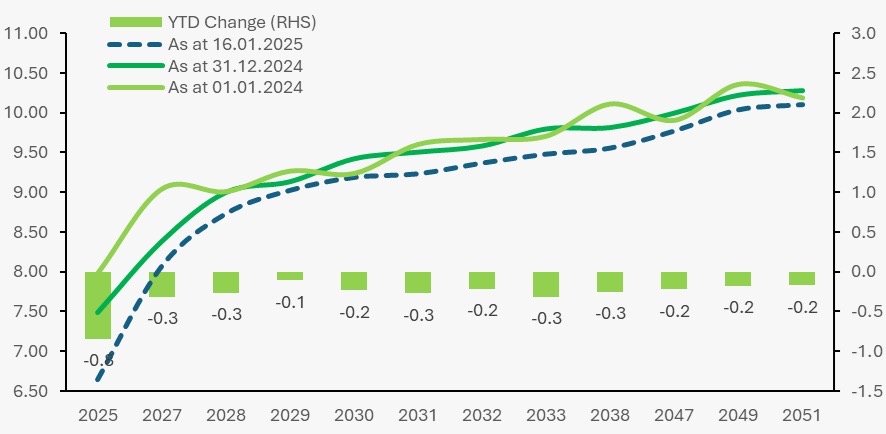
Eurobond yields rally in response to US December CPI: Nigeria’s Eurobond yields rallied by 1.2% across the curve following the release of the US December 2024 Consumer Price Index (CPI) report. The data revealed that while headline inflation edged higher to 2.9% (up from 2.7% in November), core inflation—a closely watched metric—eased slightly to 3.2%, down from 3.3%, where it had held steady over the past three months. Despite three rate cuts by the US Federal Reserve since September 2024, US bond yields have risen, driven by concerns over a widening fiscal deficit stemming from proposed tax cuts under the incoming US President Donald Trump, as well as the potential inflationary impact of retaliatory tariffs imposed in response to new US trade policies. However, easing inflation data and a gradual softening of the administration’s rhetoric have contributed to a compression in UST yields. Additionally, credit spreads have narrowed, suggesting improved offshore perceptions of Nigeria in response to FX market reforms which have boosted USD liquidity flows.
Figure 2: Nigeria Eurobond yield curve
Source: DMO
Nigeria’s CPI closes 2024 with another increase: Nigeria’s headline inflation rose further in December 2024, reaching 34.8% (up from 34.6% in November). This increase was driven by an upswing in core inflation to 28.4% (November: 27.9%), while food inflation edged slightly lower to 39.85% (November: 39.92%). On a monthly basis, inflation decelerated to 2.44% (November: 2.64%), reflecting a slowdown in food inflation even as core inflation tracked higher. Farm produce inflation slowed over the month as harvest supplies applied a downward pressure on food prices. For 2024, Nigeria’s inflation averaged 33.2%, a significant increase from 24.5% in 2023. This surge was largely attributable to shocks in the exchange rate (a 42% depreciation) and higher energy costs (+87%), which amplified inflationary pressures across all sectors
Looking ahead, a bias toward stability in the Naira and a softer outlook for crude oil prices suggest a gradual easing of inflationary pressures in 2025. Exchange rate stability remains crucial for anchoring inflation expectations. Should the Naira maintain a tight range of NGN1500-1600/$, price levels are likely to stabilize. This relatively benign backdrop could lead to a slowdown in monthly inflation, which averaged 2.5% in 2024 (compared to 2.1% in 2023). A further decline toward 1-2% levels is expected in H1 2025, with the potential for sub-1% monthly inflation once the main harvest season commences in H2 2025.
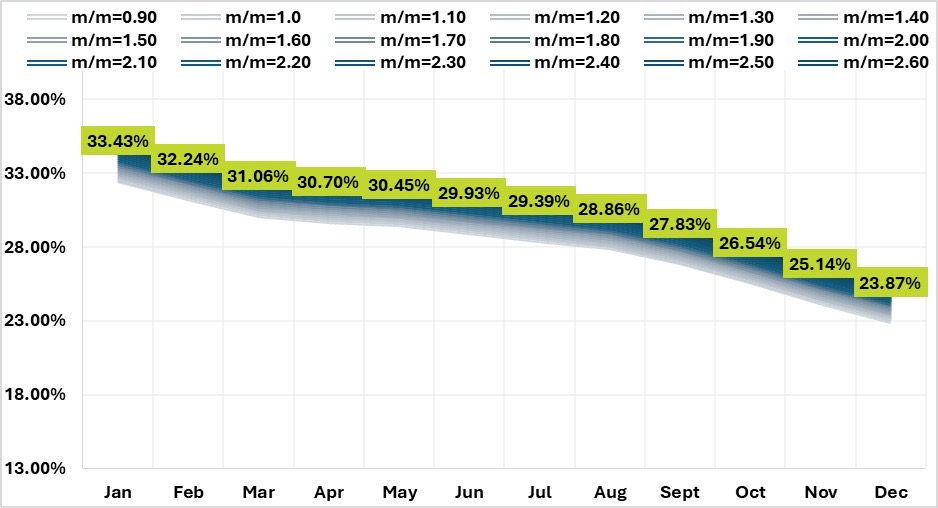
Sequentially, headline prints will remain within the 30% levels as the increments to petrol price levels over Q3 2024 will be embedded in the chained CPI series over H1 2025 before large base effects create a foundation for inflation to progressively head south over H2 2025. Overall, under the current CPI series (2009 base year), inflation is likely to progressively decline over the year with a notable down-leg to sub 25% levels harvest-driven food price moderation and exchange rate stability drive dissipate price pressures.
Figure 3: Figure CPI Inflation Forecast (2009 Base Year Series)
Source: Authors computation
Much ado about CPI rebasing: The announced CPI rebasing, which shifts the base year from 2009 to 2024 and adjusts the weights across the CPI basket, warrants careful consideration. While there has been some debate over the decision to use 2024 as the base year, it seems reasonable to view the significant Naira devaluation over the past two years as a seismic, once-in-a-generation event. This devaluation has fundamentally reset the economy, making 2024 an appropriate reference point for recalibrating the CPI series. Regarding the weight adjustments, the changes which bring Nigeria in line with the SSA norm of food weights in the 40% region appear to reflect evolving consumption patterns and seem broadly reasonable.
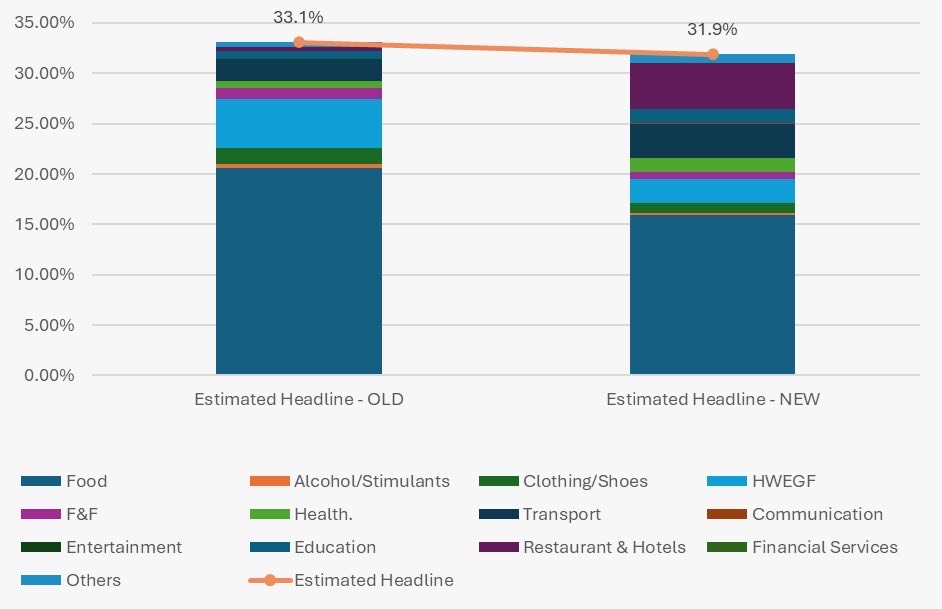
To estimate the impact of the CPI rebasing, a simple approach would be to apply the new weights to the old inflation series using December 2024 data. While this data is not entirely precise—given that some segments of the basket are not mutually exclusive—it provides a useful perspective. Preliminary analysis suggests that the new weights could lower inflation by approximately 120 basis points (bps). Back-testing for earlier months indicates a reduction in the range of 130-150bps. In contrast, during the last CPI rebase, headline inflation averaged 120bps higher post-rebase, though this outcome was not indicative of any forward-looking trends. Overall, the immediate impact of the current rebase is likely to be minimal. However, the elevated base from 2024 could pave the way for faster disinflation going into 2026 once the effects of recent shocks dissipate from the chained series.
Figure 4: Sensitizing the new CPI weights on Headline Inflation readings with 2009 base
Source: Authors estimation
Naira stabilizes, a return to the ‘poisson’ stability? Since December 2024, the Naira has stabilized since the launch of the Electronic Foreign Exchange Matching System (EFEMS), a new platform for interbank trading of US dollar to Naira transactions by Authorized Dealers. From near NGN1700/$, the Naira has moved to a tight range between NGN1540-1560/$ with the parallel premium tightening to 5-8% from 15-20% in the lead up to the December. The new system introduces an order-based approach, diverging from the historical two-way quote-driven system that has long dominated Nigerian foreign exchange markets. Under an order-based system, buyers and sellers directly submit orders to a centralized exchange, where a matching process aligns aggressive buy orders with the least aggressive sell orders. This approach, common in equity markets, capitalizes on natural liquidity and facilitates transparent price discovery. By electing for an order-based system and withdrawing from active auction interventions, the CBN appears to be signaling confidence in its external reserve levels and the potential for Naira stability. Crucially, the EFEMS system allows the apex bank to participate as a market agent to provide USD supply and provide some guidance to markets around rates while deploying it’s tightening tools to manage NGN liquidity to curtail USD demand.
Beyond the mechanics, Nigeria’s external accounts have returned to a surplus of USD13 billion over the first nine months of 2024. This recovery has been bolstered by heightened portfolio inflows and recent Eurobond issuances, which have collectively driven FX reserves to USD42 billion. On the trade front, lower oil import volumes—stemming from a resurgence in domestic crude refining—combined with subdued non-oil exports (a response to the large FX depreciation), have contributed to the improving external balance. Against this backdrop, under orthodox policy settings, the Naira appears positioned to stabilize within a more predictable range, typical of periods following significant FX dislocations.
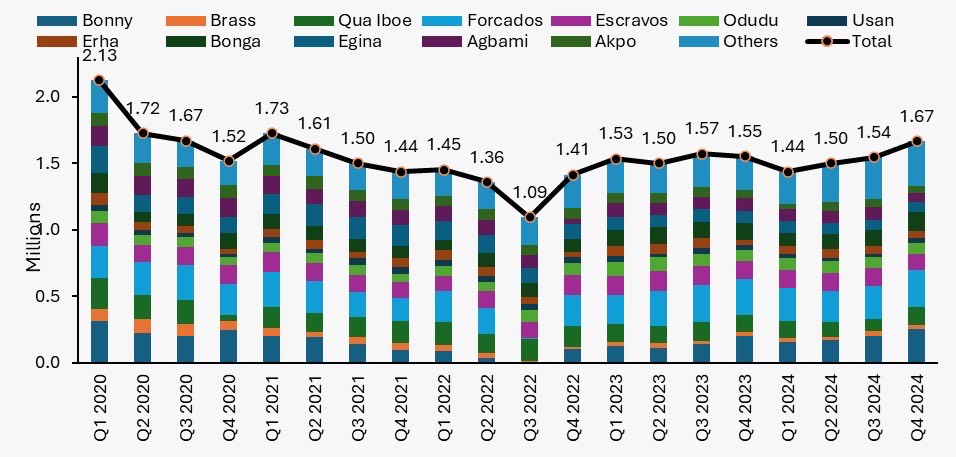
Oil output climbed in December, FID announcements speak to improved medium-term outlook: Nigeria’s crude oil production topped 1.7mbpd in December, extending recent trends over Q4 driven by higher output across key export terminals, : Qua Iboe (+41% to 134kbd), Bonny (+24% to 251kbpd), Bonga (+19% to 146kbpd) and Forcados (+13% to 274kbpd). Output remains challenged at the Bonny (35kbpd) and across a host of offshore fields: Agbami (-26% to 68kbpd), Erha ( -13% to 54kbpd), Escravos (-8% to 126kbpd), and Egina (-6% to 71kbpd). Much improved security arrangements by the Tinubu administration appear to have stabilized outages along Nigeria’s key onshore fields. In terms of re-investment, in exchange for approved asset sales, Nigeria appears to have received FID decisions by at least three oil majors: Shell (Bonga North-West, 110kbpd) and ExxonMobil (Owowo deep water, 180kbpd) while Total energies committed to the 70kbpd Ubeta which will come online in 2027. After years of dormancy, there is finally investment activity (totaling $ 15.5 billion) in Nigeria again which will support the production outlook over the medium term.
Nigeria’s crude oil production reached 1.7 million barrels per day (mbpd) in December 2024, continuing the positive momentum seen throughout Q4. This was driven by increased output across key export terminals: Qua Iboe (+41% to 134kbpd), Bonny (+24% to 251kbpd), Bonga (+19% to 146kbpd), and Forcados (+13% to 274kbpd). However, challenges persist at Bonny (35kbpd) and several offshore fields, including Agbami (-26% to 68kbpd), Erha (-13% to 54kbpd), Escravos (-8% to 126kbpd), and Egina (-6% to 71kbpd). It would appear that the Tinubu administration’s improved security arrangements have significantly stabilized output by reducing outages in key onshore fields. On the investment front, Nigeria appears to have secured Final Investment Decisions (FIDs) from at least three major oil companies in exchange for approving asset sales. Shell committed to the 110kbpd Bonga North-West project ($5billion), ExxonMobil greenlit the 180kbpd Owowo deepwater field ($10billion), and TotalEnergies pledged to develop the 70kbpd Ubeta field ($500million), which is expected to come online by 2027. After years of stagnation, there is renewed investment activity in Nigeria’s oil sector which provides some pathway for medium term crude oil production outlook.
Figure 5: Nigeria Oil Production by Field
Source: NUPRC
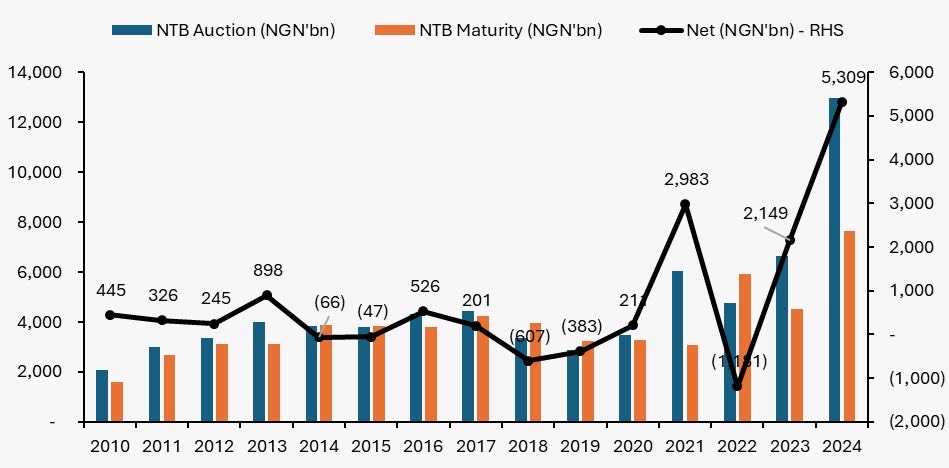
Q1 2025 NTB Calendar looks like a rebalancing act: The DMO released its NTB issuance calendar for Q1 2025 which in a departure from the refinancing norm shows that gross issuance of NGN4.3trillion worth of NT-Bills which tracks behind NTB maturities of NGN5.2trillion. This translates to net issuance of NGN734 billion in January, followed by net redemptions of NGN865 billion in February and NGN742 billion in March. Overall, this implies net liquidity injections of NGN873 billion over the quarter. In my view, this reflects a normalization of issuance trends that had spiked earlier in February and March 2024. During that period, large bond offerings totaling NGN2.5 trillion were driven by the Finance Ministry, likely as part of a strategy to reduce reliance on the Central Bank of Nigeria (CBN) for securities issuance and to attract foreign portfolio investors. With those large securities now maturing and the DMO resuming control of issuance, there appears to be a deliberate effort to scale monthly issuance to more manageable levels. 2024 was a record year for NTB issuance with total gross sales of NGN12.9trillion and net sales of NGN5.3trillion.
Figure 6: Annual NTB Issuance
Source: DMO
Does this suggest that NT-Bill issuance exceeding NGN1 trillion monthly might become the norm, given January’s planned issuance? It seems highly likely. Fundamentally, Nigeria’s budget is going to reprice higher given the large Naira devaluation in 2024 and continued momentum in debt service costs necessitating larger nominal fiscal deficits and higher borrowing requirements. Under a high-rate environment, those borrowings will have to be along the front and belly of the curve (i.e. yield curve inversion.). Nonetheless, so what happens to these maturities? I believe the CBN would need to mount a rear-guard action to mop these up via OMO auctions to manage interest rates from falling to levels that could trigger offshore liquidations of NT-Bill holdings, thereby reigniting FX pressures.
Q1 bond calendar: Start as you intend to go? The Debt Management Office (DMO) has released its Q1 2025 issuance calendar, signaling a return to the three-bond structure. This includes a re-issue of the current on-the-run benchmark 5-year (FGN 2029) and 7-year (FGN 2031) bonds, alongside introducing a new 10-year FGN 2035 bond. The planned monthly issuance mid-point is set at NGN525 billion, within a range of NGN450-600 billion. For context, gross bond sales in 2024 totaled NGN5.8 trillion, largely unchanged from 2023 while monthly average issuance stood at NGN602 billion, with average borrowing costs reaching a record 20%, compared to 15.3% in 2023. Taken on the surface, the higher plan borrowings, the return to 10-year bond sales combined with the plan to reduce NTB issuance suggests that DMO expects interest rates to moderate over 2025.
Discover more from Eco215
Subscribe to get the latest posts sent to your email.