
The one about central banking #longread
In economic literature, there is widespread agreement that price stability is the cardinal objective of central banking. However, there are nuances to this objective as depending on the peculiarities of the economy, the road to price stability can be attained either via ensuring a low rate of inflation or ensuring stability in the exchange rate. For relatively large open economies (read most advanced western economies), pursuit of the former is the norm, while for small open economies (read a lot of developing economies), the pragmatic approach is to seek to optimize for the two objectives with the appropriate qualifiers. Usually, this entails a combination of inflation targeting and/or the pursuit of real (vs nominal) exchange rate stability.
Having clarified what policy objectives should be, which policy instruments should be deployed? In standard economics, monetary policy effectively boils down to making tweaks to money supply or interest rates. Central banks often use the latter to influence the former until the zero-bound is reached (interest rates cannot go below zero realistically) from whence economics switches to the arcane with quantitative easing and/or negative interest rates. Usually, central banks identify a particular interest rate (usually a short-term rate like the overnight or maturities between 2weeks to 1month) as the key instrument to operationalize monetary policy. Essentially, monetary policy seeks to influence these interest rates in response to deviations in their policy objectives (proxied using observed inflation rates or exchange rate) from the desired level. Suppose a central bank in a large open economy apriori determines that inflation at 5% is consistent with desired economic growth conditions, if actual observed inflation is running at 10%, then the CB will look to nudge observed market rates towards a level that drives either a contraction in money supply (and by extension credit creation in banks) until the inflation trajectory moves towards the 5% level. But as we shall see all central banks are not created equal and a central assumption of classical economics required for monetary policy transmission is that the central bank is the marginal supplier of credit or liquidity in the economy. In practice, there are two types of central banks defined by looking at the drivers of their balance sheet.
All central banks are not equal
The conventional central bank of standard economics textbook is the one whose balance sheet is liability-driven which is not always the case especially in the case of resource rich countries where the central balance sheet is asset-driven. I will briefly explain these concepts to drive home the point and will lean heavily on some concepts from accounting. The classic accounting equation is defined as Assets = Liabilities + Equities. An asset is a claim to receive future cashflows which can be in the short and long term while liabilities reflect a ‘debt’ to payout future cashflows which can be in the short and long term. For a central bank, the asset-side comprises external reserves, loans provided to financial institutions, repos, investment securities among other assets. Liabilities comprise currency-in-circulation (reserve money), deposits from governments, reserve requirements from the banking system, liabilities arising from liquidity management operations, derivative financial liabilities among others.
Now for liability-driven central banks which is the classic central bank in much of economics, the dominant liability is currency-in-circulation or bank notes which is consistent with theory, the central bank has fiat monopoly over currency issuance and is the dominant provider of money supply. In this scenario, the marginal liquidity within the banking system comes from securitized bank borrowings from the central bank which creates interest income for the apex bank. As a result, for liability-driven central banks, the largest asset on the balance sheet is a mix of investment securities or loans extended to banks via repos or discount window lending. Alongside ‘seignorage’ profits earned from printing money there is little concern about the possibility of a central bank running a loss. Naturally, there is no room for monetary financing of the fiscus and crucially there exists a structural liquidity deficit within the financial system that requires access to discount windows from the central bank. Note that the presence of large fiscal financing will easily become a source of inflation. Under these settings, monetary transmission to market rates and the wider economy is stronger and effected via the discount borrowing windows.
On the other hand, for asset-driven central banks, the main driver of the balance sheet is usually a large foreign currency asset that often arises from a country that generates outsized commodity exports. There is another scenario where this can occur: large fiscal deficit monetization. Under this asset-driven scenario, the large foreign assets/fiscal deficit monetization imposes a requirement for the central bank to create liabilities either in the form of deposits (for the specific case of large foreign asset scenario) or print new domestic currency notes. The choice of transformation then informs the basis of monetary policy and has significant implications regardless of the policy objective. For asset-driven balance sheets, the corresponding item on the liability side of the balance sheet is not currency notes but either the foreign currency asset parked under deposits or the various transformations of the foreign asset either in clear domestic currency equivalents or sterilized instruments to curb growth of the structural liquidity surplus.
Nigeria’s central bank policy objective is ‘townhall different’
Given this background, which of these two scenarios does Nigeria belong to? Figures 1 and 2 show a composition of CBN’s assets and liabilities, and one can make some observations. Unlike conventional central banks, CBN balance sheet assets were historically dominated by external assets earned from oil exports up until 2015-16, after which loans and receivables became significant. Prior to 2016, the biggest item under loans and receivables was the AMCON bond which was the cost to the Nigerian taxpayer for the bank bailout of 2009. Since 2016, the largest item under loans and receivable is CBN loans to the FGN or monetary financing of the FGN’s deficit. On the liability side, the largest components are deposits (the mirror image of the foreign reserves and their derivatives) and CBN instruments, while currency notes are a small decreasing share of the balance sheet. A note on the deposits, these comprise domestic and foreign deposits which historically were dominated by foreign deposits, pre-2015-16 but have rapidly been overtaken by local currency deposits implying potentially greater fiat conversions of external assets to Naira deposits. This would also be consistent with the large CBN deficit monetization on the asset side. The large CBN instruments is itself testament to the asset-driven nature of its balance sheet as this represents the impact of trying to curtail the transformations of the foreign asset in the form of excess financial system liquidity. The IMF assets and liabilities which net-off arise from Nigeria’s holdings of SDR as a reserve asset and recent borrowings. In summary, unlike a conventional central bank, CBN’s focus is not on core price stability but on managing the fall-out of developments with regards to the large external asset and more recently monetary financing of budget deficits.
Figure 1: Composition of CBN Assets

Figure 2: Composition of CBN Liabilities
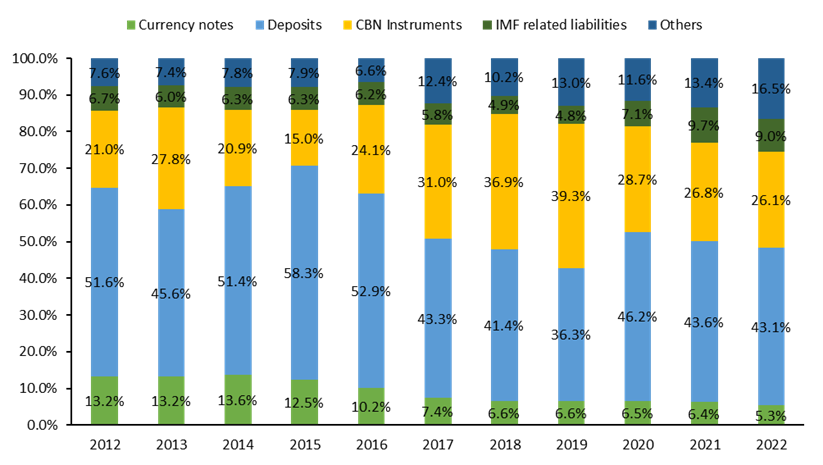
Source: CBN
The original sin
In essence, the CBN pursues other objectives aside from the core price stability as it is more focused in trying to sterilize the liquidity effect of the large foreign assets that it cannot credibly pursue price stability. This argument is not entirely new and was first mooted by the late industrialist Henry Boyo. In the absence of a credible means of transforming Nigeria’s petro-dollars, the status quo is one in which the CBN converts export earnings at a fixed non-market determined exchange rate into Naira liquidity which is then supplied to the Nigerian government for its domestic operations. Essentially, money supply grows at the pace of the conversion of export proceeds into Naira and not the conventional credit recycling process of standard economics. To mitigate against the clearly inflationary effect of these fiat conversions, Nigeria’s monetary policy becomes countercyclical by design: hawkish during periods of oil price boom and dovish during periods of oil price decline to be effective. This assumes that the central bank is able to correctly forecast the level of money supply conducive for non-inflationary credit creation to the non-oil sector. It also assumes that the central bank is more interested in real (not nominal) exchange rate stability. The absence of the two conditions would seem to explain much of the malaise with the current policy environment. The transmission mechanism to market rates is clearly broken as curtailing the structural liquidity surplus at a non-loss-making level becomes the ultimate focus of monetary policy NOT price stability. It also creates an incentive for the central bank to be obsessed with nominal exchange rate stability, which forces it to set interest rates at levels non-conducive for credit growth to the non-oil sector. Most damaging of all is the incentive effect of this backdrop on financial intermediation which rapidly devolves to a focus on exploiting interest rate arbitrage across fixed income markets (banks with large treasury operations) and rent seeking financial intermediation models as against risk taking credit creation. Consequently, Nigeria’s monetary policy tends to be inflation blind for large periods of time.
To recalibrate the status quo to a more sustainable footing, we must look to restore the natural settings of policy.
Rethinking Nigeria’s fiscal-monetary equation: Firstly, Nigeria must remove the legal surrender rights on oil exports to the CBN. So what happens to export proceeds? Force the NNPC to dispose of its FX proceeds into the liberalized FX market within a short timeline (say 30-days) required to meet the requirement for monthly FAAC distributions. If the CBN requires dollars to bolster reserves, it can enter the market and purchase at a market determined rate like every other agent using Naira liquidity on its balance sheet. Now this removes the sterilization issue as dollars purchased will largely displace the exact number of Naira on the CBN balance sheet consistent with its annual money supply growth targets. This will force the CBN’s army of well-paid PhD economists to at least do some econometric work in forecasting the required levels of liquidity (balance sheet Naira liquidity) conducive for the financial system. Either that or we set-up a separate entity independent of the CBN which manages external reserves like in China. This latter approach will remove the risk of wanton financial recklessness associated with the recently ousted CBN leadership which irresponsibly encumbered Nigeria’s financial reserves with large derivative transactions. I would prefer this approach as I do not believe CBN has not shown the maturity or cool headedness to be allowed very external scrutiny in its management of Nigeria’s external reserves. Overall removing the legal surrender rights ends the practice of forced fiat conversions of oil petrodollars at an arbitrary exchange rate which underpins CBN’s historic bias towards nominal exchange rate stability. This practice also switches Nigeria away from an asset-driven balance sheet central bank to a more conventional one.
Codify explicit policy objectives into the CBN Act: What should the appropriate goal of monetary policy be? Ideally it should reflect the idiosyncratic features of the economy as well as the long-term goal of economic policy. Nigeria is a small open economy whose large low-skilled population imposes a requirement for industrialization as part of its long-term growth strategy. Anything else is likely to be deceptive. This would suggest that policy objectives for the CBN should look to straddle between domestic price stability and ensuring a competitive real exchange rate. A very good example of this is Singapore where the Monetary Authority of Singapore (MAS) looks to attain real exchange rate stability and an inflation rate that is supportive of consumption. MAS is required to demonstrate bi-annually how its policy positions across the year ensure the attainment of these twin objectives in published reports to the government. Thus, as a small open economy with ambitions to industrialize, Nigeria’s optimal monetary policy choice should look to span both objectives with appropriate qualifiers: a low inflation rate consistent with economic growth forecasts and a real exchange rate competitive for non-oil exports.
Mandate heavy disclosure requirements on the CBN to improve transparency: The experience of the last eight years, is to paraphrase Milton Friedman, the danger of granting so much power to few individuals. Left unchecked, the ousted CBN Governor Godwin Emefiele proceeded to embark on large financially reckless derivative transactions which committed Nigeria to large USD payments without the sufficient fiscal or legislative oversight. Even worse he would do so with deliberate opacity and data censorship to mask the big gamble by refusing to publish the CBN financials and discontinuing the publication of macroeconomic data which exposed the scale of the derivative encumbrances on external reserves. The idea of central bank independence is not an invitation to non-transparency. Going forward, Nigerian authorities must impose minimum mandatory disclosure requirements on the CBN with the threat of criminal prosecution with jail terms for members of the Committee of Governors and CBN’s board. In addition, the CBN must be made to periodically (say every six months) submit a report to the National Assembly which demonstrates explicitly how its policy decisions are helping to attain the twin objectives of price stability and a competitive real exchange rate for non-oil exports. This should include a session for questions and answer as in advanced economies where legislators grill the CBN leadership on their positions. The goal is to enshrine a culture of transparency at the CBN in exchange for the independence its leadership often requests.
Restrict development finance aspirations to dedicated capitalized DFIs to tackle underserved critical sectors: One area where there is rapidly emerging consensus is the need for the CBN to retreat from the development finance forays which characterized the prior Governorship. But on others there is little agreement. In the light of the large unsecured loans that emanated from the CBN balance sheet over the last five years for various development finance activities, many of which created obvious conflicts with monetary policy, there is a need to separate these entities from the CBN. Specifically, we must look to proscribe the CBN from large scale interventions into development finance using its balance sheet. Rather the CBN can recommend to the fiscal side the creation of specific development finance entities but limit involvement to purely regulatory. As a policy, interventions to finance critical underserved sectors should evolve into specific dedicated entities outside of CBN’s oversight.
If you would like to receive this every week as well as other posts or you know someone who will find the information on this site useful, you can add your email using the subscribe button below
Discover more from Eco215
Subscribe to get the latest posts sent to your email.
Good morning,
I enjoy your analysis and find them very insightful. Do you do private corporate sessions for companies, such as a presentation on 2024’s outlook that can be used for budget planning/ strategy? If so please let me know your rates?
Regards,
Kayode Akindele
Dear Kayode, I trust you\’re doing well. can you send an email to walle.smith@outlook.com