
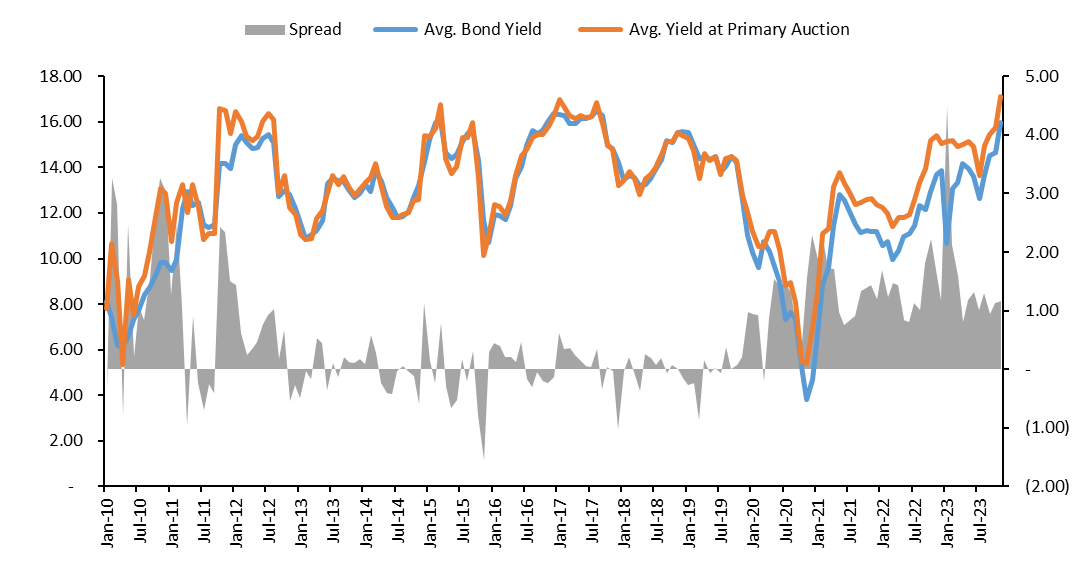
Shock and Awe at the November 2023 Bond Auction: At the penultimate bond auction in 2023 where the DMO looked to sell NGN360billion worth of bonds, the broad view was for yields to continue to slow uphill climb but with the 30-year bond likely closing around 17.5-17.75% vs 16.6% at the October bond sale. However, despite soft demand (bid-cover: 1.24x) the DMO pulled a shocker by over-extending the clearing rate to capture as much of the demand on offer (98%) which resulted in the highest average marginal rate at a bond auction (17.13%) with the 30-year closing at 18%. The DMO sold around NGN434billion.
Figure 1: Primary- Secondary Market Average Yields
Source: DMO, Authors Calculation.
In the lead up to the auction, the DMO has sold around NGN5.5trillion worth of bonds which alongside the net NTB borrowings of NGN809billion implied a run-rate around 89% for the original 2023 budget domestic requirement of NGN7trillion by my estimate. Given relative DMO sensitivity earlier in the year, one can likely link the desperation to borrow aggressively to the need to fund the new NGN2.1trillion without recourse to CBN financing. With two auctions left (before November) the risk of breaching this constraint was real and my sense is we are likely to see the DMO aggressively borrow at all PMA (especially NTB) over the rest of 2023 to cover the new target.
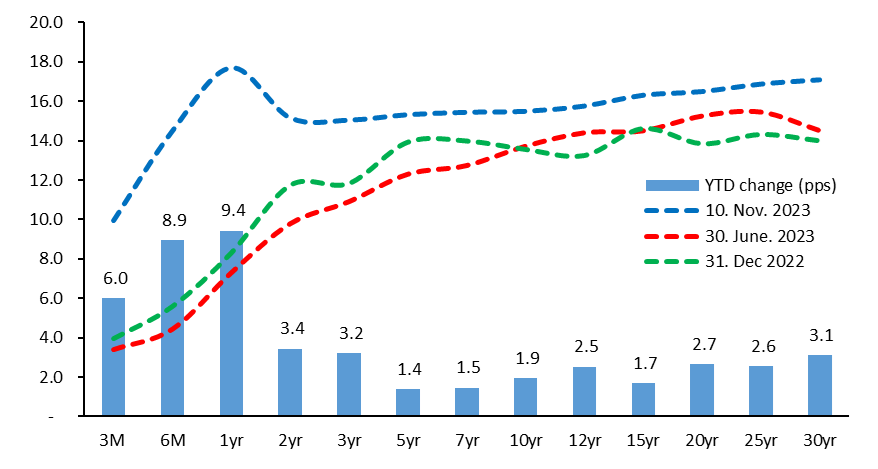
Naira yields continue to climb the north in the secondary market: Interest rates along the Naira yield curve continued to drive higher following the return to credible liquidity tightening by the CBN. For a start the financial system was tight with interbank rates rising by nearly 100bps to 17.6% following over NGN300billion in CRR debits and net NTB issuances (NGN197billion) which kept system liquidity in a net short position of over NGN200billion. Bond yields re-priced to the levels at the auction with 2053s up 90bps. We are likely to see bonds hold at this level though I suspect there is much more selling on the front-end as the 1yr is likely to reprice to 20-21% at NTB auctions over the rest of 2023.
Figure 2: Naira Yield Curve
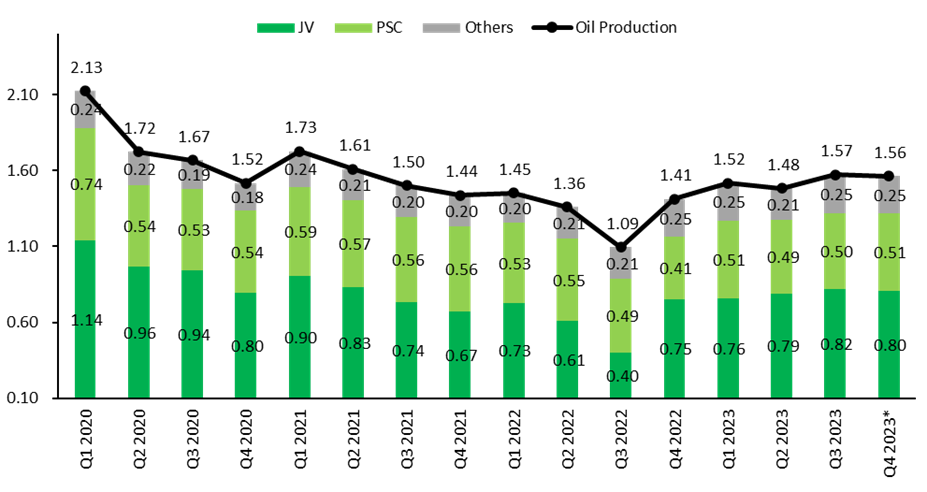
Nigeria’s oil production held steady at 1.6mbpd in October: Oil output remained flat at 1.6mbpd in October 2023 with crude production slightly higher offset by slight declines in condensate output. Trends along the big export terminals were mixed: increases along Bonny (+5% to 147kbpd), Qua Iboe (+2% to 149kbpd) and Bonga (15% to 139kbpd) amid declines in Forcados (-7% to 256kbpd), Escravos (-8% to 137kbpd) and Brass River (-14% to 19kbpd). To get to 2mbpd, Nigeria needs to re-engage the IOCs to rejig production at Brass (down nearly 80% from 2020 levels), Egina (down nearly 55% from 2020 levels) and stabilize activity along Bonny and Qua Iboe. Thus, far all the big majors Shell, ExxonMobil, EniAgip have announced plans to dispose of their onshore assets in Nigeria without any major plans to create a new basis to raise production. Nigeria’s oil chiefs are slow to react as other major oil producers like in the Gulf where focus appears to get all the oil out and sell at current prices and utilize proceeds to diversify their economy.
Figure 3: Nigeria Oil Production by Regime
Source: NUPRC
NTB auction yields close at six-year highs: At the fortnightly NTB auction where the CBN, on behalf of the DMO, sought to refinance NGN310billion worth of short-term debt, the expectations were for a reprisal of trends observed within the OMO bill section where 1-yr yields crossed 21%. Demand was moderately strong 2.8x (down from 6x in the last sale) likely tempered by another round of adhoc CRR debits by the CBN the day before. In terms of results, for the second auction in a row, the CBN net borrowed with total sales of NGN497billion with the 1-yr at an effective yield of 20%. YTD, net borrowings via NTB is now running at NGN809billion and amid press reports of a new Executive branch request to the National Assembly for extra Ways and Means suggests either greater financing requirements or that the DMO is worried about not being able to raise the funding shortfall for the NGN2.1trillion supplementary budget from domestic markets.
Inflation likely cleared 27% in October, but moderation in the monthly run rate likely to continue following the start of the main harvest : The NBS is set to publish the October 2023 inflation data and as in September, we are likely to see a repeat of the dynamic of a rising annualized headline reading but moderation in the monthly number as the start of the main harvest season drives a retracement in food prices from recent highs. Looking at some food price trends over October, maize, sorghum and millet prices broadly retreated from September levels. That said, the higher fuel price and FX shocks will keep the current run-rate elevated and my sense is for a monthly read in the 1.9-2% region which translates to headline in the 27.5-27.7% region.
If you would like to receive this every week as well as other posts or you know someone who will find the information on this site useful, you can add your email using the subscribe button below
Discover more from Eco215
Subscribe to get the latest posts sent to your email.