
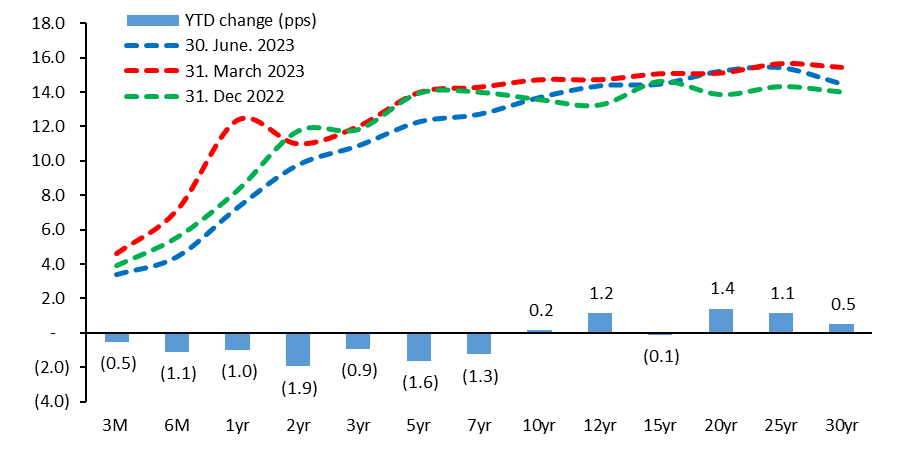
Naira curve bull steepens in response to the liquidity overload: Interbank rates slid to fresh lows of 1-2% as FAAC inflows of NGN484billion bolstered financial system liquidity already healthy in the aftermath of liquidity injections from the CBN. These inflows followed the decision to return to an ‘equitable’ CRR debiting regime, a departure from the arbitrary approach under the suspended CBN Governor Godwin Emefiele. In response, overall system liquidity hovered between NGN700-800billion, and banks have quickly deployed these inflows into securities primarily along the front-end of the curve with T-bill yields dropping to 1-3% at the secondary market. This was evident at the T-bill auction on Friday, where demand was robust with bids of NGN753billion chasing the NGN187billion on offer. Accordingly, the CBN rolled over the maturities on offer at lower stop rates across board: 91-day: 2.87% (previous 4.89%),182-day: 4.37% (previous 5.12%), and 1-yr: 6.23% (previous 8.24%). The liquidity surfeit also spurred duration buying which pushed yields down 80bps across the curve: short (down 80bps), belly (-120bps) and long (40bps).
Figure 1: Naira Yield Curve
Source: FMDQ
Over H1 2023, while the Naira yield curve was largely flat over much of the period, the CBN’s switch to an accommodative stance towards Naira liquidity in late June (though indirectly) via the return to equitable CRR computation meant that the yield curve is down 30bps from the start of the year. However, this was a non-parallel shift as there is observed divergence across curve segments: the front-end and the belly of the curve have seen between 90-110bps compression while the long-end is higher than year start (+80bps). This shift reflects technical factors associated with the liquidity injections as fundamentally the CBN has signaled higher rates via its MPR (+100bps), markets have grappled with higher bond issuance to fund a record fiscal deficit and inflation has shifted gears higher with expectations of a further run-up.
DMO publishes the 2022 DSA, advises FGN to take capex out of budget: The Debt Management Office (DMO) published the 2022 Debt Sustainability Assessment (DSA) report which is a diagnostic tool used to ascertain a country’s ability to service near and future debt obligations. The IMF and World Bank use the DSA when determining lending packages and Nigeria’s debt laws require the DMO carry out an annual assessment, so these annual reports shed some light on the thinking of Nigeria’s debt czar. The Nigerian exercise is usually multi-agency involving teams from the finance ministry, CBN and NBS and the World Bank.
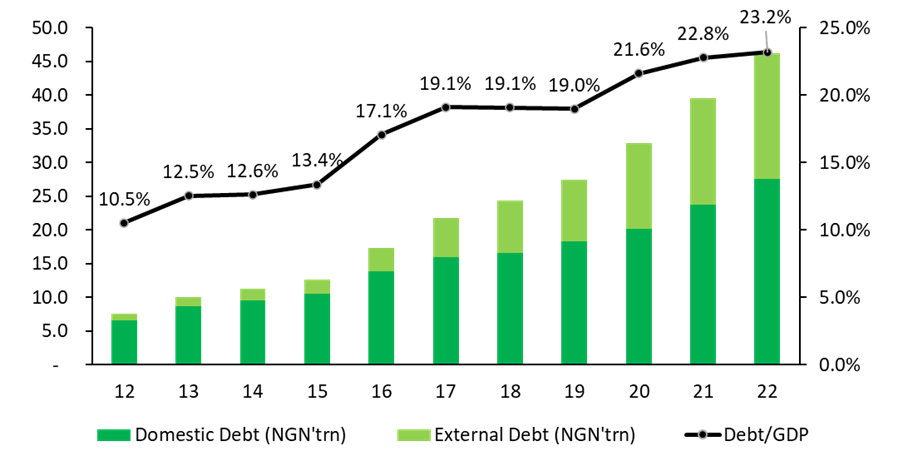
Figure 2: Nigeria’s debt data.
Source: DMO
The main findings in the 2022 report were that while Nigeria’s debt stock remains sustainable under the baseline, in an alternative scenario (which is a stress-type situation), Nigeria’s debt stock would easily breach the self-imposed legislative targets of 40% of GDP as per the last approved debt strategy over the 2023-2027. This reflects primarily the impact of securitization of the NGN23trillion Ways & Means loans and exchange rate depreciation from NGN461/$ to NGN646/$ (interesting in the light of the drop to NGN750/$). While this will clear the conservative limits imposed by the National Assembly, it is important to note that the IMF/World Bank use a 60-70% of GDP norm observed across emerging market economies.
Another area of concern is on debt-service ratios, where the DSA highlighted the long-standing revenue issues and in alternative scenarios, DSR ratios easily cleared 100%. The DMO also hinted at some discomfort with the ratio of short-term debt to total debt as being above the threshold which suggests some concern over refinancing risk (and could mean a neutral posture T-bills over the rest of 2023). More interesting are the recommendations: Firstly, that the FGN should look to push capex projects towards PPP type arrangements and look to privatise some assets. Since the Jonathan administration which pushed through the power sector privatization, Nigeria has stalled activity on this front since the Obasanjo government and there is never a good time to commercialize and privatise certain government assets than today.
Q1 2023 debt data out shows marginal increase, W&M excluded till Q2: The DMO also put out Q1 2023 debt data which showed that Nigeria’s public debt (Federal and State) climbed 7.8% to NGN49.9 trillion (USD108.9billion) which reflects new domestic borrowings over the quarter fund the 2023 budget. Domestic debt rose 9.7% to NGN30.2trillion due to higher FGN bond sales while the external debt outstanding increased by 2.3% to USD42.7billion. The DMO noted that the CBN’s Ways & Means Advances would be included in the Q2-23 debt data since it received the National Assembly approval to securitise it in May 2023.
Naira stabilizes at NGN770/$, CBN’s missing oil reserve flows: The Naira appears to have stabilized at NGN770/$ handle across the official and parallel market segments though turnover within the official IE window remains muted at USD444million (down 31% w/w) likely due to the short trading week. That said, whispers of CBN interventions were heard within the NGN760-770/$ levels. External reserves maintained the downtrend closing June at just over USD34billion (5months of import cover).
Figure 3: CBN Reserve Flows
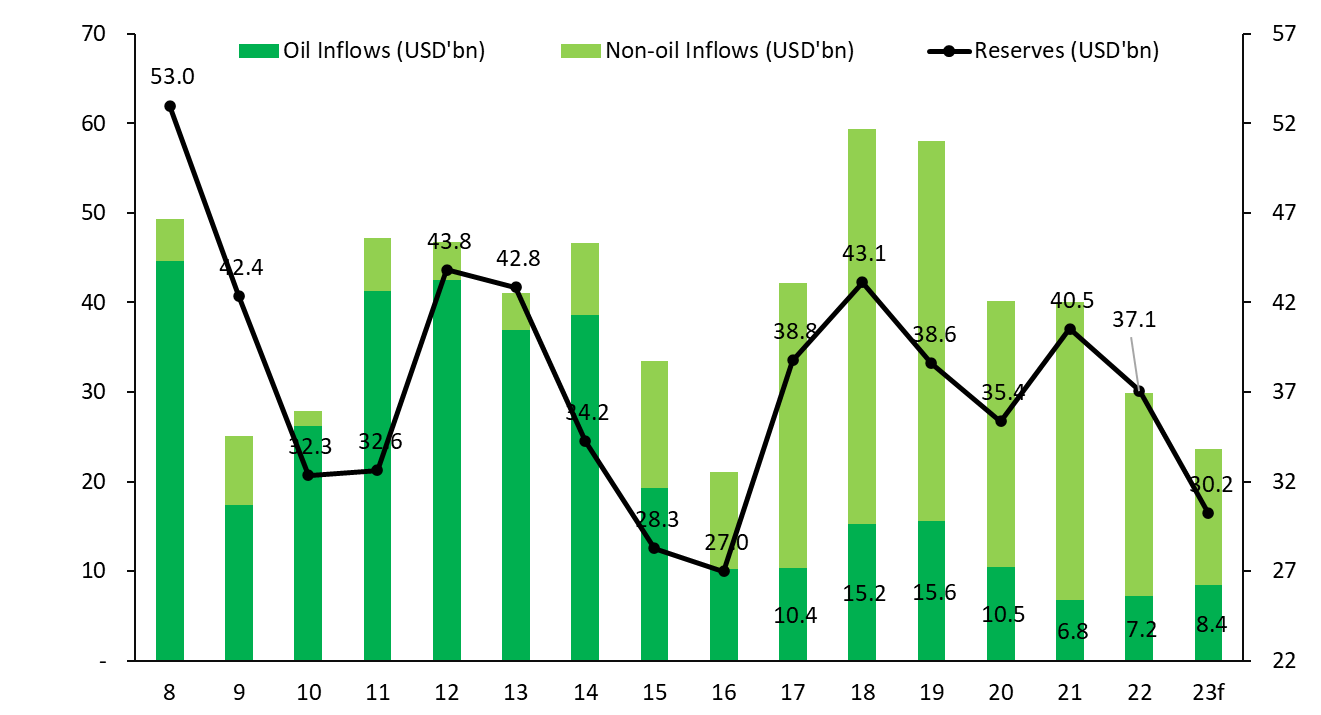
I was looking at CBN’s cashflow data and running some analysis and it struck me that the USD flows via oil has collapsed to single digits (USD6-7billion) in the last two years down from USD30-50billion during peak prices. This reflects the impact of the barter crude-refined trades which took up a large chunk of FX reserve inflows. To offset the declines, the CBN relied on large non-oil flows: swaps, Eurobond sales and portfolio inflows over the 2015-2022 period. However, unorthodox rate policies, tighter global financial conditions, and whispers of CBN’s inability to repay USD swaps suggest limited respite for non-oil flows. These pressure points appear to explain reserve declines in the face of higher production and still supportive oil prices. Nigeria will have to wait for 6-12months for the barter trades to tide out and without a large source of external financing, external reserves could fall to under USD30billion by my estimates. Something has to give! Are Nigeria’s economic managers tolerant of further exchange rate declines and its second-order impact? Three stopgaps are required in the short-to-medium term: Seek out official creditor flows (IMF/WB) AND/OR issue a large tranche of Eurobonds (>$5billion) AND/OR Adjust rates (>15%). Asset sales are possible but this will take some time and not sure that runway is there.
H2 2023 Outlook: Will the CBN return to credible liquidity tightening? bear flattening on the cards..
In shaping my outlook for the rest of 2023, I would start by noting that the change in Nigeria’s political leadership is a significant event. Where there was indecision on key economic hot-button items like the exchange rate and fuel prices, there will now be an active FGN position on these issues. We are likely to see a departure from the failed Buhari-Emefiele unorthodox experiment with key economic variables towards one which looks to marry the reality of weak fiscal revenues and the large external imbalances with the FGN’s expenditure. To get traction, the Tinubu administration will have to focus on restoring fiscal accounts (possibly via subsidy removal/reduction and privatizations) and external balances (largely via FX adjustments) drawing on insights from their declared policy documents.
This suggests that a mixture of fiscal retrenchment (bullish for interest rates) and greater tolerance for FX weakness (bearish for inflation and interest rates) in the absence of large external financing. External financing is a point I had mentioned last week, and I reiterate that Nigeria needs to request for international support given the scale of structural reforms underway. Within the current global geopolitics, this is likely to be less onerous ask and I strongly believe the government should reach out to obtain much needed external support to help navigate the impact of the painful adjustments on households. If external financing comes through, it will likely include requirements for credible monetary policy which will lead to liquidity tightening and higher short-term rates with curve -repricing implications. Where no external financing is sought, then Nigeria’s new economic managers would appear to be pursuing another variant of the unorthodox economic policy of the Buhari-Emefiele diarchy which relies on financial repression with negative real rates. Under this scenario, one can assume a bullish for the yield curve overall. My sense is the former scenario is likely though one has to be positioned to wait out the latter financial repression outcome which would appear to be potentially underway given events over June 2023.
From a supply-demand perspective, the DMO still has a large borrowing target and there is ample liquidity over the rest of 2023 to fund this given the bank CRR refunds.
How does liquidity management work?
I’ve been reading a handbook by the Bank of England on how central banks conduct monetary policy operations. The core goal of central banks is to deliver price stability, and this is achieved by targeting a set level for interest rates or the exchange rate. Now there are three broad approaches to managing money supply to achieve these objectives (i) open market operations (OMOs); (ii) standing facilities (SFs); and (iii) reserve requirements. The first two approaches work indirectly via signaling while the third is more direct. OMOs are where the CBN conducts auctions wherein it sells (buy) securities to mop-up (inject) liquidity whereas standing facilities are the rates at which the CBN remunerates banks for excess reserves (or lends reserves) to take out liquidity (or inject liquidity). These two have the same impact on the CBN balance sheet but greater influence on market rates within a market setting. The previous CBN governor, to paraphrase the IMF in its 2021 Article IV, used these tools inappropriately. CRR debits are direct and costless but create second-order distortions.
Following the CBN governor’s suspension, the CBN is not conducting OMO operations, has retained the limits which neutered the deposit facilities which would have absorbed excess liquidity and has returned cash to restore equitable CRR regime. In essence, what the CBN’s body posture is saying is that we are comfortable with excess liquidity even though in our declared MPC statements we would prefer interest rates at 18% +/- 100/700bps in a bid to stem inflation. In short, the CBN’s body language is inconsistent with its speech. There is no better explanation of non-credible monetary policy than what the present overlords of the office at 33 Abubakar Tafawa Balewa Way are providing us!
Have a good trading week!
It’s Adam Smith’s 300th birthday this month so I will look to close out with one quote
The first thing you have to know is yourself. A man who knows himself can step outside himself and watch his own reactions like an observer.
If you would like to receive this every week as well as other posts or you know someone who will find the information on this site useful, you can add your email using the subscribe button below.
Discover more from Eco215
Subscribe to get the latest posts sent to your email.
Great