
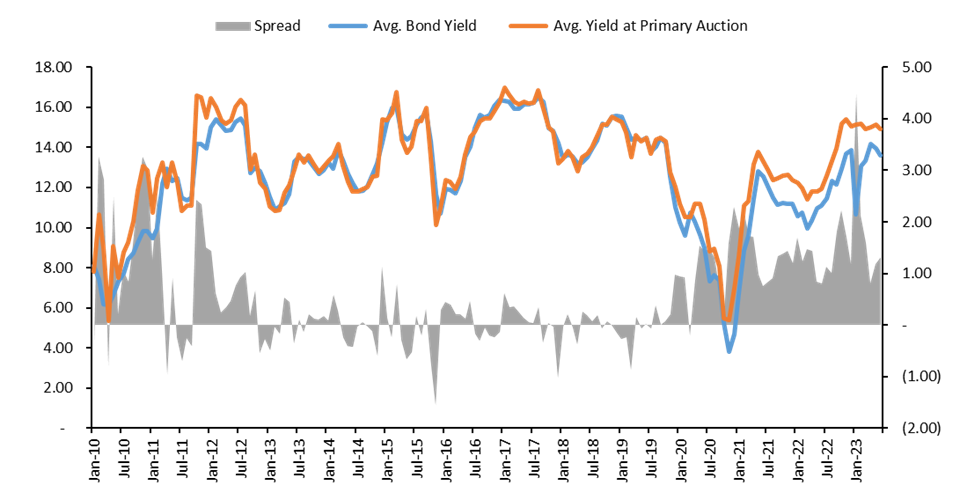
Yields slide at the inaugural bond sale of the Tinubu Presidency: At the monthly bond auction, where the Debt Management Office offered NGN360 billion across FGN 2029, FGN 2033, FGN 2038, and FGN 2053, there was a modest improvement in demand, with bids reaching 1.6 times the amount offered (compared to 1.3 times in May). However, the DMO decided to reduce issuance by 13% to NGN473 billion, including non-competitive bids of approximately NGN65 billion. Mean stop rates, which indicate the average interest rates, decreased to 14.94% from 15.15% in May. Regarding the positioning of stop rates, the DMO set aggressive rates compared to the weighted average bid rates for the 2029s, 2033s, and 2038s. However, their approach was less enthusiastic for the 2053s. Additionally, the non-competitive bids for the 2029s and 2033s, combined with the DMO’s stance, suggest a level of comfort with rates within the 13-14% range. In terms of year-to-date (YTD) issuance, gross bond sales amount to NGN3.6 trillion, compared to NGN1.8 trillion in the first half of 2022, reflecting the significant borrowing plan outlined in the 2023 budget. Relative to the domestic borrowing target of NGN7 trillion, my estimates indicate that net borrowings currently stand at 40%. Therefore, there is still a considerable way to go in terms of meeting the issuance goal.
Figure 1: Bond Yields and Auction Stop rates.
Source: DMO, FMDQ
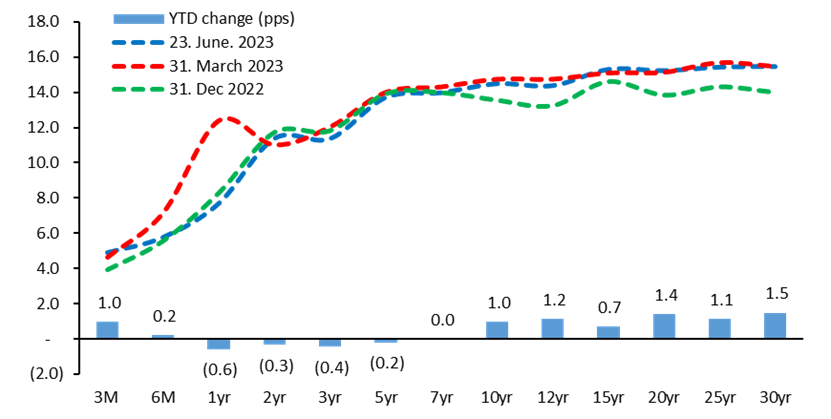
Removal of interbank restrictions and CRR refunds catalyzes bull steepening in yields along the Naira curve: The Central Bank of Nigeria (CBN) continued to ease the restrictions implemented during the tenure of suspended Governor Godwin Emefiele. Firstly, the CBN initiated Cash Reserve Ratio (CRR) refunds to banks that had been unfairly debited above the official CRR rate. This resulted in a significant increase in liquidity in the financial system, surpassing NGN1 trillion at the beginning of the week. Consequently, interbank rates experienced a sharp decline from the 12-14% range observed in recent weeks to a range of 1-2%.
Furthermore, the CBN removed another restriction on interbank rates that had been imposed by Governor Emefiele. Previously, interbank rates were confined within a narrow band bracketed by the Standing Lending Facility (SLF) rate, which was set at +200 basis points over the Monetary Policy Rate (MPR), and the Standing Deposit Facility (SDF) rate, set at -700 basis points below the MPR. This unorthodox mechanism compelled banks to lend and borrow money from each other within a tightly controlled range, irrespective of the actual liquidity conditions. While the directive did not originate officially from the CBN, it was issued through the ‘secretive’ Financial Market Dealers Association (FMDA), consisting of bank treasurers, as such the unwinding also emanated via the same group.
The combined impact of these changes prompted a surge in buying activity across the yield curve, particularly in the short-term segment. T-bill yields plummeted to the 4-5% range, while bond yields retraced by approximately 50-60 basis points by the end of the week. Given the anticipated inflows from the Federation Account Allocation Committee (FAAC), the near-term outlook suggests a bullish steepening in yields. T-bills and short-term bond maturities are expected to decline significantly compared to longer-duration plays.
Figure 2: Naira Yield Curve
Source: FMDQ
Money supply growth slowed in May, Currency in Circulation (CIC) continues to recover: Latest CBN data over May 2023 showed that a slowdown in the growth rate of monetary aggregates with M2 and M3 rising at an annualized rate of 17% (April: 22.5%) and 15% (April 22.3%) respectively. In terms of drivers, a deceleration can be seen across net foreign assets (+40% over May down from 56% in April) and net domestic assets which was largely driven by moderation in credit growth to the government slowed from the annualized 74% run rate in April to 56% in May. Private credit growth picked up modestly (14% vs 13.8% in April). Cumulative CRR debits stood at NGN15trillion while CIC continued its uphill climb rising to a five-month high of NGN2.5trillion as the CBN continued to ease cash back into the economy after the failed Naira re-design program in January 2023.
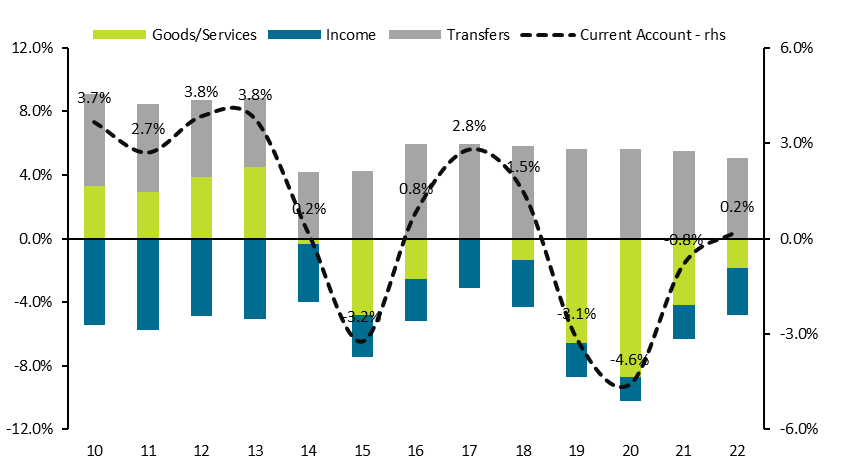
Nigeria’s external balance returned a surplus in 2022, record oil import bill: CBN data over 2022 showed that Nigeria’s current accounts returned to a surplus (USD1.01billion, 0.2% of GDP) after three years of deficits. The gains were spurred by a moderation in deficit in the Goods account on account of higher oil exports, a function of higher oil prices (+62% to USD115/b) given weaker oil production (1.36mbpd vs 1.62mbpd in 2021). Interestingly, oil imports came in at a record USD22billion (+42%) reflecting the impact of the artificially discounted petrol prices in Nigeria, thanks to petrol subsidies, which naturally spurred illegal imports from neighbouring West African countries. Nonetheless, oil inflows via the CBN reserves likely came in at a record low amount USD7billion (bizarrely the CBN elected to discontinue providing breakdowns over H2 of its inflows) reflecting the subsidy arrangements. This would appear to explain weak dollar supply within the official windows.
Figure 3: Nigeria Current Account Balance (% of GDP)
Source: CBN
Parallel market premium dissipates, but USD supply issues persist drawing CBN action: In the week following CBN’s dramatic shift towards a more flexible exchange rate system, the Naira weakened 14% over the week to close at NGN770/$ within the I&E window where turnover was down 31% to USD513million or USD103million per day. The week saw the first involvement by the CBN via a bid auction for USD30million with winning bids at NGN750-770/$. The Naira appears to have stabilized within the segment at a level to ensure indifference to parallel market exchange rates (NGN765-775/$).
Looking at fundamental REER data, the Naira appears under-valued by my estimates with a post 1999 long-run REER level at NGN672/$ in today’s currency terms. Using relatively aggressive inflation forecasts, the long-term fair value should be around NGN708/$ which suggests the current FX rate level at NGN770/$ reflects an under-valuation of the exchange rate. We know that currencies can overshoot their long run REER levels as postulated by famed German economist Rudiger Dornsbusch’s in his overshooting theory. The removal of hard pegs after a long period of over-valuation in the absence of large USD supply is one of those instances where this can happen. Nigerian policy makers need to take bold steps to engage external capital providers (foreign investors) or look to enter a stand-by arrangement with the IMF to wade through the present situation.
Naira design was negative for tax receipts in Q1 2023: Another month, another data point highlighting the damaging impact of the Naira re-design policy pushed through the suspended CBN governor and endorsed by the Muhammadu Buhari administration. According to the National Bureau of Statistics (NBS), collections from Company Income Tax (CIT) declined by 15% y/y and 38% q/q to NGN469billion in Q1 2023. Breakdowns provided show declines in local collections (-15.0% q/q to NGN301billion or 64.1% of tax receipts) and foreign CIT payments (-58% q/q to NGN168billion). When the historical annals are penned, it will show that the Buhari-Emefiele diarchy pushed through a damaging economic policy with zero rationale outside politics regardless of the consequences on livelihoods.
What can policymakers do to improve to stabilize FX markets?
Looking ahead, term premiums have surged again suggesting an unease in bond markets about the near-term direction of interest rates with short term rates falling faster than the long end. This development is a direct consequence of CBN’s decision to unwind some unorthodox non-market restrictions that distorted money markets. However, the current approach lacks any sense of sequencing which can potentially lead to market rates overshooting their intended target ranges which may be detrimental towards unlocking much needed USD flows required to deliver relief to FX markets. I outline a few ideas to help calm the storm brewing across FX markets.
- Nigeria must explore options of a formal standby-arrangement with the IMF/WB. Having front-loaded key structural reforms, the time is ripe for Nigeria’s economic managers to reach out to the IMF for a formal standby arrangement (SBA) in the region of at least $5billion. This is credit-line arrangement is par the course for countries going through balance of payment issues as Nigeria presently and need not be drawn down. The process of going through and SBA on-boarding process can help cement the nature of FX reforms while bolstering credibility in the eyes of much-needed international investors. For these two agencies, having long pushed for a flexible FX arrangement, the time is now to stand with Nigeria to ensure these gains are made permanent. The key proviso is that the line need not be drawn down as oil export receipts are likely to recover in 6-12months time with the phasing out of petrol subsidies.
- The CBN must repair the broken transmission channel between policy and market rates to regain credibility: Fundamentally, with core inflation running at near 20%, one could argue that short-term T-bill rates are mis-priced at 3-6% reflecting the impact of a liquidity surfeit within money markets brought about by the direct effect of CRR refunds by the CBN in the spirit of ‘equity’. However, these rates are out-of-line with where the CBN itself is signaling interest rates should be at 18.5% using the MPR. As I noted in my last post this breakdown reflects the breakdown of the SDF. Nigeria as with several central banks uses the corridor approach around the policy rate which implies that market rates should ideally revolve within the corridor defined by the +200/-700 bps around the MPR at 18.5% i.e. 11.5% and 20.5%.
- The CBN must return to active open market operations to manage liquidity: The long history of Nigerian monetary policy is that policymakers who ignore excess Naira liquidity within the financial system ultimately pay the price via exchange rate weakness. The next leg of strong asset bubbles across the bond markets is to take bets against the Naira. The credible way to manage liquidity under a flexible exchange rate system is via open-market operations or use of discount windows. Ignoring this approach means a return to the now jettisoned crude CRR approach which would make no sense given the reversal last week and talk about policy normalisation. With the securitization of the Ways and Means and the 40% drop in the value of the Naira, the CBN’s balance sheet is in a much healthier position than possibly anytime under the Emefiele era. The time to return to open market operations to guide the market is here alongside removing the heterodox cap on the SDF deposits of excess bank reserves.
- The apex bank must refocus communication on a clear attainable inflation target: Over the course of the week, there has been a lot of talk about where short-term interest rates should be given the run-up in inflation and the deeply negative spread on T-bill rates. If I still recall my monetary economics well, then rather than crudely target the running inflation rate which is backward looking, policymakers ideally target inflation expectations over a clearly defined period. Usually, this will be average inflation expected over an intermediate period (say 3-years) which is communicated ahead of time. Now as shocks emerge which potentially alter the trajectory of attaining the initial inflation target, policy adjusts not to the shocks but their perceived impact on the nudging inflation away from the initial target. It is this number that policymakers must work towards which is why the CBN is well staffed with economic PhDs. As I noted in my last post, supply shocks to inflation tend to be disinflationary as once they dissipate, inflation tends to return to a much lower level in the absence of further shocks. Over H2 2024, my forecasts are for inflation to return to the early teens and I suspect the CBN’s own house forecasts will likely reflect this. Thus, rather than a market rates around 20-25% as being postulated in some quarters, my sense is the market rate should move towards the 15-18% range. At this level, the interest rate differential should work in favour of portfolio flows which can provide near term support to the FX rate.
Alongside these measures, the CBN will need to do more to tackle information asymmetry issues between banks and other financial market participants by returning key policy decision making to its MPC meetings. A key feature of monetary policy under the Emefiele era was the use of circulars and communiques delivered via cliques like the Bankers Committee and the earlier mentioned FMDA.
I close with this line from the poem The Rock by T.S. Eliot.
The endless cycle of idea and action,
Endless invention, endless experiment,
Brings knowledge of motion, but not of stillness;
Knowledge of speech, but not of silence;
All our knowledge brings us nearer to our ignorance,
Where is the Life we have lost in living?
Where is the wisdom we have lost in knowledge?
Where is the knowledge we have lost in information?
If you would like to receive this every week as well as other posts or you know someone who will find the information on this site useful, you can add your email using the subscribe button below.
Discover more from Eco215
Subscribe to get the latest posts sent to your email.
Nice. You’re back!
<
div>Gre
Hi Wale , well done . Just a few comments
1.) If the CBN becomes more aggressive per OMO to tame the excess liquidity that could pour in to FX markets as you suggested; will that not be counterproductive to the truest intent of the restrictions on CRR to banks ? And will more aggression via OMO not be counterproductive towards more enhanced Private lending?
2..) With our drawdown on the Rapid FInance Facility at the IMF , dont you think it is too early to go back to the IMF /WB ?
3.) Could you please expantiate on the channels that will make supply shocks to be disinflationary per Nigeria case ?
4. ) How do you think the FG and SGs should ease the biting effect of subsidy removal and the imminent electricity removal on the majority of Nigerias real disposable income ?
Thanks a lot.
Shola ( @Obzzzy)
Thanks.