
President Tinubu suspends CBN governor, CBN lifts peg on NGN: In the space of 7-days, President Bola Ahmed Tinubu suspended the erstwhile CBN governor, Godwin Emefiele, likely bringing to an end his tragic nine-year stint as Nigeria’s monetary policy czar. The choice of a suspension over an outright removal likely reflects a temporary workaround the legal requirement to remove a CBN governor that mandates a two-third majority vote in the Senate. That said, the suspension also reflects precedent from a 2014 court ruling which allows the President ‘discipline’ a public official such as the CBN governor. While the speed of the suspension comes as a surprise, the CBN’s governor’s role in the much criticized Naira re-design policy which had zero economic basis and was clearly a political intervention implied that he was living on borrowed time. Following on from the suspension, now shorn of the need for pretending and likely urged on by the President, the CBN lifted the hard peg on the exchange rate previously set at NGN461/$. In what followed, the official exchange rate shifted from NGN461/$ to NGN663/$, then NGN702/$ before closing the week at NGN664/$. Surprisingly, the parallel market rate was barely moved which lends credence to the idea that a large share of the economy now operated at the segment with little supply within the official window. Market reaction was positive with Nigerian stocks and Eurobonds rallying in response for the second time in two weeks. So is this Day 1 of the start of another economic reform story in Nigeria or a false dawn?
Inflation maintains uphill climb, outlook points to 25-30%: The National Bureau of Statistics (NBS) published inflation data for May 2023 which showed a pick-up to 22.42% (previous: 22.21%). Looking through the monthly data, the pressure points stemmed from the core CPI (+40bps) relative to food (+10bps) though the higher level of the latter (24.8%) continued to anchor the annualized headline print relative to former (19.8%). As the last inflation print for the Buhari administration, inflation averaged 14.9% over the last eight years compared to 10.5% in the prior eight years with shocks to food inflation as the central driver.
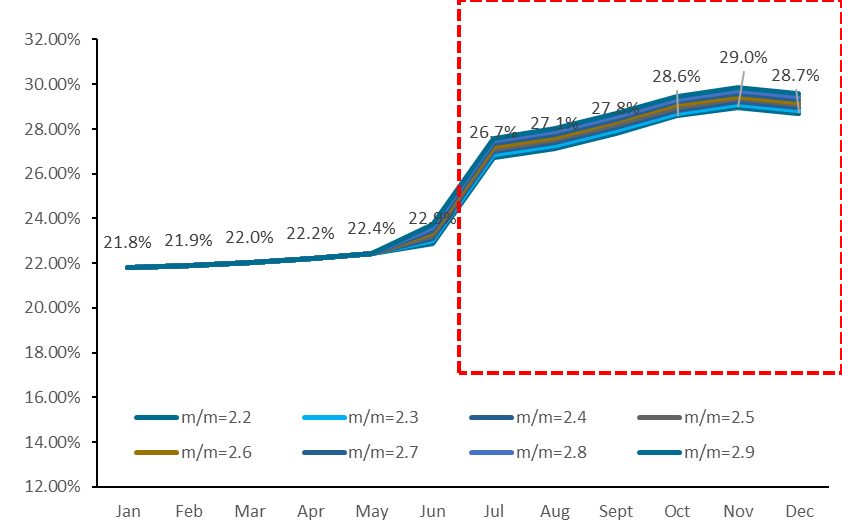
The outlook for the first six months of the President Tinubu administration points to inflation accelerating following the removal of petrol subsidies which has seen average prices rise from NGN254/litre at the end of April to NGN490-550/litre level. This will likely deliver monthly inflation for June in the 5-6% region with the annualized headline sprinting towards 26-27% zone. Fuel price hikes tend to be disinflationary given the negative effect on purchasing power and if future adjustments are muted, it sets the stage for a moderation in headline inflation towards trend level in the latter half of 2024.
Headline Inflation: 2023 Forecast
Source: NBS, Authors Computation
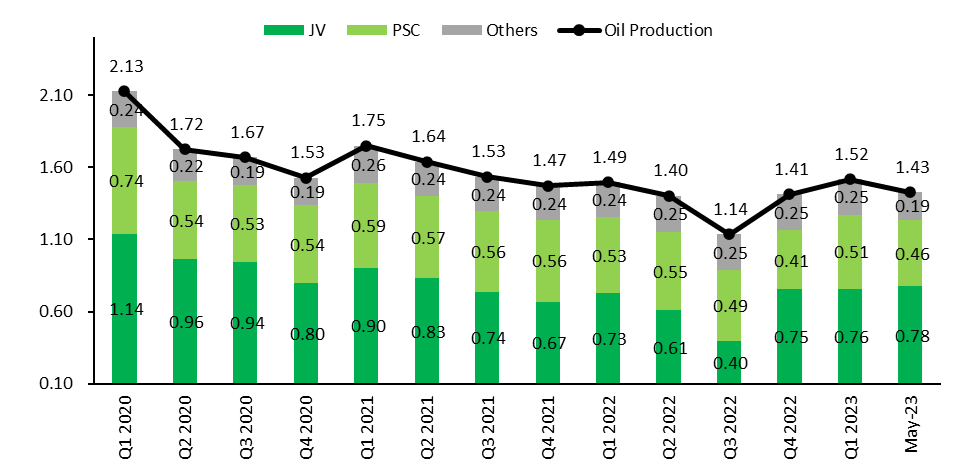
Oil production recovered in May following cessation of the Pengassan Exxxon-Mobil strike: Nigeria’s oil output recovered in May 2023 (+18% to 1.42mbpd) using NUPRC data as the strike action which paralysed exports along the Qua Iboe terminal in April was called off. Accordingly output via the pipeline surged (+101% to 132kbpd) supported by further improvements in Bonny (+20% to 120kbpd), Forcados (+17% to 226kbpd) Escravos (+16% to 134kbpd) and Erha (+114% to 74kbpd) these offset declines in Usan (-81% to 4.7kbpd). Overall, oil production appears to be stabilizing and though Nigeria could remain below its OPEC+ quota of 1.8mbpd, the oil sector is likely to exit recession over Q2-Q3 2023 with potential upside to overall GDP growth. On the exploration side, TotalEnergies announced the discovery of a commercial oilfield (Ntokon) on OML 102 which it plans to develop through a tie-back to the existing facilities. Of the big IOCs, TotalEnergies appears to still have interest in E&P activity and the development of this field suggests some upside to production over the medium term.
Nigeria Oil Production By Fiscal Regime
Source: NUPRC, Authors Calculation.
Nigeria’s fixed income markets at ease, the calm before the storm? Local currency debt markets appear unruffled by the ongoing volatility across other Naira assets possibly reflecting President Tinubu’s long expressed aversion towards higher interest rates. System liquidity remained modest at NGN233billion though down from last week’s levels of NGN543billion which left interbank rates largely unchanged at 12%. At the T-bill auction, the CBN rolled over NGN35.5billion in maturities at lower stop rates 4.89% (previously: 4.48%), 5.12% (previously: 6.00%), and 8.24% (previously: 9.45%) for the 3M, 6M and 1yr tenors on offer. Bond markets were also unmoved possibly reflecting lack of clarity and rumours about an easing in the harsh CRR regime which characterized the Emefiele governorship ahead of the June 2023 bond auction. The DMO will hold the last auction in H1 2023 with NGN360billion worth of bonds on offer across the FGN 2029, FGN 2033, FGN 2038 and FGN 2053.
Where are we headed in fixed income markets?
In the coming days, the monetary policy environment is likely going to be very fluid as the acting CBN governor appears focused on unravelling Emefiele’s heterodox policies. This is a heavy workload, and the near-term targets will be removing the odd rules around the FX market. On the market itself, the key problem requiring attention is on the supply side. Thus, while the exchange rate is probably running close to fair value, the CBN will need to do the following:
- Clarify monetary policy objectives: At the heart of the CBN’s misguided pursuit of nominal exchange rate stability was the idea that it was the only realistic route to lowering inflation. But Nigeria’s headline inflation is dominated by food (55%) and shocks to supply chains have wrought havoc over the last eight years. Essentially, the solution is not to be found in monetary policy which renders the CBN’s pursuit of nominal FX stability meaningless as it penalizes non-oil exports by keeping the Naira at an unsustainable strong level in REER terms. Nigeria’s monetary policy should devolve to setting interest rates at a level that delivers a competitive real exchange rate for non-oil exports while balancing the need against keeping core inflation stable.
- Resolve the issue of surrender rights at the heart of Nigeria’s fiscal-monetary policy nexus: The second key issue that requires resolution is what to do with the forced surrender of oil export proceeds to the CBN at a rate it determines. This has long been identified as the fundamental lever that drives CBN’s dictatorship on the exchange rate: the long-standing attribute of forcibly converting oil proceeds to Naira at an exchange rate unilaterally determined by the CBN. Thus, the real cost of FX reserve acquisition by the CBN is the effectively price of printing new naira which creates a cavalier attitude towards a market driven exchange rate system. Furthermore, it ties the growth rate of money supply to the oil receipts necessitating an auto-immune response by the CBN towards liquidity within the banking system. This constant sterilization of this liquidity by the CBN has been identified as the underlying driver of Nigeria’s relatively high Naira interest rates. It is probably better to allow Nigeria’s federal and sub-national fiscals to independently sell their USD positions for Naira to meet their fiscal requirements and have CBN purchase USD at market determined exchange rates from these entities within the market. This will allow CBN pursue more realistic monetary targeting.
- Regain credibility by delivering real returns on short term interest rates: With a credible monetary policy objective and clear resolution of the the oil revenue surrender right issues, the CBN is now free to pursue a credible inflation targeting policy. Given the issues around headline, the preferred inflation measure should be the core CPI. In terms of policy variables, CBN should look to restore efficacy of its interest rate tools by lifting the cap imposed by Godwin Emefiele on how much excess reserves bank can park at the Standing Deposit Facility (SDF). Historically, the SDF was the floor for market rates and effectively helped teleguide market rates in tandem with the MPR, until the Emefiele introduced a daily limit on how much banks can park at the segment. Lifting this cap is the key to restoring the transmission of the MPR to market interest rates. Thereafter short-term rates will need to rise in the face of inflation to raise the returns for holding Naira. Given the disinflationary effect of supply side shocks, these hikes should be temporary with a more benign outlook for inflation over H2 2024.
As Nigeria calls time on the Emefiele era, it is pertinent to note Milton Friedman’s commentary on the Great Depression in America. He noted that it reflected the issues that arose when so much power is concentrated in the hands of a few individuals and why there was need for clear rules around monetary policy to prevent the arbitrariness of the individual. This lesson is valid in the context of the economic disaster brought about the failed policies of the Buhari-Emefiele diarchy over the exchange rate. More than any other things, the statist doctrine on the exchange rate broke the back of domestic and foreign investors, Nigerian workers and business owners and the society at large. One only hopes this episode does not repeat itself in the future. Doing so will require imposing steep penalties on the protagonists with some form of prosecution or public censure.
If you would like to receive this every week as well as other posts or you know someone who will find the information on this site useful, you can add your email using the subscribe button below.
Discover more from Eco215
Subscribe to get the latest posts sent to your email.
Hi Boss, thanks for the update.
Could you please buttress more on this point \”Nigeria’s monetary policy should devolve to setting interest rates at a level that delivers a competitive real exchange rate for non-oil exports while balancing the need against keeping core inflation stable\” in the context of the need to raise short-term interest rates to deliver a real return.
Thank you
Hi Ope, my view is policy makers need to focus on finding a level of interest rates that achieves both objectives. From a REER perspective, the Naira now appears under-valued which would suggest that policy-makers now need to shift towards bringing down core inflation. This will entail raising ST rates to a level that raises the rewards for holding naira.
Thank you for this