
CBN continues down the path of orthodoxy, lifts SDF cap: Following the ouster of Godwin Emefiele in July and the subsequent installation of Yemi Cardoso, the CBN has progressively taken steps to return to some semblance of orthodoxy. Outside the big FX adjustments in June, the recent moves have been towards restoring the transmission between policy rates and market rates which the CBN, under Emefiele, worked to deliberately destroy via a host of circulars including one which placed a NGN2billion daily limit on excess bank reserves parked at the CBN standing deposit facility (SDF). Regular readers of this column will remember that this is one drum, I’ve been beating for some time so it was with some relief when I read this news. When I started my career, one of the very first macroeconomic papers I drafted and published, in the light of JP Morgan’s inclusion of Nigerian FGN bonds in its EMBI in August 2012, was to reveal that the SDF was a floor for T-bill rates using some regression analysis. It’s why I was pretty sure that the development was the first real signal of a pivot back to monetary orthodoxy and re-connecting policy rates to market rates. The SDF functionality works as banks had the option of parking idle excess reserves at the window in the event that T-bill rates fell below the SDF rate which was usually set at a discount to the monetary policy rate. By imposing the NGN2billion daily limit, Emefiele was breaking that link as there was no alternative that banks could use to force pricing of T-bills to align to policy rates and the excess liquidity above NGN2billion would work to drive T-bill yields below the SDF. Governor Emefiele would further de-link the relationship with the introduction of an asymmetric corridor around the MPR.
Figure 1: NTB yields and SDF rates

Source: CBN, Bloomberg.
The move to impose this cap was disguised as part of a desire to force banks to lend, one of the several false flag operations mounted by the Emefiele era CBN, when in reality the ultimate intent was to lower the cost of liquidity management. As I wrote in my post on central banking last week, for central banks with asset-driven balance sheets, the primary goal of monetary policy is to ensure zero-loss liquidity management (not price stability). This explains why the Sanusi-era CBN liked to tweak with the cash-reserve ratio (CRR) alongside very limited tolerance for liquidity. The restoration of the SDF efficacy will likely see the CBN return to regular liquidity management operations which should see short-term market rates return to within the MPR corridor (15.75%-19.75%). One key feature of the SDF is that it helps provide a sense of the health of overall banking system liquidity which is useful feedback for the CBN to determine whether its current policy parameters are meaningful. Frequent OMO auctions to curb will indicate future CRR hikes and other zero-cost liquidity sterilisation techniques. Interestingly, the Cardoso CBN has retained the practice of adhoc CRR debits which suggests that it is not losing sight of the impact of liquidity management on its profitability. In that sense, the feature of an open OMO auction helps provide a clear signal of where the CBN wants market rates which closes the loop for monetary transmission.
DMO taps NTB auction aggressively, the onset of fiscal ‘tightening’: At the NTB auction in the prior week, where the CBN, on behalf of the Debt Management Office (DMO), looked to rollover NGN108billion worth of maturities, demand was strong, led by banks, with bids 6x the offer targeting the 1-yr. In a surprise the DMO chose to over-allotted at the auction with total sales of NGN370billion at respective stop rates -91-day, 6.00% (previously: 3.67%) 182-day, 9.00% (previously: 5.11%) and 364-day, 13% (previously: 9.25%). It would appear that banks knew something was up, as earlier in the day, the air was thick with rumours that the CBN had lifted the SDF cap. Why did the DMO chose to return to net issuance at the NTB segment? Is it a sign of a change in thinking in view of the rise in long-dated bonds? My sense is that with only two auctions left and around NGN1trillion left to borrow on the domestic leg, as well as possible advance notice of the planned NGN2.1trillion supplementary budget, the DMO elected to tap the front-end to meet its borrowing target. Furthermore, with yields rising towards 17% on the long end, it makes sense to borrow short at elevated yields in the hope of refinancing at lower yields in a year, once base effects exert a gravitational effect on inflation in H2 2024.
CBN returns to credible liquidity tightening, yield curve inversion incoming? As I noted in my note on central banking, Nigeria’s asset-driven balance sheet means that monetary policy is more focused on figuring out a minimum loss approach to liquidity management than solving the core mandate of price stability. With this in mind, central bank governors who chose to ignore the need for credible liquidity management pay the price in currency pressures. For those who plumb for credible management liquidity, striking a balance with respect to CBN profitability is the key concern. This would explain why Sanusi Lamido ‘invented’ public cash reserve ratio debit (set at 75%) alongside private CRR and OMO tightening to curtail excess financial system liquidity. So last week, in response to the surge in SDF balances, the CBN elected to drain around NGN400billion at interesting rate levels with the 1-yr OMO at an effective yield of 21%. This was accompanied by CRR debits which helped decimate liquidity levels. The return to credible liquidity tightening would suggest the CBN is likely clearing ground for USD interventions to stabilise the FX market. This, alongside, DMO’s new attraction to front-end issuances suggests a yield curve inversion on the cards, just like the pre-Emefiele era.
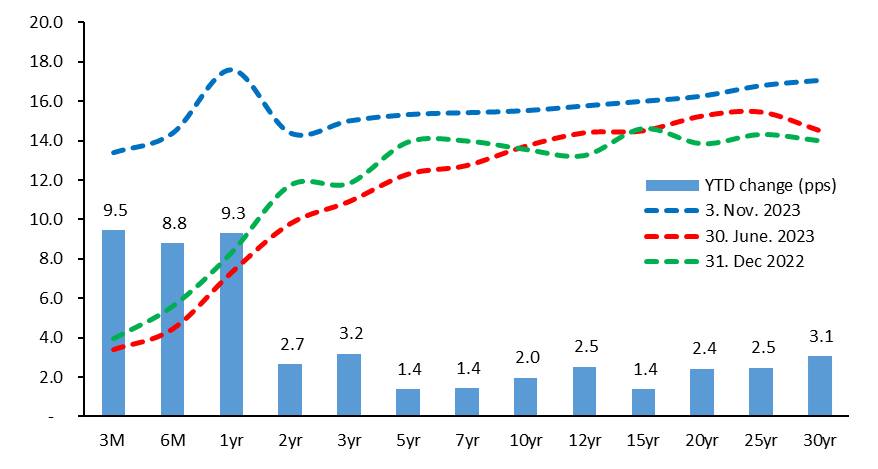
Naira yield curve sell-off as domestic short-money exits duration: The natural consequence of a normalization in monetary policy is start of a yield curve inversion as short-term rates rise rapidly under pressure of thinning financial system liquidity and heavy securities supply from Nigeria’s monetary and fiscal authorities. Across board, yields are up 417bps from June 2023 with the front-end up over 1000bps with one-year yields now over 17%. FGN bonds which have been quietly selling off through October are not left out of the action but the sell-off is a bit more measured with 150-250bps rises from half-year with the 30-year now at 17%. Newbies will have to brace for impact and there has been frantic selling by short-money and a rush to issue paper by large Nigerian corporates trying to beat the rise in rates. For long money investors who suffered under the weight of Emefiele’s financial repression, this is the proverbial light at the end of the dark negative real yield tunnel.
Figure 2: Naira Yield Curve
Source: Bloomberg
In the week ahead, there are NTB maturities of NGN310billion which means the CBN, on behalf of the DMO, will look to refinance these maturities in an eagerly anticipated auction. Given the fairly large size on offer, yields are likely to reset to over 15% given the SDF corridor, likely higher DMO appetite and the sell-off in secondary markets. Over the rest of the year, the passage of a NGN2.1trillion supplementary budget likely to be financed via domestic borrowings has generated a lot of noise. It is interesting that the executive chose to push this item this late in the year. My sense is this amount has been mostly spent and this exercise is to avoid creating W&M overdrafts as with the Buhari regime. Whichever way one views it. risk-free paper supply is going to rise over the remainder of 2023 and with the auto immune CBN attacks on financial system liquidity, the only way is up for rates along the Naira yield curve. Brace yourselves.
If you would like to receive this every week as well as other posts or you know someone who will find the information on this site useful, you can add your email using the subscribe button below
Discover more from Eco215
Subscribe to get the latest posts sent to your email.