Nigeria Macro Weekly – #2025.02
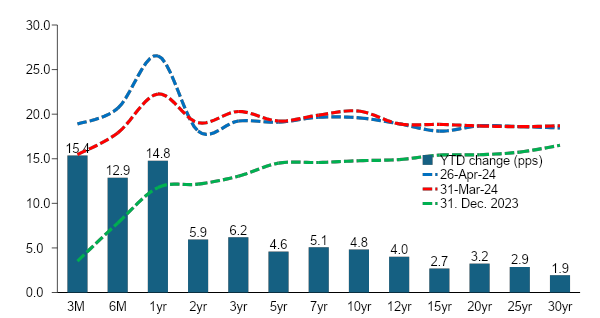
Robust system liquidity drives lower stop rates at the NTB auction, bonds remain bearish: At the fortnightly Nigerian Treasury Bills (NTB) auction, the Central Bank of Nigeria (CBN), acting on behalf of the Debt Management Office (DMO), refinanced NGN530 billion worth of bills. System liquidity remained robust, driving strong demand at the auction, with bids reaching 4.8x the offer. Consequently, stop rates for the 1-year tenor declined to 21.75% (from 22.6%), while rates for the 3-month (18%) and 6-month (18.5%) tenors held steady. Following the auction, the secondary market for short-dated NTBs turned bullish, with yields dropping by 80-90 basis points across longer-dated tenors. However, the bond market remained bearish, likely due to pension funds rebalancing away from loss positions in 2024 and positioning ahead of the upcoming auction for the new 2035 bond issuance.
Figure 1: Naira Yield Curve

Source
Nigeria’s Eurobond yields moved slightly lower over the week ahead of US FOMC: Next week sees the first monetary policy committee meeting of the US Federal Reserve in 2025. Market expectations are for policy rates to remain unchanged. However, recent comments by President Donald Trump about possible rapprochement on the tariffs has supported a slight dip in U.S. Treasury yields. The 10-year Treasury yield dipped by 2 basis points to 4.619%, while the 2-year yield edged lower to 4.266%. Given the relative quiet in US Treasuries, improving perceptions around Nigeria have supported compression in spreads over US Treasuries with price gains sitting around 1% YTD.
Figure 2: Nigeria’s Eurobond yield curve

Source: DMO
Nigeria’s PMI data climbed above 50 in December: Recent data from the Central Bank of Nigeria (CBN) and Stanbic IBTC/S&P Global revealed that the higher-frequency Purchasing Managers’ Index (PMI) climbed above the 50-point threshold, reaching 51 and 52.7, respectively. A PMI reading above 50 indicates economic expansion, while readings below 50 signal contraction. Notably, both indices had remained in contractionary territory for the past 2-3 months. The Stanbic survey, which samples 400 firms, and the CBN’s broader survey, which tracks 1,900 firms, both reported a pickup in new orders, suggesting improving underlying business conditions. This uptick in sentiment appears to be supported by the recent appreciation of the Naira. The takeaway is that Nigeria’s economy may be beginning to recover from the significant price shocks of the past two years. As a result, 2025 growth forecasts, currently projected at 3-3.5%, may need to be revised upward to 3.5-4%.
Nigeria’s external debt: The Debt Management Office (DMO) recently released data on Nigeria’s external debt, which stood at USD43 billion at the end of September 2024, up slightly from USD42.5 billion at the end of December 2023. This increase was driven by fresh borrowings from multilateral agencies. Notably, the DMO excluded the USD900 million domestic Eurobond issuance, which is classified as domestic debt. In terms of debt servicing, Nigeria paid USD 3.6 billion in external debt service costs through September 2024. It’s worth noting that this figure includes principal repayments totaling USD1.9 billion. Following the Eurobond issuance in December 2024, Nigeria’s external debt is estimated to have closed the year at approximately USD 45.2 billion. This represents around 24-26% of the country’s nominal GDP for 2024.
Figure 3: Nigeria External Debt – Composition

Nigeria’s domestic debt surges in 2024, but single-digit W&M securitization appears to be keeping costs trim for now: While external debt trends remained relatively subdued, the domestic debt landscape saw significant activity. According to the Debt Management Office (DMO), Nigeria’s domestic debt surged to NGN69.2 trillion by the end of 2024, marking a 30% year-to-date increase. This rise was primarily driven by an 80% spike in Nigerian Treasury Bill (NTB) issuances, which reached NGN11.7 trillion. The Federal Government of Nigeria (FGN) aggressively ramped up NTB sales throughout 2024 as part of a strategy to attract offshore FX flows. However, this has raised concerns about rollover risk, though I view these concerns as more theoretical than practical in the Nigerian context. Meanwhile, bond debt also grew by 20% to NGN53.2 trillion. In terms of debt servicing, Nigeria paid NGN4.3 trillion in domestic debt service costs during the first nine months of 2024. The bulk of these costs (87%) stemmed from interest payments on bonds. Despite a 20% increase in bond issuances over 2025, the average cost of Nigeria’s bond portfolio remains in the low teens, largely due to the W&M securitization, which was priced at 9%. Domestic FGN debt now stands at 24% of GDP. When combined with external debt service costs, total debt servicing reached NGN 10 trillion. Annualizing this figure against FGN revenue implies a debt service-to-revenue ratio of 62.5% (down from 73% in 2023).
Exchange rate trends remain stable, external reserves slide: The Naira remained relatively stable at the official window, trading at NGN 1,555/USD, supported by Central Bank of Nigeria (CBN) interventions totaling over USD 500 million in January. However, external reserves declined by 1% over the week to just under USD 40 billion, likely due to partial repayment of the Rapid Financing Instrument (RFI) facility obtained from the IMF during the COVID-19 pandemic.
This week marks nearly 80 years since the historic Bretton Woods Conference of 1945, which laid the foundation for today’s international exchange rate system. Initially, the system was based on pegged arrangements relative to the US dollar, which retained gold convertibility. However, advanced economies transitioned to floating exchange rates in the 1980s in response to increasing capital flows and the development of cost-effective institutional mechanisms for hedging FX volatility. Emerging economies, particularly in the aftermath of the financial crises that swept Latin America and Asia in the 1990s, also shifted to floating exchange rate regimes. In contrast, African economies remain an outlier, as the region continues to predominantly maintain fixed or pseudo-fixed exchange rate systems. This is partly intentional and partly reflective of Africa’s limited integration into global trade and capital flows. Nowhere is this more evident than in Nigeria, where another experiment with exchange rate flexibility is currently underway. After abandoning its attempt at pegging the Naira, authorities are not trying to set a floor for the exchange rate, which appears to have overshot its implied REER mean. To do this requires significant external reserves, which authorities have built by taking advantage of a rise in inflation to hike market interest rates to cultivate portfolio inflows. Given the low level of Nigeria’s integration into global trade and capital market flows, the improved external reserve position, in the absence of any negative commodity price shocks speaks to a stability bias in the exchange rate within the NGN1500-1600/$ region.
January 2025 bond auction: At the first bond auction of the year, the DMO would look to sell NGNNGN450 billion bonds split across the FGN 2029 (NGN100 billion), FGN 2031 (NGN150 billion), and the new January FGN 2035 (NGN200 billion), taking a cue from the NTB sale and at the start of the year, demand is likely to be strong heading into the auction, and the DMO is likely to oversell to try to get ahead of another heavy domestic borrowing schedule and in view of the ongoing re-allocation away from the front end of the curve to reduce rollover risks. The return to a 3-offer bond auction vs. the 2-offers in December could see the DMO attempt to re-align the curve to set expectations for the rest of the year. This could see the 2029s set in the 21.50-70 range, the 2031s at the 22% handle, and the 2035s at the 22.4-22.5 handle.
I will close with the phrase. In everything finite, there is a contradiction between its general nature and its particular existence, between its concept and its reality. The task is to reconcile these opposites into a higher unity – Georg Wilhelm Friedrich Hegel
Discover more from Eco215
Subscribe to get the latest posts sent to your email.