
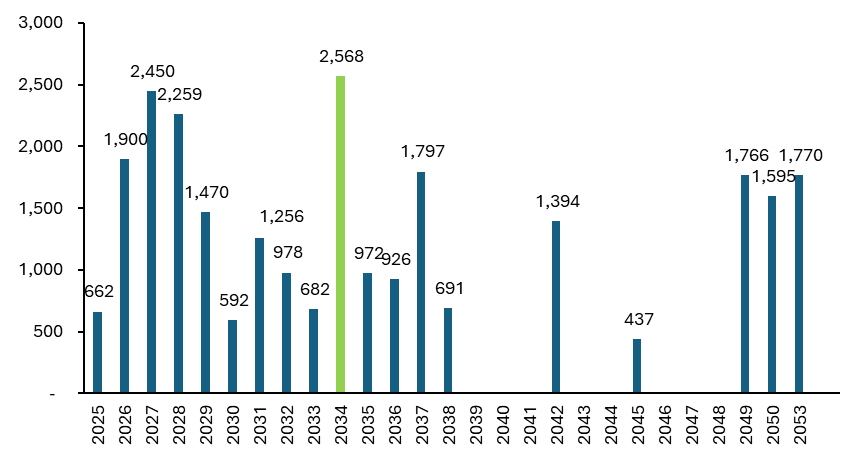
Bond yields rally on short covering linked to potential changes in bond calendar: A bizarre week in debt markets as despite tight liquidity conditions across money markets, bond prices rallied 0.9% w/w driven by sudden declines on the 10yr FGN paper (FEB 2034), where yields fell nearly 60bps midweek to 19.4% before retracing to 19.63% at the close of the week. The drop in yields appears to have stemmed from a short squeeze on the 2034s following speculation that the DMO was likely to discontinue the paper from regular issuance next month. This reflects concerns that total issuance maturing in 2034 had hit NGN2.5trillion, a threshold thought to be some sort of ceiling on annual bond sales maturing in a particular year. Whether such a ceiling actually exists is a different matter, but this realization appears to have spooked significant short covering in the tenor with the knock-on effects on the rest of the curve. Markets retraced by the end of the week as sellers appeared to provide the shorts with paper to cover.
Figure 1: Annual Bond Maturities
Source: DMO
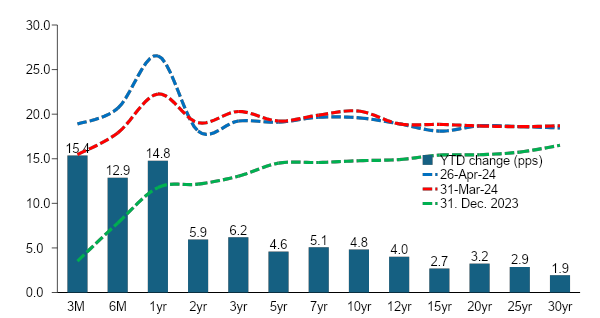
NTB yields remain unchanged as demand moderates in the face of tight liquidity conditions: At the primary market auction (PMA) where the Central Bank of Nigeria (DMO), on behalf of the DMO, looked to sell NGN143billion worth of Nigerian Treasury Bills (NTB), demand was softer than at prior auctions with bids 5.3x the offer (vs. 12x at the last auction). This moderation provides some support to the argument that offshore investors are starting to lose faith in the Nigerian carry trade following the downturn in reserves. In terms of stop rates, the auction closed as follows: 3M 16.24% (unchanged), 6M – 17.00% (unchanged) and 1yr – 20.70% (unchanged).
Figure 2: Naira Yield Curve
Source: FMDQ
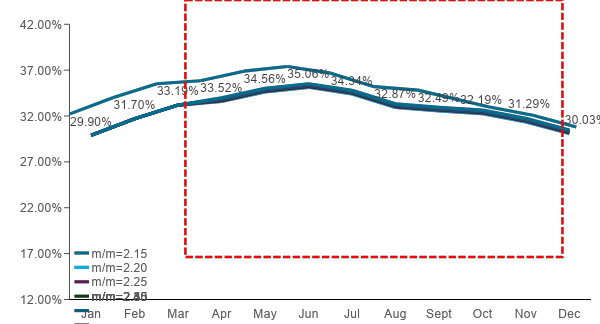
Inflation climbed further in March, but monthly trends slowed: Headline inflation continued to rise in March, climbing to 33.2%, up from 31.7% in February. This upswing reflects adverse base effects as monthly trends showed that inflation slowed to 3.02% from 3.12% in February. Looking at the components, food inflation accelerated to 40.2% while core inflation came in at 25.9%. On a monthly basis, food inflation declined 16bps from February in line with farm produce prices suggesting some retracement following Naira stability over March. This coincides with moderation in diesel prices following the onset of sales into the local market from the Dangote refinery, where a change in regulation regarding sulfur content permissible within Nigeria is likely to temper the more volatile trends associated with diesel prices. Over the month, it was reported that the Nigerian Midstream and Downstream Petroleum Regulatory Authority (NMDPRA) has reduced the minimum sulphur content for diesel products imported into Nigeria from 1000ppm to 200ppm. This pulls the rug from the feet of diesel importers as Dangote Refinery has obtained an exemption for its own product with a 700ppm sulphur content. The development radically switches pricing of diesel away from these importers who benchmark the price to parallel market spot rates towards Dangote refinery where trends are more likely to reflect a mixture of crude inventory and exchange rates. In recent weeks, Dangote Refinery has been cutting its own diesel prices which sets the stage for sticky trends in transport and food prices which could translate into a downtrend in monthly inflation trends though this is conditional on exchange rate trends. Overall, the sense is that inflation is likely to enter a sluggish pattern between 33-35% with a peak in June after which base effects set the stage for inflation to head down towards 30%. The caveat being that the CBN is able to keep the Naira within the NGN1000-1500/$ corridor.
Figure 3: 2024 Headline Inflation: Actual and Forecast
Source: NBS, Author’s calculations
External reserve declines sprinkle doubts over Naira outlook: After paring back losses over March, the Naira reversed course last week with a 12% drop across the official segment to NGN1339/$ and with the parallel hovering around NGN1400/$. This follows a pick-up in bearish sentiments from offshore investors mirrored across parallel markets which subsequently induced the CBN into interventions. It would appear that the new source of sellers are foreign portfolio investors looking to either bank profits from the 2-month long Naira carry trade or risk triggers going off following the drop in Nigeria’s external reserves. Nigeria’s external reserves are hovering at $32.1billion, down 2% YTD and 5% from the $34billion peak announced in February, despite higher oil prices and purportedly large foreign portfolio inflows. Though the CBN governor would later state that the downtrend reflects outflows linked with debt service payments, the reserve metric is a key flashing sign for risk departments of large foreign asset managers and declines towards trend lows are likely to trigger a sell signal for liquidating exposures within frontier markets.
Essentially, Nigeria’s strategy of relying on portfolio flows to stabilize FX markets is facing its biggest test despite all the technical adjustments pushed by the CBN over Q1 2024. Having front-loaded the large painful adjustments in policy to the currency markets, it is pertinent for Nigerian authorities to directly engagement with multilateral financiers pending when the encumbrances on oil exports clear up to allow for FX reserve accretion. Curiously, the finance minister announced that Nigeria was in the process of obtaining a fresh World Bank concessional loan facility in the USD2.25billion region. In approaching the World Bank, who have approved several facilities to Nigeria in recent years though Nigeria has been unable to meet the terms for drawdowns, it would appear that the idea that the resources required to solve the current FX quagmire are internal is on a weak footing. In a sense, absent a resurgence in oil production to over 2mbpd in the face of presently high oil prices, it would be difficult to imagine a scenario where Nigeria does not either eventually issue a large Eurobond or approach the IMF to solve ongoing issues. Pending when authorities come to this realization, we might continue to rely on punitively high interest rates to cultivate portfolio flows. Essentially the solution to the problem will have to come from the fiscal side and the present monetary approach is amounts to playing for time.
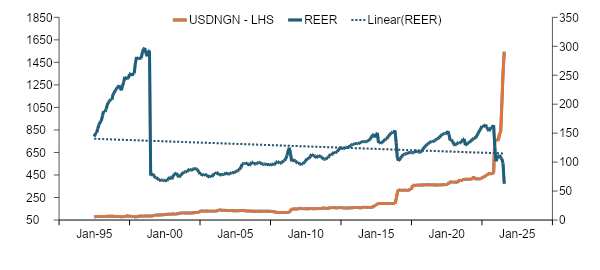
Fundamentally, the Naira now appears in deep value territory looking at latest data from Breugel updated through February 2024 which suggests a 14% undervaluation in the spot rate from the long-run trend implied using REER data.
Figure 4: Naira/USD: Nominal and REER
Source: CBN, Bruegel
In the week ahead, focus shifts towards the FAAC inflows next week but bond markets remain trapped under the spell of heavy paper supply as the FGN looks to support CBN plans to bolster NGN by offering high yields on government securities. Though the peak level in yields is driving bullish sentiments, it is important for domestic investors to realize that offshore investors remain a fickle crowd with a hand on the trigger to sell paper at the slightest news. This means paper supply could be a worry across primary and secondary debt markets. Inflation is likely to remain elevated in the near term though in a sluggish pattern before yielding to base effects in H2 2024. Policy will remain restrictive over the year until the dark clouds over the Naira blow away.
Good to be back!
Discover more from Eco215
Subscribe to get the latest posts sent to your email.