
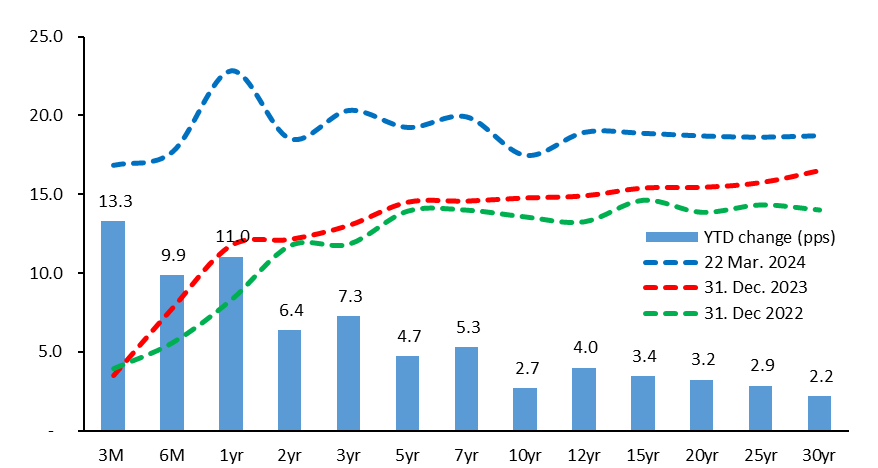
NTB yields as CBN switches to carry trade policies to stabilize the NGN: Thus far in 2024, the front-end of the yield curve has seen a strong repricing as paper supply as been heavy along the segment driven by the elevated issuance of NTB instruments by the CBN, on behalf of the DMO. Relative to NTB maturities of NGN1.6trillion, NTB sales are running at NGN4.45trillion which likely reflects the cessation of Ways & Means financing by the CBN. This implies that fiscal liquidity needs which are likely to be heavy at the start of the year given the uneven revenue profile are now going to be financed via the market in the form of short-term borrowings. OMO issuance has also been heavy at NGN2.1trillion as the CBN has sought to position Nigeria as the best carry trade destination in the world to cultivate much needed foreign portfolio flows to shore up the currency. This has pushed NTB yields from single digit levels in January to effectively around 19-27%.
Bond yields hit fresh highs at the March 2024 auction, push higher at private sale: At the monthly bond auction, with NGN450billion worth of bonds on offer, the Debt Management Office (DMO) sold NGN608billion at average clearing rate of 20.1% (February: 18.75%). Bond markets were further left stunned two days after the monthly auction by the announcement of a private bond auction of NGN2.4trillion in 2–4-year amortizing bonds at an issue yield of 21% to banks. It would later emerge that on CBN urging, Nigerian banks placed around USD2billion in swaps in exchange for high yielding Naira instruments which was the objective of the private bond auction. This is a departure from the historic norm of using OMO bills for the Naira leg of these dollar swaps, which likely suggests balance sheet problems limited the CBN’s ability to sell such instruments. In all, the heavy supply of bond paper has worked to push bond yields higher with yields along the curve up 600bps YTD to a range of 16.8-20%. Over Q1 2024, the DMO has sold NGN2.5trillion worth of bonds (net of bond maturities: NGN1.8trillion).
Figure 1: Naira yield curve
Source:
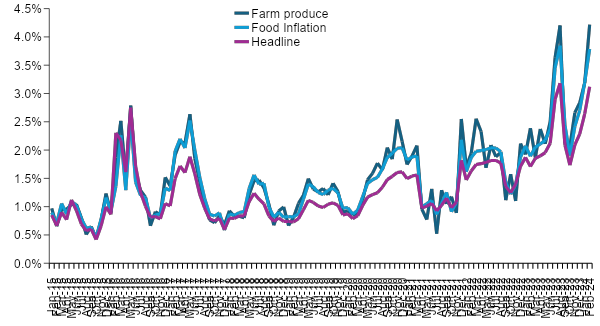
Inflation surges to 28-year highs, driven by a mix of Naira weakness and soaring energy costs: Headline inflation maintained its uptrend with the NBS February 2024 print at 31.7% up from 29.9% in January. Most inflation forecasts projected headline running hot towards 35% with a peak in June-July before a retracement into the mid-20s level over H2 2024. However, the passthrough effects of fresh Naira turmoil over February (down **%) via its effect on food and energy costs suggests a higher ceiling for inflation over 2024. Monthly inflation climbed to 3.12% (January: 2.64%) largely driven by food inflation (3.8%) with core inflation at 2.1%. The run-up in food inflation was underpinned by higher farm produce (+4.2%), which is a sub-index that tracks the price of domestically produced foods in Nigeria. Farm produce is the key component of food inflation and the urban component ran hot (+4.9%) in February with rural farm produce running at 3.6%. This differential is pretty large and potentially reflects two factors. Firstly, with diesel prices now running at +50% relative to 2023 levels, the cost of transporting items from the rural production regions to the urban consumption regions is more expensive. Secondly, is potentially via the trade channel, where Naira weakness relative to the CFA Franc of Nigeria’s neighbours is driving higher export prices which is forcing domestic farm produce prices to re-set higher. This is consistent with economic theory as Naira depreciation is driving higher exports towards our Neighbours who have received a huge price discount on Nigerian items as they hold the strong Euro-pegged currency. This trade channel has presumably informed a wave of crackdowns on exports to these neighbours.
Figure 2: Monthly Headline, Food and Farm Produce Inflation
Source: NBS, Authors calculation
Looking ahead, higher interest rates and improving USD liquidity within the formal sector suggests that the Naira should retrace in the coming months from the low reached in February. However, the inventory effect means that price cutbacks are unlikely in the near term until authorities are able to stabilize the exchange rate. My updated forecasts sees inflation running towards 35-36% in the June-July period before closing the year around 30%.
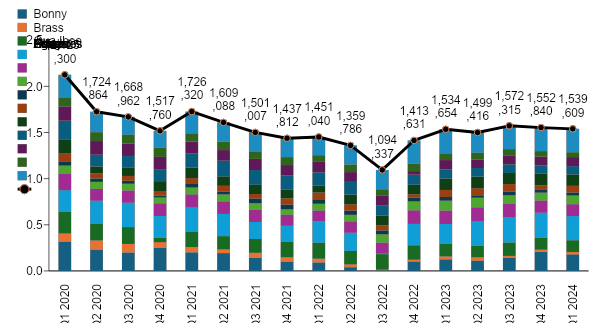
Sluggish trends in Nigeria’s oil production: The NUPRC put out data on Nigeria’s oil production which showed that oil output average 1.54mbpd in February (down 6% from January) but in line with the 1.5-1.6mbpd range over the last few months. The key pressure points over the month was along the Bonny terminal (-20% to 179kbpd) and long-standing issues at Brass where output remains 70% below 2020 levels. Though much of dominant narrative tends to associate Nigeria’s ongoing production headaches with theft, my thinking is that this effect is exaggerated. Unlike in prior episodes, Nigeria is struggling to get out put back to the 2mbpd region which would suggest other more structural factors at work. For example, some of the weakness stems from a group of offshore fields (Usan, Erha, Bonga, Egina, Agbami and Akpo) which account for around 37% of production using February 2024 data but where output is down some 30% from 2020 levels. This has nothing to do with theft but reduced IOC investment. Following the passage of the long-delayed petroleum industry act in 2022, the lukewarm posture towards investing in Nigeria by the IOCs and the raft of divestments points to a secular decline in oil production if not met with renewed political rapprochement. It’s time to directly engage with the IOCs to invest in Nigeria’s oil and gas sector. It’s the easiest FDI win the government can achieve and can solve short- and medium-term external account problems at least cost.
Figure 3: Nigeria’s oil production by field
Source: NUPRC
Naira depreciation continues to flatter trends in monetary aggregates via translation impact: Money supply data from the CBN showed that the key monetary aggregates M2 and M3 grew at a YTD annualized run rate of 115% and 123% through February 2024 to NGN93.9trillion and NGN95.3trillion respectively. A brief technical exposition: In Nigeria M3 is the key monetary aggregate defined as M2 (broad money) and CBN bills while M2 is defined as M1 (Narrow money) + quasi-money (defined as time and savings deposits). M1 itself is defined as currency outside banks + demand deposits while M0 (base money) is defined as currency in circulation plus bank reserves and CBN special intervention reserves.
Over the period, the return to aggressive open market operations by the CBN which saw it issue around NGN1.6trillion in bills which accounts for the difference between M2 and M3 growth. So, what is driving the big expansion in M2? From the definition above, it should be the sum of the trends across M1 and quasi-money where the former grew only 3% to NGN30.2trillion over the period while the latter accelerated at an annualized pace of 184% to NGN63.7trillion through February 2024. Are Nigerian banks suddenly better mobilizing deposits? This is unlikely its more likely that the jumps reflect the translation effect of FX depreciation in the reporting of USD deposits in Naira. Latest CBN data on USD deposits places the item at USD22.2billion or 44% of banking sector deposits as at the end of September 2023. Another plausible factor, though to a lesser degree, is the impact of larger FAAC inflows which gets parked into deposits.
Figure 4: Trends in Growth Rates of Selected Monetary Aggregates

Source: CBN
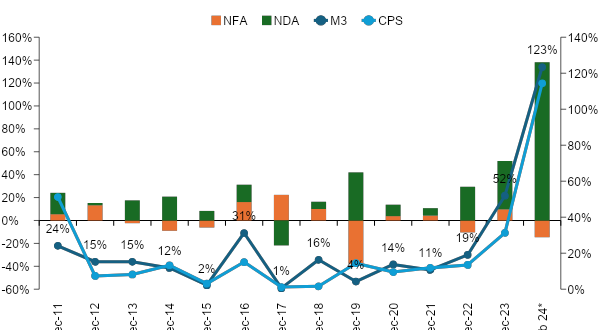
Another way of interpreting money supply trends is to use the structural variables of net domestic assets (NDA) and net foreign assets (NFA) which are down 21% to NGN7.7trillion from the end of December 2023 while NDA is up 156% at an annualized pace through February 2024 to NGN88.1trillion. NDA is made up of two components credit to the private sector (which mirrors developments on the deposit side) and credit to government. CPS is running at an annualized rate of 176% through February 2024 to NGN80.9trillion while credit to the government is at sprinting at a paltry 7% pace (flattish from December levels) to NGN33.9trillion. In effect private sector lending is the main driver of growth. However, this again likely reflects the flattering impact of Naira depreciation on USD loans within the banking sector, in lock-step with the trends on the deposit side of things. In summary, run-away naira depreciation is the key driver of the heady growth in money supply. It would be better for the CBN to include a measure of money supply growth which strips out FX effects to help it better situate the argument on tightening as from this analysis its clear Naira depreciation is the main driver of the current expansion in money supply and not the other way around.
Figure 5: Trends in Growth in Selected Monetary Aggregates – Structural Decomposition
Source: CBN
Naira stabilizes on increased portfolio flows into official FX markets, Naira undervalued: The Naira pared back losses against the dollar in March with a 10% gain in the last week to sub NGN1400/$ levels within the official section thanks to improved USD liquidity and CBN interventions within the NGN1300-1400/$ corridor. Given the higher interest rates on offer, Nigeria has become a carry-trade destination again with foreign portfolio investors. The improved liquidity within the interbank along with the resumption of sales to BDCs has worked to take pressure off the parallel market where the NGN has appreciated in line with the official segment. In REER terms, Bruegel data puts the Naira under 100 (96) at the end of January 2024 for the first time since 2007 which implies under-valuation territory. Nigeria’s external reserves have recovered largely driven by swap arrangements and portfolio inflows as there has been unusual silence in CBN press releases about oil inflows. This would suggest that these export flows remain encumbered. In all, while Nigeria is stabilizing the FX via carry trades, these are essentially stop-gap measures while larger moves take place in the background. An external program perhaps or recovery in oil flows? The latter is unlikely as with petrol prices stuck at NGN650-680/litre levels, the NNPC is likely engaging new financial engineering to manage prices that is mortgaging more export dollar receivables. Nigeria needs to find a way to have foreign financing arrangements as carry trades will need to unwind at some point.
March 2024 MPC meeting: Nigeria’s central bank commences its two-day policy meeting today and expectations are for another rate increment in the aftermath of the record 400bps increment in February. Looking at the minutes of the February 2024 MPC meeting, one can see signs of strong CBN coordination in member statements especially on the downward adjustment of the SDF rate to -700bps. The entire meeting appeared coherent except on this point whose inclusion and the relative agreement suggests it was an idea sold by the CBN to the non-insiders. There is no difference between using Open Market Operations and discount windows to execute monetary policy as both achieve the same objective. In the Nigerian case, the interest costs associated with OMO sales which the CBN sold at effective yields of 27% in the week after the MPC is less than that associated with SDF facilities at 15.75%. this is the only reason for the asymmetry which was given away by Deputy Governor Emem Usoro: the CBN was trying to manage the costs of liquidity management. In essence, while the CBN went all out to signal tightening with the rate hikes, it was clear-eyed enough to want to keep a cost on the cost of sterilizing banking sector liquidity which would be heavy via the SDF. It perhaps is also indicative of what we already know about Nigeria’s monetary policy rate: it is largely meaningless as a measure of the actual adjustments required to deliver interest rate adjustments. Unlike other central banks, the first problem the Nigerian central bank has to grapple with is excess liquidity arising from life under a regime of fiscal dominance. This means curtailing the liquidity level and it defacto defines the monetary policy posture and as well as the level of market rates. In terms of instruments, preference under this setting will be for low-cost approaches like the CRR as against expensive OMO and symmetric discount windows around some base rate. Essentially, this makes other policy instruments merely symbolic except those which directly sequester liquidity. Thus, to be credible, Nigeria’s central bank will need to hike the CRR further though at 45% one wonders how much headroom remains. At some point the CBN will need to jettison the liquidity ratio requirement as its now clearly another meaningless toolkit. What is the point of a 30% liquidity ratio with CRR closer to 50%.
What do I think the MPC will likely do? Historically, Nigeria’s central bank tended to adopt an inert stance in the meeting following one in which there was a significant policy action except during crisis times. This would suggest a hold at this meeting. But Mr. Cardoso has shown himself be a different man with his own approach. As such my sense is another hike (+225bps) to get to 25% with likely re-adjustments to the corridor to a symmetric one to appear credible to foreign portfolio investors who seem to be his key audience in the current environment.
Goodbye Herbert Wigwe: Nigeria and indeed Africa lost something on February 10, 2024. That day, time stood still as everyone struggled to accept that the force of nature known as Herbert Wigwe had departed this world in a helicopter crash alongside his wife and son. Herbert was a strong believer in Nigeria and Africa. In a fireside chat last year in Lome, Togo, I watched him give an insight into what drove his desire to create a global African financial institution. He stated that the absence of a truly African financial entity meant that as Africans, very often we were left at the airport tarmac due to some random rule change by global financial regulators that often cut us off from global finance in a negative non-random way. You could be a well-run business prevented from transacting globally simply because of your country of origin. Most non-African financial service firms would hastily move to embark on wholesale shut-out of Africans as a risk management strategy to avoid running fowl of sanctions. Herbert’s vision was to create an African financial powerhouse that would not blanket discriminate against Africans in a bid to align with these arcane rules that were really designed by Westerners as part of the fabric of global geopolitics and not really about fighting criminal activity. This was his dream and he worked tirelessly to get this done at breathtaking speed. I close with this quote by Martin Luther King, which I believe captures the persona of the man, “We are now faced with the fact that tomorrow is today. We are confronted with the fierce urgency of now. In this unfolding conundrum of life and history, there “is” such a thing as being too late. This is no time for apathy or complacency. This is a time for vigorous and positive action.”
Discover more from Eco215
Subscribe to get the latest posts sent to your email.