
Build-up in financial system liquidity drives a bull steepening of the Naira yield curve in August: After surging over the first seven months of 2024, interest rates across the Naira yield curve turned south in August, with yields tumbling 120 bps over the month. The compression reflected declines across the front-end (down 260 bps), belly (down 25 bps), and long end (down 112 bps). The dis-inversion in part reflects hints about lower borrowings by the fiscal side, after the Debt Management Office’s (DMO)’s offer circular for August 2024 showed a drop in planned bond sales for the month to NGN190 billion (July: NGN300 billion), even though the DMO would actually sell more (NGN375 billion) at the mid-month auction. However, the move seemed to spark bullish sentiments in bonds as the DMO for the second consecutive month elected to net-redeem NGN450 billion in T-bill maturities in August, larger than the July net repayment of NGN259 billion. The liquidity release from the NTB segment alongside elevated FAAC distributions created a liquidity deluge within the financial system. Completing the dovish influences on interest rates was the double barrel circular releases by the CBN on activities within its discount windows. As we shall see, the market interpretation of these circulars is that by and large they indicate a shift in CBN posture away from the hawkish rhetoric that has been in place for much of 2024. Given that inflation, which declined for the first time in over 19 months, remains well above CBN targets over the next 12-months, it would appear that this new circular more directly reflects the old CBN headache about the punitive costs of liquidity management.
Figure 1: Naira Yield Curve

Source: FMDQ
CBN emits dovish signals with SDF circulars and OMO auctions: Amid a liquidity build-up in financial markets, the Central Bank of Nigeria (CBN) issued two circulars on August 26 regarding the operationalization of its standing facilities. The CBN employs a corridor approach in its monetary policy, where it signals its expectations for short-term interest rates relative to its policy objectives. This framework is anchored by the Monetary Policy Rate (MPR), which serves as the base rate, and is flanked by two standing facilities: the Standing Deposit Facility (SDF), where banks park excess reserves, and the Standing Lending Facility (SLF), where banks borrow to cover deficit positions. In theory, market interest rates (such as interbank and treasury bill rates) are expected to remain within this corridor. These rates, in turn, influence other key variables, such as the money supply and exchange rates, which are central to achieving price stability. This corridor approach is also used in Ghana.
Now, turning to the CBN circulars: the first circular effectively announced the reopening of its lending window, which had hitherto been sort of closed to banks. The second circular, more significant for Nigerian interest rates, introduced a cap on the excess balances banks can hold within the SDF. As noted earlier, the SDF is a discount window where banks deposit excess reserves and earn interest, currently set at MPR minus 100 basis points (25.75%).
The new circular establishes a daily cap of NGN3 billion per bank on the amount of excess reserves that can be deposited in the SDF at the standard rate. Any balances above the NGN3 billion threshold will earn a lower interest rate of 19%. Given that Nigeria has 26 commercial banks, 6 merchant banks, and 4 payment service banks, this cap effectively limits the CBN’s total daily remuneration at the SDF rate of 25.75% to NGN108 billion. For context, average daily SDF balances in August were around NGN336 billion, and on the day the circular was issued, the balance was NGN626 billion. In effect, the CBN has lowered the rate on SDF deposits exceeding the cap to 19%, reducing the incentive for banks to park large amounts of excess liquidity at the SDF. In practical terms, banks will deploy excess bank reserves into short-term securities above 19% until the front-end of the curve plummets to an effective yield of 19%. Under an atmosphere of declining fiscal securities issuance, the implication is that the entire yield curve could potentially compress well below where the CBN’s official posture for interest rates are. The day after revealing the SDF circular, the CBN proceeded to conduct an OMO auction wherein it reduced the effective yield on the 1-year tenor to 26% from 28% previously. The reduction in OMO yields and kinking of SDF discount rates was interpreted by the market as effectively dovish signaling hence the fall in interest rates. Given that the most optimistic near-to-medium term inflation outlook remains elevated (25-30%) relative to trend levels (12-13%), the leg-down in interest rates appears premature if the CBN intended for this.
Figure 2: SDF and NTB Rates

Source: CBN
There are two plausible reasons why the CBN chose this approach. First, the argument that the CBN aims to encourage banks to lend can be easily dismissed, as the current objective of tightening monetary policy is to prevent lending. If the CBN were to push this argument, it would result in a significant loss of credibility. The more likely explanation is that the CBN is attempting to reduce sterilization costs at current interest rate levels. While central banks are not profit-driven, in African frontier markets, there is an implicit expectation that losses will not be politically tolerated. It seems the CBN has reached a point where it can no longer bear the costs associated with sterilizing excess liquidity.
The two-tier approach to SDF management will erode the CBN’s ability to credibly manage market interest rates. History offers a clear example: In 2016, the former CBN governor imposed a cap of NGN7.5 billion (later reduced to NGN2 billion) on SDF balances, with excess balances earning zero interest. This move was a precursor to the CBN’s descent into monetary unorthodoxy—a stance the current leadership has worked hard to correct.
So, how can the CBN tackle the challenge of sterilizing liquidity while still maintaining control over short-term interest rates?
- Re-introduce a Two-Tier CRR Regime for Public and Private Sector Deposits:
During the tenure of Sanusi Lamido, the CBN introduced a two-tier Cash Reserve Ratio (CRR) system, with a higher CRR on public sector deposits and a lower one on private sector deposits. This innovation allowed the CBN to sequester excess public sector liquidity (mostly from FAAC allocations) at zero cost, while managing private sector deposits at the regular CRR level. Given the CBN operates under fiscal liquidity dominance, which makes market-based liquidity management costly, this approach would allow for more credible liquidity control while still influencing short-term interest rates. - Adopt a Danish-Style Aggregate Target for SDF Balances:
Another option could be setting an aggregate target for daily SDF balances, similar to what is done in Denmark. Under this approach, the CBN could tolerate daily SDF balances up to a certain level, with any excess automatically rolled into OMO instruments of a target maturity. While this doesn’t resolve the cost issue, it maintains the integrity of market mechanisms and avoids distorting rates. The current approach, which combines a kinked SDF rate with occasional OMO issuances above 19%, is disruptive.
Of the two approaches, the first—reintroducing the two-tier CRR regime—is superior to the kinked SDF approach. It allows CBN to manage liquidity at a lower cost while regaining control over short-term rates. The second approach is more suited for periods of relative market calm, where the need to curb liquidity is less pressing. In the current environment, allowing interest rates to fall could have negative consequences for the exchange rate, which is again testing the NGN1600/$ level.
High CRR requirements are not uncommon in emerging/frontier markets where interest rates are elevated and under scenarios where central bank balance sheets are asset driven. It’s a standard tool in monetary policy operations. The SDF kinking, however, risks allowing a buildup of fiscal liquidity, amplified by a weakening naira, to push interest rates below the MPR corridor, undermining all the credibility the CBN has sought to build over the last 12 months.
Oil continues to support economic growth: The NBS reported that Nigeria’s Q2 2024 economic growth quickened to 3.2% relative to the 3% reported in Q1 2024. Looking at the data, growth was largely powered by the robust expansion in the oil sector (+10.2%) relative to the non-oil (+2.8%). Nigeria’s oil production has climbed to 1.5mbpd relative to 1.3mbpd in Q2 2023. On the non-oil side, growth was hampered by soft trends across agriculture (+1.4%), manufacturing (+1.9%) and trade (+0.7%) though services grew by 5% on account of ICT (+5.2%) and financial services (+29%). Assuming oil output steadies around the 1.6-1.7mbpd guidance from the NNPC, then Nigeria is on track to muddle through to an annual expansion of 3.3-3.4% in 2024 (2023: 2.7%).
Figure 3: Nigeria GDP: Sector Decompositio

Source: NBS
Money supply growth remains elevated, evidence of strong capital flows? CBN released data on Nigeria’s monetary aggregates through July 2024 which showed that money supply growth remained strong with annualized growth of 59.6% and 58.4% across M2 and M3 respectively. Much of the momentum appears driven by net-foreign assets (annualized: +442%) relative to net domestic assets (NDA) which is running at an annualized growth rate of 7.15%. In terms of credit growth, though lending to the private sector remains appears high (+35% to NGN75.5trillion), this largely reflects translation effect of Naira depreciation on USD loans within the banking sector as against organic loan growth. The data also shows a drop-in public-sector lending (-74% to NGN19trillion) though this likely reflects offsetting impact of the Ways and Means Securitization. Evidence of the impact of CBN tightening can be seen in the low growth in base money (+5.7%) which leaves the high expansions observed across quasi-money (+78%) as the main drivers of growth. Indeed, when one looks at the aggregate expansion in QM over 2024 (+NGN22trillion) relative to NFA growth (+NGN24trillion), it would appear that large capital flows (portfolio flows and remittances) attracted to the high interest rates have been central to the uplift in money supply. This is consistent with the growth in Nigeria’s external reserves over the period.
Nigeria domestic dollar bond sale: Nigeria’s long discussed debut domestic dollar bond sale commenced in mid-August, with funding expected to close by the end of this week. Initial indications suggest the offer, set at USD500 million, is likely to be oversubscribed, potentially reaching USD1 billion. Despite early skepticism (myself included), it appears the Nigerian government has successfully mobilized its financial institutions to redirect idle dollars—previously held in zero or low-interest arrangements—into a 5-year bond offering a 9.75% yield. According to the latest data from the CBN, USD deposits within the Nigerian financial system amounted to USD20.7 billion at the end of March 2024, mostly held by non-financial corporations and residents. The relatively high coupon, set at a spread of +600 basis points over US Treasuries, seems to have attracted both retail and institutional investors. The apparent success of the sale underscores the substantial pool of idle dollars within the Nigerian financial system. Perhaps more intriguing, however, is the broader implication of this Eurobond issuance for Nigeria and, potentially, for Sub-Saharan Africa (SSA). Historically, Eurobond issuances have been tied to global financial centers in Europe and the U.S. A successful domestic sale in Nigeria could open the door to a new market for SSA sovereigns and corporations. This shift means issuers may no longer need to engage with European and American judicial systems, which can be challenging and often perceived as biased against African entities. If Nigerian regulators seize this opportunity, they could position Lagos as a new hub for SSA Eurobond issuances, unlocking significant potential for the region.
CBN conducts RDAS FX auction, resumes BDC allocation: the end of floating? The Naira came under renewed pressure at the official and parallel markets where both rates closed at NGN1593/$ and NGN1660/$, down 32% and 27% from the start of 2024. The fresh weakness induced another CBN intervention sale to BDC operators at NGN1580/$ at the end of last week. In August, the CBN also announced after a nine-year hiatus, a retail Dutch Auction System (rDAS) sale of USD876million at NGN1495/$. The return to rDAS, which was re-introduced by Joseph Sanusi in July 2002 after debuting in Nigeria in 1987 and during short-lived spells over the 1990s suggests that the CBN is either starting to harbour some doubt regarding the efficacy of the current Naira free float experiment or more that the apex bank is now in a position (given rising FX reserves) to directly intervene to stabilize the exchange rate and set a floor for Naira weakness. From a fundamental perspective, the Naira, at current levels across the official and parallel markets, appears undervalued looking at the level implied from the long-run REER average (NGN845/$) and is very close to the weakest level implied by REER (NGN1702.72/$). Market failure is a real problem in the presence of poorly developed markets and currencies can overshoot their PPP implied levels.
In developed markets, the supply of foreign exchange is pluralistic in nature, involving numerous agents such as large banks, institutional asset managers and multinational firms. In this environment, many buyers and sellers meet, often through phone calls or trading platforms, to exchange currencies and the equilibrium conditions for a market determined exchange rate is an optimal solution. This situation contrasts sharply with what obtains in Nigeria, where there are many buyers but there is essentially one dominant supplier of FX who is large relative to other individual FX suppliers by design. By law, the CBN centralizes Nigeria’s oil export proceeds, which allows it to dominate the market and even more importantly the CBN is the regulatory arbiter of the FX market with significant influence on the actions of other agents. This dynamic of a domineering influencer shifts the Nigerian FX market from the classic free market of many buyers and many sellers to one where there is a single powerful player who can effectively frame conversations around price. For years, this was the case and CBN determined the Naira clearing rate through explicit declarations or auctions. Since the FX market was historically heavily reliant on CBN liquidity—primarily sourced from oil revenues—any decline in oil prices weakens the CBN’s position as it increases the likelihood of a devaluation, triggering speculation, currency substitution, and arbitrage. Under a liberalized capital account system as presently obtains, large players within the financial system who possess greater access to information about actual FX market conditions, having zero penalties or costs associated with taking short positions against the Naira can force a correction in market pricing. Given the conditions of market failure already in existence, this guarantees that exchange rate trends are more often than not tilted towards the downside. (there is probably an argument here for justifying windfall taxes on FX profits, but I will leave that for now). In all, the experience of the last 15-months provides firm evidence that Nigeria does not possess the institutional requirements to credibly anchor the exchange rate under a freely floating exchange rate regime.
Figure 4: Naira Exchange Rate: Nominal and Real

Source: Bruegel, CBN
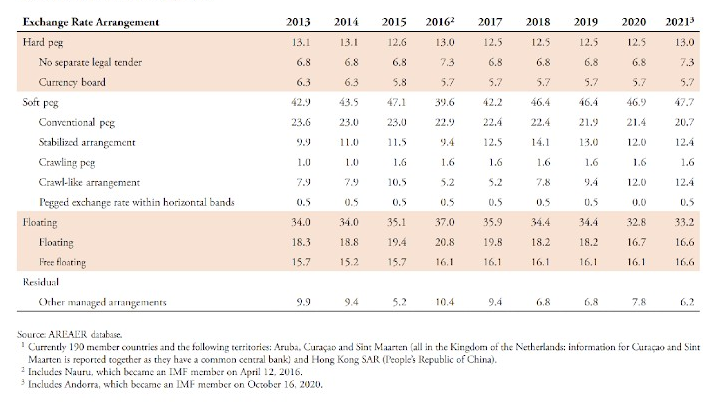
In a seminal paper on exchange rate systems, the authors Calvo and Reinhart (2002) contend that “countries that say they allow their exchange rate to float mostly do not”. Indeed, the experience in Africa is telling as declarations of floating tend to coincide with plans by countries to obtain financing from the IMF. In other words, without the pressure of a currency crisis and its political implications alongside the prospect of cash from the IMF, these countries would never countenance floating their currencies. On the other hand, the standard medication from Bretton Woods is to float likely out of fear of being seen to be externally dictating a level for the currency to adjust. Indeed, in the latest Annual Report on Exchange Arrangements and Exchange Restrictions (AREAER, 2021), the dominant exchange rate regime is a soft-peg or dirty float arrangement wherein countries seek to anchor their exchange rates through a mix of stabilized arrangements, crawling pegs or banks.
Figure 5: Extract of IMF AREAER 2021
To understand the drivers of currency systems, one must consider the historical backdrop. After WWII, the fixed exchange rate system replaced the gold standard as the dominant FX regime globally, establishing fixed exchange rates between countries while the U.S. dollar-maintained convertibility to gold. Under this system, exchange rate adjustments were traditionally driven by balance of payments (BOP) surpluses or deficits. In theory, countries with deficits were expected to devalue their currencies, while surplus countries were to appreciate theirs. Post war, the primary driver of the balance of payments was transactions in goods and services, or the current account. However, with growing global financial integration, capital flows soon surpassed current account transactions, becoming the dominant driver of BOP adjustments.
The scale and speed of capital and financial account transactions, combined with deeper financial globalization, made it increasingly difficult for countries to maintain fixed exchange rates without rapidly depleting their reserves. Additionally, the development of deep, liquid derivatives markets enabled large corporations and individuals to hedge against currency volatility at reasonable costs. This is significant: according to the latest data from the Bank for International Settlements (BIS) triennial survey on global FX market turnover, hedging activities now account for more than half of global FX market activity, led by swaps (49%), forwards (14%), and options (5%), with spot transactions making up 33%. This combination forms the foundation for de facto (though not always de jure) floating currencies. As a result, the currencies of advanced economies have largely evolved into floating exchange rate regimes. Thus, floating exchange rate regimes are typically found in highly integrated, open economies where capital and financial account transactions dominate BOP dynamics. These economies also benefit from liquid institutional hedging mechanisms, which help mitigate FX market volatility.
In contrast, emerging and frontier market economies, which are not integrated into global capital flows and where BOP transactions remain dominated by current account flows will naturally struggle to implement true floating exchange rate systems. Announcements about adopting floating exchange rates in these markets frequently prove to be short-lived, even in periods of relative calm. Without the necessary conditions, these economies tend to operate under managed floats or peg their currencies to provide stability. Do IMF and World Bank economists misunderstand this reality when they consistently advocate for floating exchange rate systems by default? I believe they are fully aware of the institutional weaknesses that make floating exchange rates impractical in many frontier market economies. Instead, their advocacy for floating regimes often serves as a safeguard/cover against accusations that the IMF imposed large devaluations as a precondition for lending. By advocating those economies float their currencies instead, the IMF/WB are well aware that the initial ‘float’ will cascade into large depreciation which is the same outcome as a prescription for devaluation. But one approach will likely engender domestic opposition while the other approach insulates the IMF/WB and achieves the same outcome.
It is within this setting to understand the latest Nigerian attempt at Naira flotation. Lacking dollar reserves and having walled itself from global capital flows and broken the remittance flow channels, the CBN sought to recast itself in a new light (following the ouster of the previous Governor) as a born-again convert of orthodox monetary policy. This was essentially a game of chance, another desperate roll of the dice to see if a double six can materialize to save the day. It was not a well-planned or orchestrated transition into genuinely floating the exchange rate. This explains why there was a relative reluctance towards obtaining a liquidity backstop, as with Egypt and more recently Ethiopia.
So, what should Nigeria do with respect to the exchange rate?
- A soft peg (dirty float) arrangement with a gradual flexibility: Firstly, the question of the appropriate currency regime must be viewed within the broader context of Nigeria’s economic strategy and its monetary policy framework. Given Nigeria’s large population, significant untapped natural resource wealth, relatively underdeveloped manufacturing base, and limited access to global capital flows, one has to admit that a fully floating exchange rate may not be the best immediate option. Instead, a managed float (aka dirty float), where the central bank allows the naira to float within a target band (which can be crawling) but which allows for interventions to prevent excessive volatility is optimal. Lacking the depth of capital market integration, Nigerian policymakers should be open to the idea of more frequent auctions as a way of framing and anchoring expectations about the future trajectory of the exchange rate. This would help Nigeria avoid the sudden-stop shocks associated with a completely free-floating currency while still allowing for periodic adjustments based on market dynamics.
- Focus on price stability, not inflation targeting: An exchange rate strategy cannot work in isolation. It is always linked to the monetary policy framework. Though Nigerian policymakers are always quick to declare the adoption or plans for inflation targeting (IT), as with the floating declarations, these tend to be false dawns. A more pragmatic position under economic systems of fiscal liquidity dominance such as ours is a combination of monetary targeting (MT) and real exchange rate targeting. Why? The default posture of Nigeria’s fiscal side is expansionist, a by-product of petro-dollar conversions and a political system oiled by distributions from the centre with limited focus on prudence. Lacking an effective counterbalance to fiscal profligacy, Nigeria’s central bank’s de facto monetary policy framework ought to target base money under an MT framework. Central bank governors who ignore this reality often end up fighting and losing currency battles. This explains why the most successful CBN governor in the post-1999 era was Lamido Sanusi Lamido, whose adoption of a two-track CRR approach helped contain liquidity sterilization costs while anchoring the exchange rate firmly, leading to price stability. Facing expansionist finance ministers, Nigeria’s central bank should look to constrain base money growth, especially during periods of low oil export receipts, as exchange rate stability is illusionary in the absence of large external reserves. This is the folly of floating that somehow dollar flows will appear once the Naira is devalued, even though Nigerian markets are not deeply integrated with global financial centres. Nigeria’s monetary policy should look to target some level of money supply growth rate consistent with potential USD availability from exports, remittances, and capital flows and align clear lines of sight on USD demand arising from an expansionist fiscal expenditure profile as well as dollar transformations into Naira. This second point is where having a perspective on the real exchange rate is crucial and a desire to support non-oil export competitiveness.
- Deliberately build foreign reserves: Exchange rate stability is an illusion in the face of low external reserves. Nigerian policymakers must prioritize targeting a minimum intertemporal level of net foreign exchange reserves, say USD50-75billion, to build the resilience required to weather unexpected shocks to the economy. Longer term, the goal should be a minimum number of over $USD 100 billion. To get here, policymakers must close ranks to figure out what key export sectors can deliver at scale external reserve accumulation within 2–4-year windows and work actively to back those projects/industries today. We have to be deliberately paranoid about driving towards these projects.
- Focus on export competitiveness and diversification: Does this mean no retreat, no surrender strategy to FX rate management? On the contrary, within the context of Nigeria’s economic resource endowments and constraints, policymakers must look to deliver competitiveness to Nigeria’s non-oil manufacturing exports. Lacking the ability to deliver productivity improvements from increased socio-economic infrastructure like cheap industrial-scale electricity and efficient transport links, the CBN can look to deliver an exchange rate trajectory that consistently keeps the Naira competitive from an export (not import) standpoint.
In summary, Nigeria should adopt a pragmatic approach, balancing the need for stability with flexibility. A managed float combined with a broader economic strategy focused on diversification, fiscal consolidation, and deeper financial markets would provide the necessary foundation for exchange rate policy in Nigeria.
References
Mariam El Hamiani Khatat, Mark Buessing-Loercks, and Vincent Fleuriet (2020). Monetary Policy Under an Exchange Rate Anchor. IMF Working Papers.
Calvo, Guillermo A and Carmen M Reinhart, “Fear of floating,” The Quarterly Journal of Economics, 2002, 117 (2), 379–408.
Discover more from Eco215
Subscribe to get the latest posts sent to your email.
Egbon Wale,
Solid solid solid report and an interesting read.
Brilliant Read
We don’t have a lot of strength in terms of fiscal policy to reel in inflation and I fear that the float might be coming to an end soon
A very insightful article. The diagnosis is spot on and the recommendations are not only practical but tailor-made to the country’s peculiarities.
Exceptional explanation Sir.