
Nigeria Macro Weekly – #2025.10: Oil output declined in February, Eurobonds remain under pressure, NBS hiccups on rebasing and bears re-surface in bonds
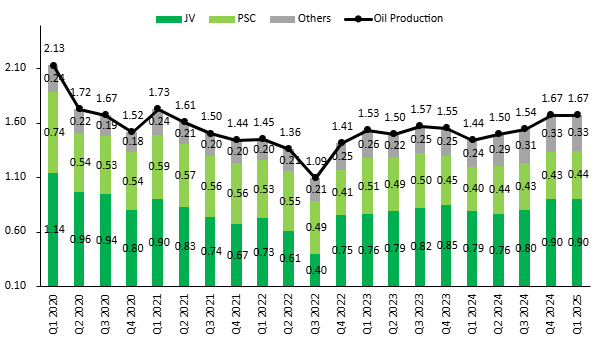
Nigeria’s oil output slid over February, despite higher shipments: NUPRC data showed that Nigeria’s oil output declined in February, falling nearly 4% to 1.67mbpd. The downturn was primarily driven by lower production from Bonny (-13% m/m to 227kbpd), Forcados (-3.2% to 277kbpd), and Escravos (-4% to 138kbpd), which offset gains from Qua Iboe (+2% to 156kbpd), Bonga (+2% to 133kbpd), Agbami (+18% to 83kbpd), and Usan (+20% to 39kbpd). Excluding condensates, Nigeria’s crude oil production stood at 1.47mbpd, slightly below its OPEC+ quota of 1.53mbpd. Interestingly, tracking data had previously indicated that Nigeria was producing 70-80kbpd above its quota, suggesting that future revisions to the reported figures may be likely.
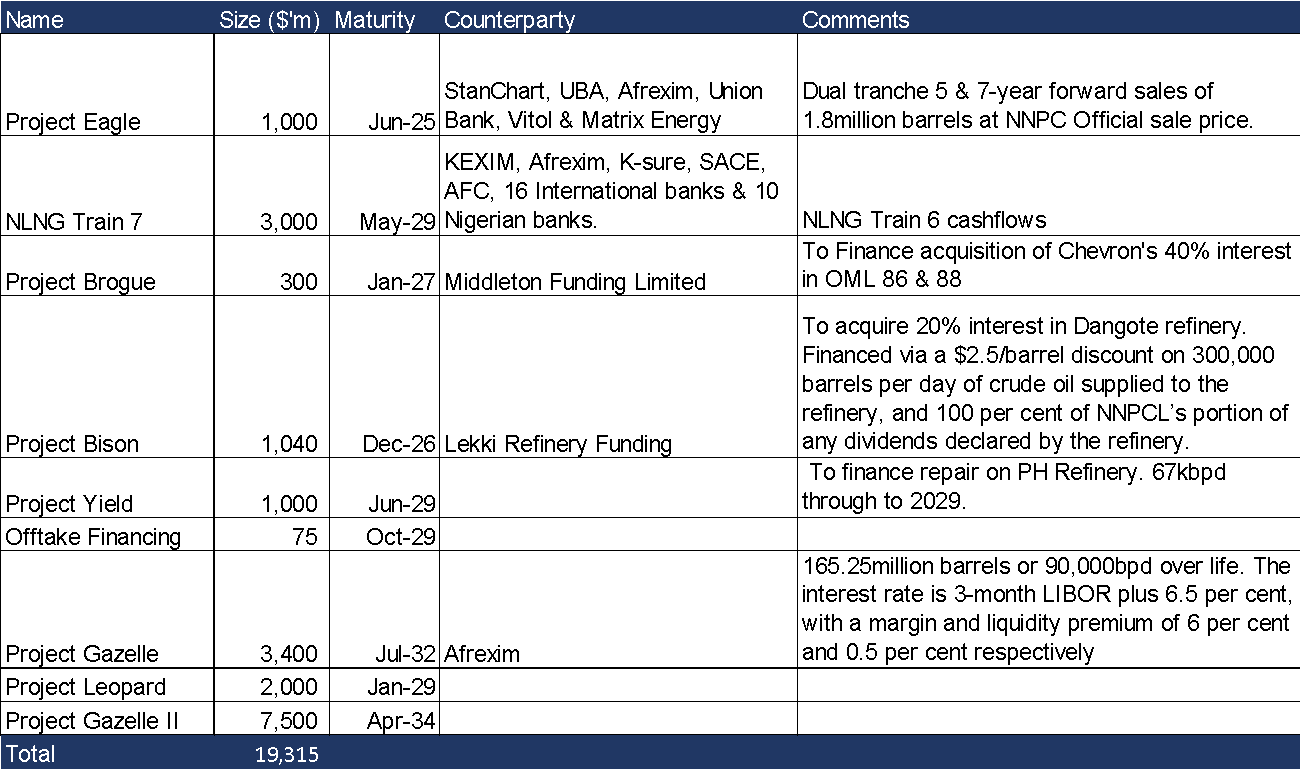
Meanwhile, media reports this week indicate that NNPC and Dangote Refinery have hit another impasse in their long-running dispute over crude supply, prompting Dangote to source Saharan blends from Algeria. Reports suggest that NNPC had ceased crude deliveries to the refinery, citing a lack of available barrels due to longstanding commitments tied to controversial crude-for-refined-petrol swap deals. Though NNPC later clarified that the cessation would only go into effect at the end March as the 6-month Naira crude supply agreement was for only 6-months from October 2024. Beyond the headline, the key is that the NNPC appears set to resolving these legacy liabilities which in my view would be a positive step toward reconnecting Nigeria’s USD liquidity situation to trends in official oil exports. In terms of liabilities, an article in the Thisday newspaper appears to have put some skin on these items which I have set out in table 1 below.
Figure 1: Nigeria: Crude Production
Source: NUPRC
Table 1. NNPC Forward Sales Agreements
Source: BusinessDay, Daily Trust, Cable, Thisday
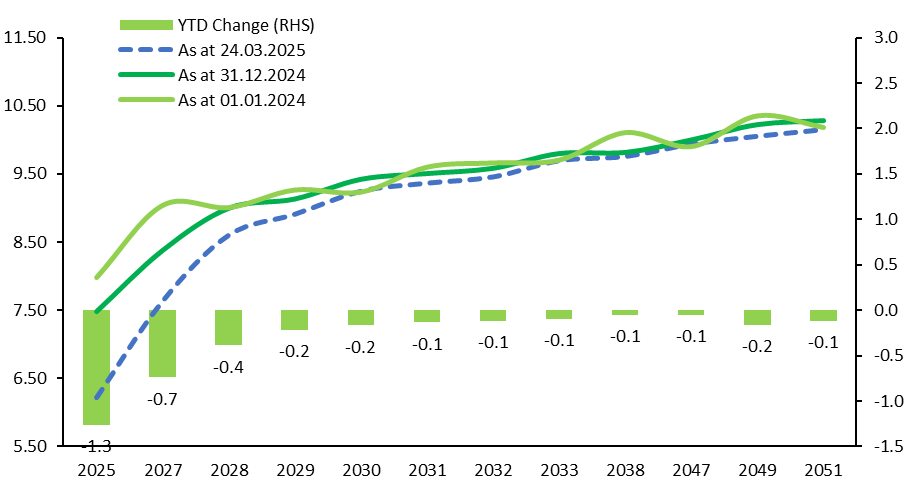
Lower oil prices drives weaker sentiment around Nigerian Eurobonds: Sentiment around the Nigerian Eurobond complex continued to weaken, with yields rising by 7-10bps over the week. In March, Nigerian Eurobonds have declined nearly 3% (YTD: +1%), underperforming the benchmark EMBI-GD, which fell 0.5% MTD (YTD: +2.5%). This underperformance reflects deteriorating sentiment driven by the decline in oil prices throughout the month. For context, the 10-year U.S. Treasury complex is down 1.5% MTD (YTD: +3%), suggesting that part of Nigeria’s weaker performance stems from growing concerns about its credit outlook. This negative sentiment has likely been exacerbated by reports of fresh attacks on oil installations amid the ongoing political crisis in Rivers State.
Figure 2: Nigeria: Eurobond Curve
Source: DMO
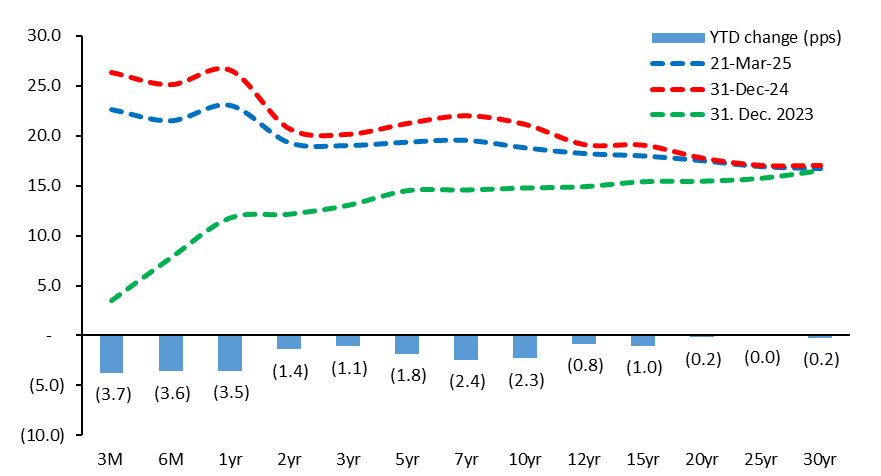
DMO surprises with a re-adjusted NTB calendar, front-end yields back up: The DMO surprised debt markets with a revised NTB issuance calendar. Contrary to the original plan to issue NGN4.3 trillion (against NTB maturities of NGN5.2 trillion), the new calendar raised gross issuance to NGN5.1 trillion—an unexpected increase of NGN800 billion. This unplanned issuance introduced a new auction date, triggering panic across liquidity-constrained fixed-income markets. With system liquidity deeply negative and the banking sector increasingly reliant on the CBN discount window, discount rates on the front end spiked from around 17% to nearly 20%, where the NTB sale eventually cleared. The auction was weak as markets struggled to absorb the surprise supply. In terms of actual NTB issuance, the DMO has sold NGN4.7trillion worth of bills over Q1 2025, well clear of its original plan. Thus, after initially signalling a strong hand, the revised calendar revealed the DMO’s need to borrow more than anticipated—exposing a weaker underlying position behind the NTB redemption strategy.
Bonds sell-off as markets adjust to tight liquidity conditions and rising securities supply: In response to the sell-off on the front-end, bond yields also sold-off from near 18% levels, markets re-tested the 20% resistance level as the curve repriced the impact of the higher paper issuance. At the monthly bond auction where the DMO had NGN300billion on offer, demand was weak with a bid-cover ratio at 1.8x (last: 4.66x) reflecting tight liquidity conditions within the banking sector. Thus, the DMO had to rely on non-competitive allocations of NGN152.45billion to raise NGN424billion. Stop rates closed higher on average 19.5% (last: 19.3%). In between the DMO also put out that it plans to sell around NGN300billion sukuk debt over April, after a one-year hiatus. Market focus will likely shift to inflows from the maturing FGN 2025 bond (NGN562billion) which will support liquidity induced buying over the near term.
Figure 3: Naira Curve
Source: FMDQ
Inflation declined in February, but questions on large December 2024 adjustment: The National Bureau of Statistics (NBS) released the February CPI report, revealing a decline in headline inflation to 23.2% from 24.48% in January. Alongside this, the NBS published a recast CPI series using a 2024 base year. Interestingly, the historical CPI data under this new base year remained largely consistent with previous monthly and year-on-year readings. The only notable deviation occurred in December 2024, when the NBS made a significant 12 percentage point (pps) month-on-month (m/m) reduction, seemingly to align the CPI reading with the 100-index mark. This adjustment likely explains the sharp jump in m/m inflation to 10% in January. While I won’t speculate further, this unusual adjustment may explain the NBS’ initial hesitation to release the recast series in January.
Interestingly, in its graphic for the February 2025 release, the NBS persisted in using the 2024 old 2009 series, even though it had claimed combining both series was incorrect. The reason it fell on its own sword could be an attempt to sidestep addressing the unusual December 2024 adjustment. Historically, CPI rebasing exercises have not included such abrupt, single-month adjustments, so it is likely that the NBS will face scrutiny once this development gains attention.
Additionally, the NBS has adjusted the composition weights for urban and rural inflation, with urban areas now accounting for 71% and rural areas 29%. This reweighting reduces the influence of domestic farm produce on headline CPI, making it more reflective of exchange rate trends, transportation costs, and energy prices. The NBS has also started disaggregating inflation data into goods and services, offering more nuanced insights into underlying trends. Notably, they now include a farm produce index — a metric I previously had to estimate manually — which provides valuable insights into domestic food production trends.
Looking ahead, the adjusted CPI series suggests a more sluggish disinflation trajectory, with the NBS’s December 2024 adjustment setting the stage for a surge in inflation, possibly reaching +30%, in December 2025.
Since publishing the February report, the NBS has since deleted the back-casted data and reverted to the original position outlined in the January CPI report. In defending the deletion, the NBS would claim that the previous upload was merely a worksheet that was erroneously uploaded and not the actual result. Even if one were to somehow swallow this line, on its twitter handle and on the report itself, the NBS disingenuously combined the old showing a December 2024 CPI of 34.8% and new CPI series showing the rebased CPI series. This is despite the Statistician General insisting that the two series should not be compared in his speech announcing the CPI rebasing results. This combination of old and new CPI series is not a simple error but a deliberate sleight of hand to obscure the inexplicable 15% December 2024 CPI figure. The deletion was ostensibly to remove the discomfort of having to explain the sharp decline which has cast serious doubt over the entire CPI rebasing exercise.
I leave with this quote by 1991 Economics Nobel Laureate Ronald Coase: If you torture the data long enough, it will confess to anything.
Discover more from Eco215
Subscribe to get the latest posts sent to your email.