Last week, the Debt Management Office (DMO) updated data on Nigeria’s external debt position through June 2026 which showed a pick-up (+5%) to USD54.5billion. Central to the uplift is the impact of Nigeria’s first drawdown of $1.5billion from the $5billion total return swap (TRS) program agreed with the First Abu Dhabi Bank. So, what is a total return swap? Total return swaps are the newest kids on the block in the world of sovereign financing by African governments. I found an excellent chart in this article by Ashurst Perkins Coie published in August 2026 which provides a good explanation about how TRS works in practice.
Chart: Sovereign Total Return Swaps Borrowing
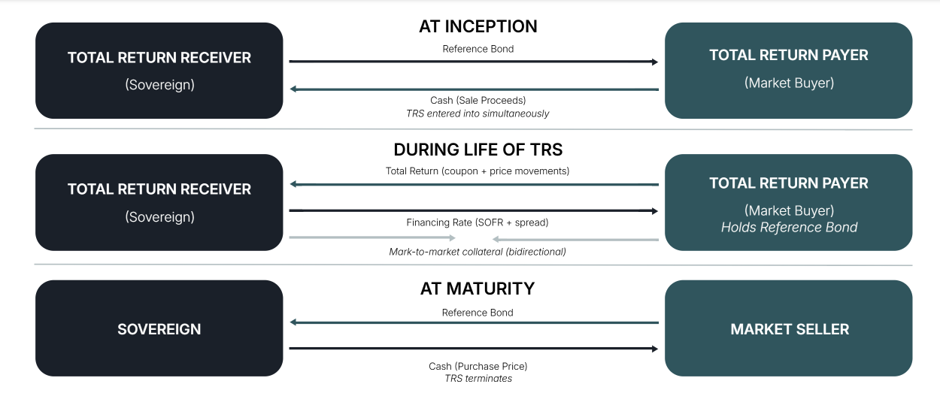
Source: Total Return Swaps and Sovereign Debt Sustainability: Evolving Use of Innovative Debt Products. Authors: Daniel Franks, James Coiley, Tom Longmuir, and Sanju Ganesan.
In practical terms, a TRS loan entails two linked transactions with the first leg involving a government (read like the FGN) borrowing a floating rate USD loan from a bank like First Abu Dhabi. The reference rate for this loan is usually the 6-month SOFR rate for USD loans (EURIBOR is used for EUR loans). SOFR means Secured Overnight Financing Rate (SOFR) and reflects the actual cost of overnight borrowing secured by US Treasury securities and serves as a benchmark for dollar funding. It replaced the much-maligned LIBOR rate. The second leg of the transaction references a portfolio of naira denominated FGN bonds in Nigeria’s case (Angola used a portfolio of Eurobond securities) which is sized at 133% of the floating rate loans value. Now in theory, the coupons on these bonds and changes in market value feed into the swap’s payments, which are netted off against payments on the financing leg. In practice and in Nigeria’s own, this might not be the case given that margin call payments require USD compensation for First Abu Dhabi. The value of this FGN bond portfolio is also monitored over the life of the deal on a monthly frequency in Nigeria’s case (usually this is done daily) and when the market value falls, the FGN may have to post additional collateral. The wording of the Finance Ministry’s disclosure is not clear as to whether the margin requirement is met at 133% or if its 100%. Anyway at maturity, the positions are unwound and the dollar financing is repaid.
The Nigerian transaction is novel because it allows the government to borrow dollars against naira bonds, opening another route to foreign currency funding beyond multilateral lenders and the Eurobond market. This option is particularly useful in a market where sell-offs in US Treasuries can push up borrowing costs for issuers outside the US. It also brings in a UAE-based lender, First Abu Dhabi Bank, expanding Nigeria’s pool of creditors beyond the Western financial institutions that have traditionally dominated its commercial borrowing.
So how should one think of pricing? In terms of pricing, the first tranche was set at SOFR plus 395 basis points with subsequent tranches priced at SOFR plus 400bps. Using the SOFR of 3.66% at the end of June 2026 puts the indicative dollar financing rate at roughly 7.6%, compared with yields of about 6.9–7.2% on Nigeria’s outstanding 2032 and 2033 Eurobonds. On the surface, that suggests that the TRS is slightly expensive, though one should note that secondary market yields on existing Eurobonds are not necessarily the rates at which a sovereign can issue new debt. For instance, Angola’s $1.5billion May 2026 Eurobond transaction, was issued at yields of 8.25% and 9.5% on bonds maturing in 2031 and 2037 respectively.
Thus, the attraction of the TRS is therefore less that its quoted rate is unequivocally cheaper than a Eurobond and more that it gives Nigeria another route to dollar funding when conditions in the Eurobond market are less accommodating. A UAE-based bank may assess and price Nigerian risk differently from investors buying sovereign bonds against a US Treasury benchmark, though we cannot tell from the disclosed spread alone whether the overall transaction is cheaper unless fees and the economics of the naira bond leg are included. In any case, First Abu Dhabi Bank is becoming an increasingly important source of funding for Nigeria, having provided up to $1.9 billion in project financing in 2025.
So, what are the risks? They come from three sources: upward increases in the SOFR reference rate, sell-offs in FGN bond yields and Naira weakness. The first is straightforward as the TRS provides dollar financing at a floating rate, so an increase in SOFR raises the interest bill. Since the move away from LIBOR at the end of 2021, SOFR has become a principal benchmark for new dollar loans, making this a familiar risk for any borrower with floating-rate dollar debt. The second risk arises from a sell-off in the Naira bond yields. DMO disclosure shows that the FGN issued a new bond 16.9556% FGN May 2032 as collateral to First Abu Dhabi which commenced trading at a yield of 18.61% on 29 June 2026. Assuming this was the yield on issue, then in the event of a sell-off in yields above this level, Nigeria will have to make margin call payments in USD to FAB. Presently, Naira yields on the tenor are around 16.72% implying sizable gains on the collateral and near-term outlook is likely downward following the rate cuts (First Abu Dhabi must be wondering if there is more to the nature of the seismic MPC rate cuts announced by the CBN last week). A move above 18.61% would not, by itself, establish that a margin call is due on account of another variable, which leads us to the third source of risk: the exchange rate. The initial $1.5 billion drawdown appears to have been translated at roughly ₦1,376/$, as such naira depreciation beyond this level will likely trigger margin calls depending on the interaction with bond yields. That said, the two risks can also reinforce each other: a bond sell-off alongside naira weakness would reduce the collateral’s dollar value more quickly leading to margin call payments.
Overall, the readthrough is that to keep costs associated with the facility within manageable levels, Nigeria will likely have to contain yield upside and keep the FX rate fairly stable. With record oil prices and reserve levels at multi-decade highs, Nigeria should be in a position to manage these two risks. Overall, in terms of diversifying external borrowing sources, this is a big step forward. However, while Nigeria continues to demonstrate growing sophistication in borrowing terms, the gap in transparency around these TRS transactions are harder to overlook: the Finance Ministry and DMO needs to do a better job on providing adequate disclosure around these loans as markets price opacity and uncertainty especially in frontier markets.
Figure 1: Nigeria – External Debt
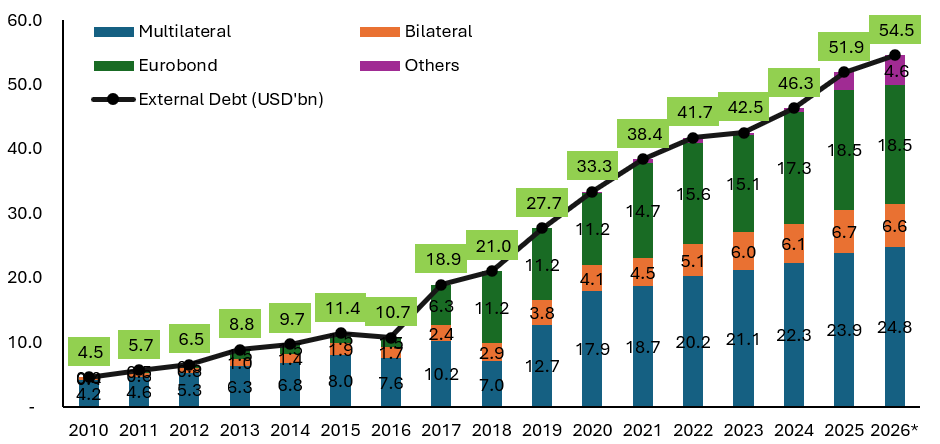
Source: DMO *June 2026
Figure 2: Nigeria – External Debt Service Costs
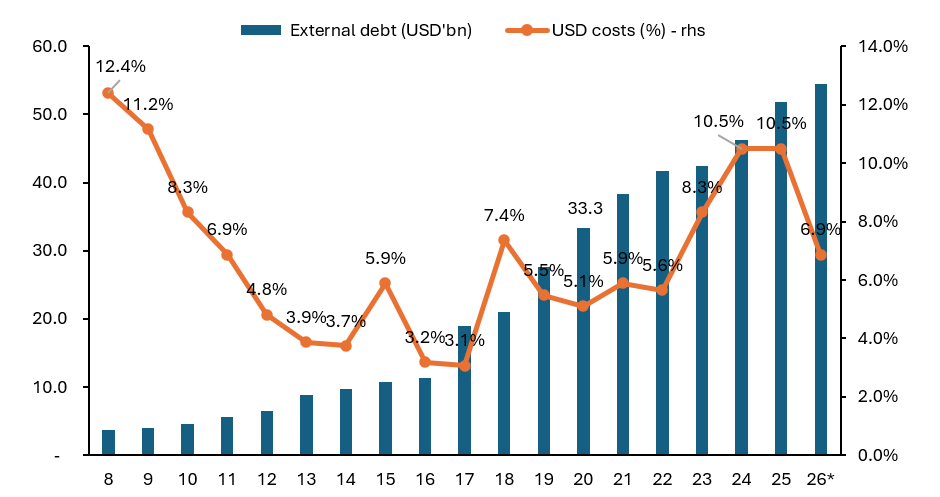
Source: DMO, Authors computation, June 2026
Discover more from Eco215
Subscribe to get the latest posts sent to your email.