Nigeria Macro Weekly – #2025.04:
DMO’s redemption sparks a rally in Naira fixed income, Naira stability and Eurobonds continue to rally
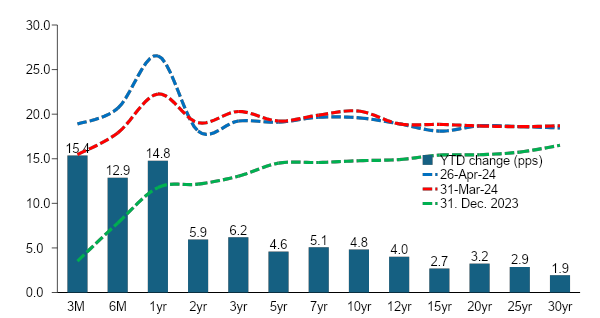
DMO’s heightened focus on rollover risk triggers a strong rally across the curve: In my last post, I noted that the Debt Management Office (DMO) was likely to undersell at the NTB auction, where it had NGN670 billion on offer, relative to demand, as it aims to reduce rollover risk given the large maturities carried over from 2024. Consistent with this view, the DMO sold exactly NGN670 billion, despite robust demand at the auction, with total bids reaching NGN3.2 trillion. This allowed for a net redemption of NGN 285 billion and triggered another sharp decline in the stop rate for the widely watched 1-year NTB, which fell to 20.32% (effective yield: 25.6%) from 21.8% (effective yield: 28%) at the previous auction. The plunge in stop rates fueled a rally in secondary market fixed-income trading, with the 1-year NTB resetting at a discount rate of 19.2% (effective yield: 23.85%). The ripple effects of the NTB auction also spilled over into the bond market, where yields fell by an average of 30 bps, with the 10-year bond sliding 80-90 bps. Across the benchmark curve, yields compressed along the front (-15 bps) and belly (-28 bps) segments, while the long end remained flat. Essentially, a mild form of bear flattening.
Looking ahead, near term focus shifts to the remaining NTB auctions for the quarter. The DMO’s calendar indicates further redemptions on February 19 (NGN580 billion), March 5 (NGN647 billion), and March 26 (NGN483 billion), with a net sale scheduled for March 12 (NGN388 billion). Barring any interventions from the Central Bank of Nigeria (CBN), this points to continued bullish momentum in yields. The Cardoso-led CBN, which has adopted a more orthodox approach, is unlikely to resort to aggressive above-board CRR debits, making OMO auctions the primary tool for liquidity management. Another key risk to monitor is the upcoming CPI report, due next week, which will be the first release following the recent rebasing exercise. More on this later in the week.
Figure 1: Naira Yield Curve

Source: FMDQ
Does it make sense for the DMO to be concerned about rollover risk? Rollover risk refers to the possibility that the DMO may struggle to raise the funds needed to refinance its NTB obligations, which are typically used to meet liquidity needs. Given the historically high maturities in 2024 and a declining inflation outlook—which could lead to softer interest rates—analysts at international credit rating agencies and the IMF are likely to scrutinize the DMO’s ability to manage its debt profile effectively. For context, gross NTB issuance surged from NGN6.5 trillion in 2023 to NGN12.9 trillion in 2024. Adjusted for maturities, this represents an increase in net NTB issuance from NGN2.1 trillion to NGN5.3 trillion. Compounding these challenges, the cessation of Ways and Means (W&M) financing means the government no longer has access to CBN overdrafts in the event of a failed NTB auction. Against this backdrop, the DMO appears justified in redeeming some NTB maturities to credibly mitigate rollover risk concerns.
That said, my sense is that following the seismic Naira depreciation of 2023-24, everything in Nigeria has to be re-set higher: fiscal revenues, fiscal spending, and borrowing along the NTB and bond segments. Crucially, as the NTB redemptions are going to be refinanced using bonds, are we really going to redeem now when, say, 2026, NTB issuances are going to rise to reflect the much larger size of FGN operations? The latter point now suggests that the second-order rally in bonds following the drop in NTB auction could be entirely misplaced as bond supply is likely to remain elevated in 2025, after two years of stagnation at NGN5.8trillion. Assuming January 2025 inflation holds up above the MPR level, then DMO is likely to display a strong appetite for borrowings than markets are currently pricing for bonds.
Figure 2: Gross and Net NTB Issuances

Source: CBN
Nigeria’s Eurobond yields continued to decline in tandem with US Treasuries: Over the week, US Treasury yields cooled further, as market concerns over tariffs eased in the face of a softer-than-expected US employment report which showed that the U.S. economy added 143,000 jobs in January, down from an upwardly revised reading of 307,000 in December and below economists’ expectations for 170,000. The unemployment rate also declined unexpectedly, to 4.0% from 4.1% in the prior month. Market concerns also eased after President Trump agreed to postpone tariffs on Mexico and Canada for 30 days. Against this backdrop of improving sentiment across US Treasuries, the rally across Nigerian Eurobonds continued with yields down roughly 50bps across the curve and by extension prices now up approximately 2% year-to-date.
Figure 3: Nigeria’s Eurobond yield curve

Source: DMO
Naira remains stable, all set for the net external reserve number: The Naira continues to trade within the tight NGN1490-1500/$ range within the official market while appreciating within the parallel market to NGN1555/$ from NGN1600/$ in the prior week. The development continues to reflect improved supply within the official segment, which has diminished demand at the parallel market. CBN applied more pressure over the week with the announcement that it would extend USD25k dollars in weekly sales to BDC operators until May 2025. On the reserves front, the gross external reserves maintained their downward trend, declining to $39.4 billion. As I noted previously, this decline is partly due to significant outflows in January, including the repayment of Nigeria’s COVID-19 IMF facility and heightened CBN interventions in the FX market. In a notable shift, the CBN appears poised to begin publishing its net external reserves data, responding to requests from offshore stakeholders, whom the CBN has increasingly prioritized. Currently, Nigeria publishes a 30-day moving average of its gross external reserves on the CBN website, with the spot number disclosed during MPC meetings. The introduction of net reserve figures could provide greater transparency but also raises the prospect of heightened market volatility, as investors reassess Nigeria’s external liquidity position.
But how can the CBN regain control of short-term interest rates: As I noted last week, the potential for a drop-off in NTB yields, relative to the levels implied by policy rates, has reignited concerns about monetary policy transmission and efficacy. Currently, even with the decline in NTB yields, interbank rates closed the week higher, reflecting tight liquidity conditions within the financial system. This raises the question: where did the NGN3 trillion of NTB bids come from? The answer lies primarily with non-bank financial institutions (FIs), which have grown significantly in recent years—a trend consistent with global patterns as assets increasingly flow outside the traditional banking system. Open market operations (OMOs) are designed to address excess liquidity wherever it exists in the domestic economy, whether within banks or non-banks. In my view, it is time to revisit the argument and restore non-bank access to the OMO window. The current bifurcation is a legacy of the unorthodox tiering of debt markets in 2019, when the CBN restricted domestic non-bank FIs from participating in OMOs, limiting access to banks and offshore investors.
The DMO’s current redemption strategy is set to unleash a torrent of liquidity from non-bank FIs, which will exert downward pressure on rates, potentially pushing them well below the levels targeted by the CBN for market interest rates. OMO yields tend to mirror NTB patterns, and the CBN risks a disorderly breakdown of its current carry-trade FX management strategy. As we saw in mid-2024, an uncontrolled buildup of excess liquidity can drive market interest rates (NTB + OMO) well below the CBN’s target range, reigniting pressures on the Naira. To address the DMO’s concerns about reduced participation in its auctions due to pricing disparities, the CBN could, as an interim measure, allow domestic non-bank investors access to OMO instruments in the secondary market. This would serve as a second-best option while maintaining market stability.
Longer term, Nigeria must adopt a credible monetary policy framework that incorporates interest rate targeting while also focusing on managing financial system liquidity in line with a medium-term exchange rate target. Such a framework should balance the need for non-oil export competitiveness with a tolerable level of inflation. The current reliance on interest rates as the primary policy instrument is Pareto inefficient and fails to address the broader macroeconomic challenges effectively.
I will close with the phrase by Georg Wilhelm Friedrich Hegel.
In everything finite, there is a contradiction between its general nature and its particular existence, between its concept and its reality. The task is to reconcile these opposites into a higher unity.
Discover more from Eco215
Subscribe to get the latest posts sent to your email.